Error Budget Policy for Small Engineering Teams
A policy that turns reliability debates into measurable budgets for shipping.
An error budget policy turns a fight about feature velocity versus reliability into a math problem. Instead of arguing about whether it's safe to ship, a small team checks a number. That number either says go or it says stop, and neither side gets to overrule it just by talking louder.
Most small teams never get this far. Reliability stays a vague aspiration, something everyone nods about in standup but nobody measures. So when things break, the team freezes deploys out of instinct, argues about when to unfreeze, and burns a week rebuilding trust instead of building anything else. The fix is not more discipline but an agreement made in advance. It's an agreement made in advance, before anyone's paged at 2 a.m., about what happens when reliability slips.
That agreement traces back to a change management problem more than a reliability one. Per Google's SRE Workbook appendix, roughly 70% of outages trace back to a change, such as a deploy, a config flip, or a migration. So the real question a small team needs answered isn't "are we reliable?" It's "should we be allowed to ship right now?" That's a governance question, and it needs a mechanism, not just good engineering instinct.
What error budgets are and where the math comes from
Google's SRE book introduced the error budget as the fix for a specific fight: product wants velocity, engineering wants stability, and without data, whoever's more senior or more stubborn wins the argument. The error budget replaces that argument with arithmetic.
Three concepts stack on top of each other here, and the order matters.
An SLI, or Service Level Indicator, is what gets measured. Availability, latency, correctness, whatever tells you the service is doing its job. An SLO, or Service Level Objective, is the target you commit to hitting on that indicator. The error budget is the gap between complete, flawless performance and the SLO. It's the amount of failure you're allowed to have.
One distinction matters more than any other here: derive the error budget from an internal operating target, not a formal customer commitment. A formal customer commitment of that kind is often contractual, made to a customer, and usually carries penalties attached. An SLO is an internal operating target, meant to flex and improve over time. Error budgets come from SLOs because SLOs are built for exactly that kind of iteration. Confuse the two and the budget becomes a legal liability instead of a planning tool, because a formal customer commitment carries penalties an internal target doesn't.
The arithmetic is simple enough to run on a whiteboard. A 99.9% SLO gives roughly 43.2 minutes of allowed downtime per 30-day month, per OneUptime. Tighten to 99.95% and the budget shrinks to about 21.6 minutes a month, per a BackendBytes example. Annualized, that 99.9% target works out to 8.76 hours a year. Small numbers, but they change how a team thinks about a bad deploy: it's not "we had an incident," it's "we spent 12 of our 43 minutes."
SLIs need to measure what users actually feel, not what a server dashboard reports. "99.9% of login requests complete within 800 milliseconds" tells you something real. "CPU utilization stayed below 70%" doesn't, because a user has never once complained about CPU utilization.
Google's canonical error budget policy and what it commits a team to
The reference document here is Google's SRE Workbook, Appendix B, written by Steven Thurgood and published February 19, 2018. The example policy covers a game service with daily backend releases and weekly client pushes, which is a useful detail because it shows the policy was built for a team shipping constantly, not one that deploys twice a quarter.
The policy defines exactly two states. Budget healthy: releases proceed on the normal schedule, no extra hoops. Budget exhausted, measured over a rolling four-week window: all changes halt except P0 and P1 fixes and security patches, until the service climbs back within its SLO.
Three conditions make reliability work mandatory, not optional, once budget runs out:
- A code bug or a procedural mistake caused the miss
- A postmortem turns up a hard dependency that needs softening
- Miscategorized errors, if counted correctly, would have caused the miss anyway
And three conditions let a team keep shipping features even after a budget miss, because the miss wasn't really theirs to fix:
- A company-wide networking failure outside the team's control
- An outage caused by another team, one that's already frozen its own releases in response
- Budget eaten by traffic outside the SLO's intended scope, like load tests or penetration testing
Google also sets hard postmortem triggers. Any single incident that burns more than 20% of the four-week budget requires a postmortem with at least one P0 action item. If a whole class of outage (not one incident, a pattern) eats more than 20% of budget over a full quarter, that becomes a mandatory P0 item in quarterly planning.
Disagreements, meanwhile, get escalated to the CTO. That's not a bureaucratic flourish. It takes the decision out of whatever politics are happening on the team that week and puts it somewhere neutral.
None of this is punishment. This is the part small teams tend to misread: none of it is punishment. The freeze is organizational permission, written down in advance, not a penalty box. It's organizational permission, written down in advance, to stop shipping features and go fix what's actually broken, without anyone having to argue for that permission in the moment.
Adapting the four-threshold model to a team without a dedicated SRE
Google's binary model (healthy or exhausted) works fine at Google's scale, where dedicated SRE teams sit between engineering and operations. Smaller teams tend to need more resolution than an on/off switch, because a team of four can't absorb a sudden full freeze the same way a large org can absorb it.
OneUptime's material lays out a four-level model, expressed as something like an error-budget-policy.yaml file sitting in the repo:
Green, above 50% remaining: ship at normal pace, run planned experiments
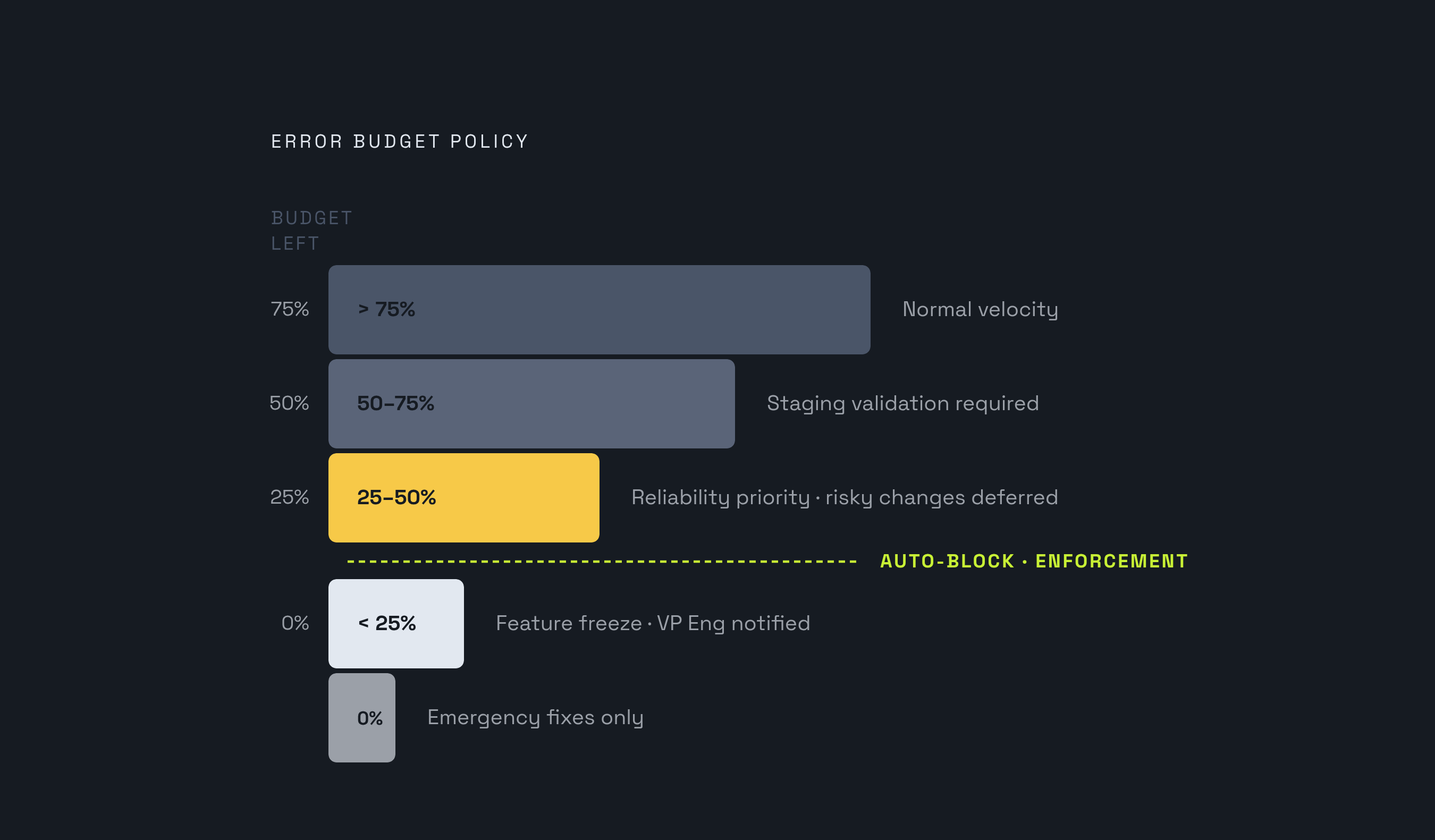
A worked example from BackendBytes, dated Q1 2026, shows a slightly stricter version of this, signed off by both engineering and product leadership. It sets a 99.95% availability SLO (21.6 minutes a month), a latency SLO of 95% of requests under 200ms, and a quality SLO of 99.9% error-free responses. Its thresholds run: above 75% remaining is normal velocity, 50 to 75% requires staging validation before any deploy, 25 to 50% means reliability takes priority and risky changes get deferred, below 25% is a feature freeze, and 0% means emergency fixes only, with the VP of Engineering notified directly. It reviews the SLOs monthly and adjusts targets quarterly.
What makes either version work is that both sides agreed to the thresholds on a calm Tuesday afternoon, not during an outage. It's that both sides agreed to them on a calm Tuesday afternoon, not during an outage. Product needs to sign this document too, not just engineering. If that step is skipped, the freeze will always look like an engineering team grabbing power to protect itself, even when the data says the freeze is justified.
Small teams don't need all three SLIs on day one. Start with availability. Add latency and correctness once there's real instrumentation to back them up.
Burn rate alerting: detecting budget exhaustion before it happens
Waiting for the budget to hit zero is waiting too long. The damage is already done by then. Burn rate alerting exists to create urgency while there's still budget left to spend on fixing the problem.
Google's SRE Workbook lays out a two-tier alerting model built on burn rate, which is just the speed at which budget is being consumed relative to normal.
A critical, fast-burn alert fires at several times over the normal burn rate, sustained across both a 1-hour and a 6-hour window. At that rate, a full month's budget disappears in about two days. That's a page-the-on-call-immediately situation. A high, slow-burn alert fires at 6 times the normal rate, sustained across a 6-hour and a 1-day window, which exhausts the monthly budget in roughly five days. That one gets a high-priority ticket, not a 2 a.m. page.
The two-window requirement isn't decorative. A single short window can be triggered by a five-minute blip that resolves on its own. Requiring both windows to agree filters out noise without dulling the alert's ability to catch a real problem early.
None of this requires custom tooling. Most observability platforms already express these rules in Prometheus alerting syntax, so a small team is configuring existing infrastructure, not building new infrastructure.
Where it gets interesting is tying burn rate straight into the deploy pipeline. If the CI/CD system checks error budget state before every release, a team sitting below 25% remaining gets an automatically blocked deploy, with a message along the lines of "wait for recovery or file an exception." The policy enforces itself. Nobody has to remember to check a dashboard before merging.
Decent instrumentation produces the data that traces, metrics, and logs depend on, so without it none of this works. Instrument once with OpenTelemetry and keep the data portable across tools. Traces answer "where is the time going." Metrics answer "is the system healthy at scale." Logs answer "what exactly happened." And SLOs, always, get defined from the user's point of view, never from a server resource metric that a user will never see.
Attributing budget consumption to find what's worth fixing
Burning budget is one thing. Knowing why is the part that actually changes what a team does next. Every time budget gets consumed, label the cause: deployment regression, infrastructure failure, dependency outage, unexpected traffic spike.
That label decides where the next sprint's effort goes, and it should decide that more than gut feeling does.
If most of the budget loss traces to deployment regressions, the fix is canary deploys and automated rollback, not more redundant infrastructure. If a single dependency keeps eating the budget, the fix is softening that dependency (retries, fallbacks, circuit breakers), not tightening internal reliability that was never the problem. And if the culprit turns out to be miscategorized errors, ones that shouldn't have counted against the budget in the first place, the fix is correcting the measurement, not tightening an already-accurate SLO.
The 20%-in-one-incident postmortem trigger is a useful structural marker in any incident review process. Below that threshold, a lighter incident review usually covers it.
Small teams don't need a dedicated reliability dashboard to do this well. A simple log, cause, duration, budget consumed, kept next to the SLO document, builds a quarter-over-quarter picture of where the failures actually live. That log becomes the evidence base for the next planning conversation.
Google's own example policy calls out miscategorized errors specifically, both the kind that inflate consumption artificially and the kind that quietly hide real failures. Attribution is the mechanism that catches both. Skipping it to make a dashboard look greener defeats the entire purpose. The goal was never a green dashboard. It's a service that actually works.
The four failure modes that cause error budget policies to become shelfware
Plenty of teams write an error budget policy, get it signed, and then watch it gather dust. There are four specific ways that happens.
Lack of alignment. If engineering sets the SLO alone, product will treat every freeze as an ambush. If product sets it alone, engineering will treat the target as fantasy. The policy has to be co-owned from the very first draft, or whichever side didn't help write it will quietly resist it forever.
Overly aggressive targets. An SLO the team breaches constantly stops meaning anything. People learn to shrug off the alert because the alert never stops firing. If the budget is perpetually near zero, there are only two honest moves: invest seriously in reliability, or renegotiate the target down to something achievable. The budget is supposed to create useful tension, not train the team into learned helplessness.
Blame culture. The moment a budget breach turns into a hunt for who to blame, people start hiding problems instead of reporting them, or quietly reshaping metrics to dodge the consequences. Google's own policy document is explicit on this point: halting change is permission, granted in advance, to stop and fix things. It's permission, granted in advance, to stop and fix things.
No review cadence. A budget that nobody looks at in a structured setting just sits on a dashboard collecting dust, invisible to actual planning decisions. A monthly SLO review and a quarterly target reset, the same cadence BackendBytes uses, closes that loop and forces the data back into the room where decisions get made.
The thread running through all four: error budgets work as decision frameworks. They answer "should we deploy this right now?" The moment a team starts treating the budget as just another metric to glance at, something to answer "how are we doing?" instead, the policy stops driving decisions and starts just decorating a dashboard.
On-call health is a decent early warning sign that a policy has stopped working. A 2025 industry survey found 62% of SREs had considered quitting over on-call burden, with the average SRE getting paged 4.3 times per shift. When a policy is actually doing its job, incidents get prevented at the source. When it's not, the same incidents keep happening, and on-call just absorbs them over and over, shift after shift.
A lightweight SLO document for a team of two to six engineers
The document doesn't need to be long. It needs to be complete enough that nobody has to guess what happens next.
A minimum version includes the service name and its scope, one to three SLIs framed from the user's side (availability, latency, correctness, never CPU or memory), and the SLO target for each one with the math shown: SLO percentage converted into minutes of budget per month. From there it needs the four-threshold policy with a named, specific consequence at each level, attribution categories for labeling budget loss, the 20%-in-one-incident postmortem trigger, an escalation path for when people disagree, and signatures from both engineering and product leadership. Close it out with a review cadence: monthly check-ins, quarterly target resets.
Don't start at 99.99%. That target leaves a monthly budget of about 4.32 minutes, which is barely enough room to breathe, let alone operate. For most web services, 99.9% (43.2 minutes) is a sane starting point. Tighten the target later, once the team has actually hit it consistently for a while.
Keep the whole thing short enough to read in one sitting and sign off in a single meeting. Complexity kills adoption on small teams faster than almost anything else, because nobody has the bandwidth to maintain a 20-page reliability charter alongside actual feature work.
The document belongs in version control next to the codebase, not buried in some separate wiki nobody opens. Treat it like any other engineering artifact: reviewed, versioned, updated through the same process as everything else.
Not every service needs the same target, either. A payment API and an internal admin tool have no business sharing an SLO. Tiering targets by how much a service actually matters keeps a team from wasting effort over-engineering reliability nobody needs.
How the deployment pipeline enforces the policy automatically
A written policy is only as strong as the last person who remembered to check it. On a small team moving fast, that's a fragile dependency, so the fix is to take the human out of the loop entirely and let the pipeline enforce the rule.
Deployment gating does this directly: the CI/CD pipeline queries current error budget state before every release. If the budget drops below 25% remaining, the deploy gets blocked automatically, with a message telling the team to wait for recovery or file a formal exception.
That gate needs an escape hatch, though. It's a policy gate, not a locked door. A genuine P0 fix should still be able to get through, but only via an explicit override action, someone typing a command and owning that decision, never by the system just quietly letting a change slip past the rule unnoticed.
Burn rate ties into this same pipeline. At a fast-burn rate several times higher than normal, the kind that empties a month's budget in two days, deploys block automatically the moment the alert fires, before the budget even hits zero. The pipeline isn't just reacting to a state, it's watching the trend and cutting off new risk before the numbers force the issue.
That's the entire point of building the policy into the pipeline instead of into a wiki page: the rule enforces itself, every single time, regardless of who's on call, who's distracted, or who forgot to check the dashboard that morning.