Dependency Scanning Integration in GitHub Actions CI Pipelines
Automate dependency scanning in CI to catch vulnerabilities before merge.
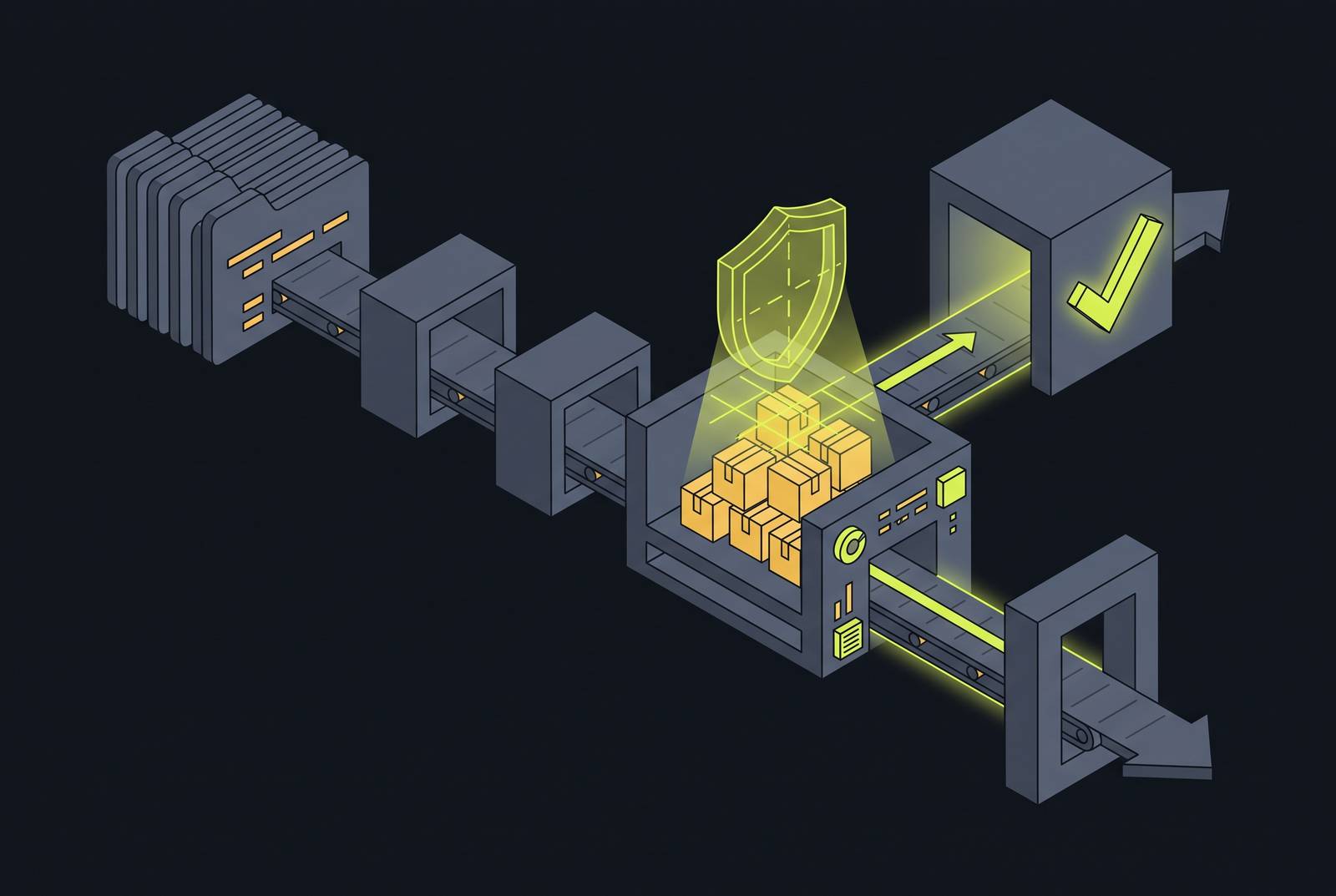
A useful setup scans dependencies before builds that take time and resources, blocks fixable high-risk findings, and sends the rest to someone who will act on them. That setup also needs a protected workflow, because a scanner cannot defend a pipeline that gives attackers control of the scan itself.
Why dependency scanning belongs in CI rather than left to developers or periodic audits
Tests, linting, and formatting checks can all pass while an application still contains dependencies with known critical CVEs. Modern applications pull in hundreds of transitive dependencies that no developer tracks manually. Leaving that work to individual habits creates a gap precisely where CI is supposed to provide a repeatable check.
GitHub Actions is a natural place to close that gap because its native SARIF support brings scan results into the GitHub Security tab. A production-calibrated software composition analysis stage scans lockfiles and container images on every commit and pull request, blocks merges on a defined severity tier, and generates an SBOM as a release artifact. A periodic audit cannot replace that check at the point of change. A weekly scan still has a role, but it catches newly disclosed vulnerabilities in existing dependencies rather than deciding whether a proposed change should merge.
How to choose a scanner given your language ecosystem, compliance posture, and team size
Start with the languages and package types the application uses, then look at what reports are needed and how much the team can spend. This choice determines coverage, false-positive rate, SBOM format, and licensing constraints. A tool that fits only part of the stack can force a rebuild of the scanning stage later.
For most teams starting out, Trivy is the baseline. It is free under Apache 2.0 and supports npm, pip, Go, Rust, and Java. Its scan targets include filesystems and container images, while its misconfiguration scanner covers Terraform, CloudFormation, and Dockerfiles. Its frequently updated database draws from NVD, GitHub Security Advisories, and OS vendor feeds through Aqua's open-source trivy-db, though its false-positive rate is moderate compared with curated commercial alternatives.
Use Syft with Grype for precise OS-package matching when breadth is a lower priority. Syft generates the bill of materials, and Grype matches its contents against known CVEs. Syft JSON retains the most complete information, while CycloneDX and SPDX are also supported. Scanning the SBOM first works well in regulated environments where teams spend time and money on triage because of package-matching noise. High-compliance teams can also pair Trivy's breadth and speed with Grype's OS-package precision to reduce blind spots.
If developers need deeper remediation advice, Snyk offers a human-and-AI-curated database and native IDE and CI plugins. Its free tier has what most small-to-medium projects need, but the more advanced features need the enterprise tier. The trade-off is dependence on proprietary enrichment and early-disclosed vulnerabilities while retaining access to public CVE feeds. For Java/Maven-heavy teams that want downloadable HTML reports, OWASP Dependency-Check is a slower fallback with a CVSS-based gate such as --failOnCVSS 8.
Tools for a single language add to these choices while leaving the need for broad coverage in place. For JavaScript/Node, npm audit gives a fast first pass, and Snyk can check React/frontend dependencies in more depth. For Go, govulncheck adds code-level reachability analysis to filter out noise from vulnerable paths that the application never calls. For projects that use this package manager, composer audit checks for packages known to be vulnerable. Choose these additions for the information they contribute, rather than running more scanners simply to produce more findings.
Where in the pipeline to place the scan step and why order matters
Run secret detection first and make it blocking, because a credential cannot be un-leaked once it reaches a log. Next, scan the dependencies in the lockfile before building the image. That order catches the majority of known dependency issues quickly and avoids spending build time on changes that will be rejected anyway. After the build, run SAST, then the container scan, then the license check and report upload. Scan the container after the build because the base-image layers bring in OS-level vulnerabilities that a lockfile scan does not cover.
Cache the Trivy vulnerability database for reuse across runs. Repeated network fetches introduce flakiness and API rate-limit failures into a check that needs to be dependable. The date-based cache key is trivy-db-${{ runner.os }}-${{ env.CACHE_DATE }}, with trivy-db- as the fallback restore key. That fallback allows the workflow to restore a recent cached version on a cache miss.
Run the strict lockfile and image checks on pull requests and pushes to main. Add a full scan on Monday morning each week to catch newly published CVEs in dependencies that have stayed the same. Pin scanner versions explicitly, as in pip install pip-audit==2.10.1, so a tool update does not silently alter CI behavior. Update those versions deliberately during sprint planning. Apply the same discipline to action references by pinning full commit SHAs.
How to set severity thresholds that block real risk without paralysing developers
Installing a scanner does not settle the harder question of what should stop a merge. A gate that treats every finding as an emergency trains developers to suppress, override, or bypass it. A warnings-only setup fails in the opposite direction because its findings never carry a consequence.
Use a two-tier model. The hard gate fails the build on CRITICAL and HIGH findings where a fix is available, with no exceptions for that tier. MEDIUM and LOW findings still appear in reports and get tracked tickets, but they do not block the merge. Those tickets go into sprint planning. Findings without a fix must also remain visible even though ignore-unfixed: true excludes them from the blocking decision.
For a codebase with an existing backlog, begin with CVSS 9–10 and clear the critical queue first. Then lower the threshold to HIGH. Blocking everything from the start can leave CI broken for weeks, with no workable order in which developers can make repairs.
Reachability analysis can make the remaining signal more precise. A vulnerability five levels deep in a dependency path the application never calls is a different risk from one in a direct dependency's hot code path. govulncheck makes that distinction for Go, while Snyk and some commercial tools offer reachability analysis for other ecosystems. The complaint that hard gates cause too much triage is fair when every alert blocks work. It is much weaker when the gate covers only fixable HIGH and CRITICAL findings and everything else has a tracked route to resolution.
How to surface scan results where developers and auditors will actually act on them
Results need to reach developers during review, auditors gathering evidence, and the people tracking remediation deadlines. SARIF upload to the GitHub Security tab provides the main developer-facing path. Trivy supports format: sarif natively, and the upload job needs security-events: write. The github/codeql-action/upload-sarif action carries those results into GitHub, but the reporting path and the blocking decision remain separate concerns.
A SARIF upload alone does not make a gate. For the blocking scan, use exit-code: '1', ignore-unfixed: true, and severity: CRITICAL,HIGH. Keep a broader reporting output as well, because a report limited to the blocking tier cannot provide visibility into MEDIUM and LOW findings. That separation lets developers see the full backlog without making every item a merge failure. It also avoids presenting a narrow gate report as a complete account of dependency risk.
Preserve JSON or HTML reports with actions/upload-artifact and if: always() so a failed build does not prevent evidence retention. Link each artifact to its commit and run ID. For SOC 2 Type II, push scan summaries and SBOM metadata to a centralized store such as S3, Azure Blob, or a dedicated compliance platform, linked to change management records. Define severity-based closure windows and retain evidence that they are enforced, because auditors sample alert-closure times. A documented dismissal explains a decision, while an open alert with no action or note shows that the control is being ignored.
Hardening the pipeline itself against supply chain attacks that bypass the scanner
The workflow running the scanner is itself a privileged program. It holds a GITHUB_TOKEN, may reach cloud credentials, and executes third-party code. The tj-actions/changed-files compromise in March 2025, CVE-2025-30066, exposed this risk when existing version tags were redirected to a malicious commit and 23,000 repositories began dumping CI secrets into public build logs. The initial foothold came from a leaked token in reviewdog/action-setup, CVE-2025-30154. That chain shows why protecting application dependencies without protecting workflow dependencies leaves a separate attack path open.
Pin every action to a full 40-character commit SHA. The supplied checkout reference is actions/checkout@11bd71901bbe5b1630ceea73d27597364c9af683, with v4.2.2 kept as a human-readable comment. Dependabot can raise pinned-SHA update pull requests, so pinning keeps updates possible and makes changes reviewable. Set the workflow's default token permissions to contents: read, then grant write scopes only to jobs that need them. In particular, reporting needs security-events: write.
Replace long-lived cloud credentials with GitHub Actions OIDC where the workflow needs cloud access. Use the sub claim to limit the cloud trust policy to the specific repository and branch. Keep untrusted event data, including pull request titles, issue bodies, and branch names, out of direct interpolation into run blocks. Pass that data through environment variables instead so the shell treats shell metacharacters as data and does not execute them.
These controls matter beyond publicly known CVEs. The ChainDrop npm worm in early August 2026 and the AsyncAPI pipeline compromise in July 2026 illustrate compromised packages propagating through large ecosystems. Static CVE scanning catches versions known to be bad, but it may miss a newly injected malicious version of a package that was previously clean. Pinning dependencies by content-addressable digest rather than mutable version tag provides a structural defense against that gap. Scanning and workflow hardening address different failure modes, so neither substitutes for the other.
A complete working pipeline that combines all four stages: scan, threshold, gate, report
The combined workflow runs on push and pull request triggers and has a separate scheduled job for the full weekly scan. Its default permission is contents: read, with security-events: write reserved for the SARIF-upload job. Checkout and all other action references are SHA-pinned. After the blocking secret check, restore the Trivy database cache and run the filesystem scan against the lockfiles.
Preserve complete findings for SARIF visibility and JSON evidence, while the blocking evaluation uses severity: CRITICAL,HIGH, ignore-unfixed: true, and exit-code: '1'. A filesystem gate report can use the output name trivy-results.sarif. Upload reporting outputs even when the gate fails, rather than making evidence depend on a successful scan result. The merge decision and the saved record should come from the same run, though each serves a different purpose.
Once the lockfile gate passes, build the image, run SAST, and scan the image with the same fixable HIGH/CRITICAL threshold. Keep the container-layer findings in a second SARIF report because they cover a different dependency surface. Complete the license check, generate an SPDX or CycloneDX SBOM, and attach it as a release artifact. Preserve the JSON scan report through actions/upload-artifact with if: always(), linked to the commit and run ID. For a legacy backlog, start the blocking evaluation at critical only and expand it to HIGH after that queue is cleared.
The production test is whether these stages form one enforceable path. Scan order must provide early feedback, the threshold must isolate actionable risk, the gate must affect merges, and reporting must survive failure. A pipeline that does only some of those things leaves either a security gap or an operating burden.