Failure Mode Analysis for Stateful Web Applications
Identify four failure modes in stateful apps before they silently corrupt data in production.
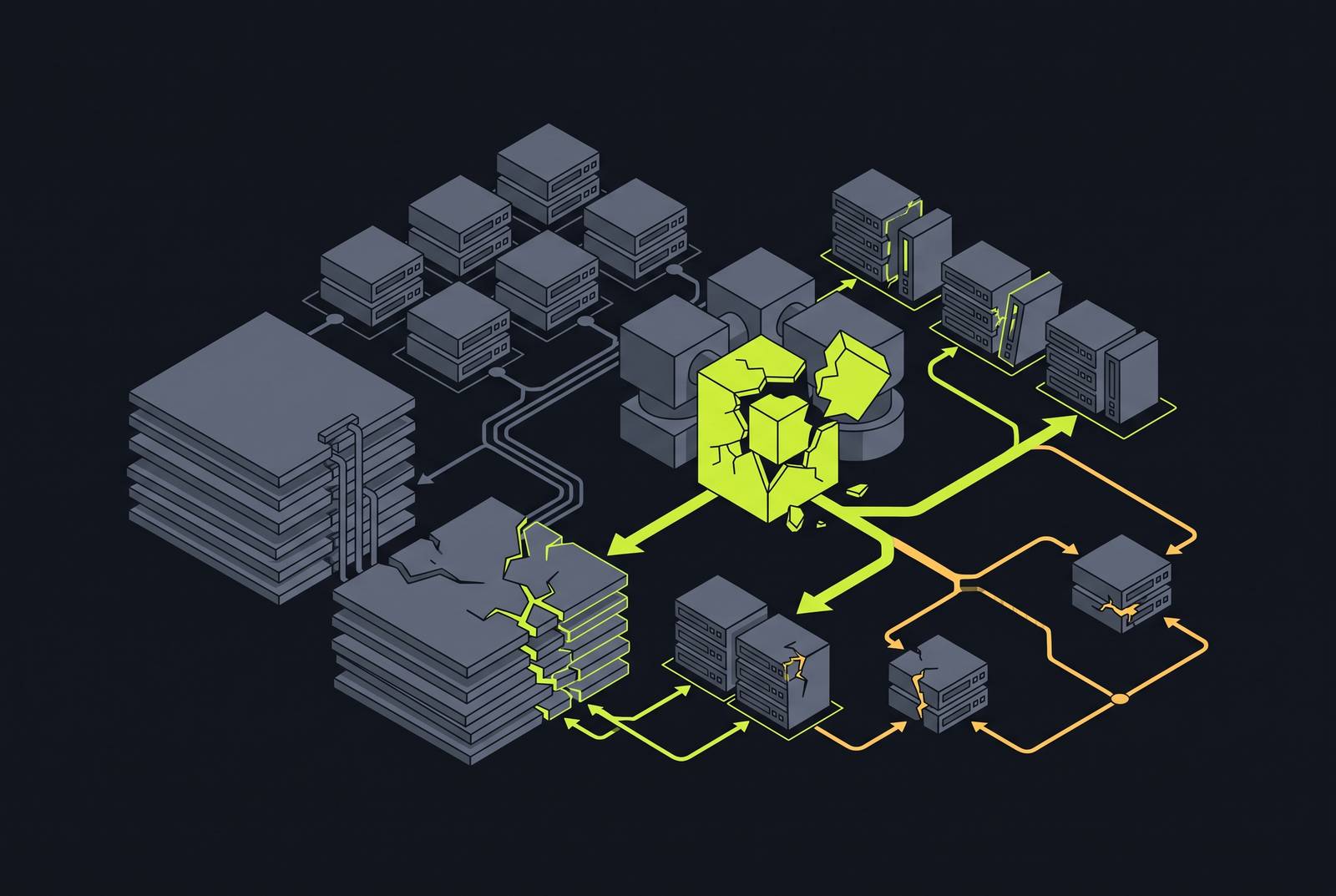
Stateful web applications fail in a small number of predictable ways: session loss, data corruption, split-brain state, and cascading persistence failures. The point of this piece is simple: a structured failure mode analysis, borrowed from hardware safety engineering, lets teams name these risks before they show up in production instead of after.
Stateless and stateful systems don't just behave differently, they fail differently. A stateless app has no memory between requests. Any server can answer any request, so a crash is a shrug: traffic moves to another replica, nothing is lost, the failure is loud and it heals itself.
A stateful app is different because it holds onto a session, a user's in-progress form, a write-ahead log, or a cache with data nowhere else. CloudZero described this in January 2026 by comparing a kiosk and a barista: a kiosk works the same no matter who's staffing it, but a barista who knows your order carries the whole experience, so the experience falls apart when that barista isn't there. That's what happens when a stateful pod dies. It doesn't just stop serving, it can take the session, the log, or the cache with it. The failure might be silent. It might be partial. It might corrupt something rather than simply stopping.
That silence is the dangerous part. A crashed stateless pod throws an error somebody sees. A stateful failure might just quietly evict a user, or write half a record, and nobody notices until a report looks wrong three weeks later. Catching that means investing in observability across storage performance, replication state, and error rates so anomalies surface before they compound, not after.
Statefulness also drags in infrastructure that stateless apps don't need: sticky load balancing, replication, standby capacity. Every one of those is more surface area for something to break. And stateful systems scale unevenly. Growing is easy, you add capacity. Shrinking is dangerous, because sessions are tied to specific instances and you can't drain a node without risking the data sitting on it. CloudZero's January 2026 piece also points out the cost consequence: stateful infrastructure behaves like a semi-fixed cost rather than a variable one. It's harder to forecast, harder to pin to a specific team or feature, and it leaves you holding capacity you can't release even when you want to.
These aren't abstract concerns. They predict, with real specificity, where and how a stateful system is going to break. The rest of this piece names those breakage points one at a time.
The FMEA framework adapted for software systems
Failure Mode and Effects Analysis, or FMEA, is a bottom-up method: list every way a system can fail, describe the effect of each failure, and score how bad, how likely, and how detectable each one is. It comes out of safety-critical hardware, formalized through ISO 26262 and the AIAG/VDA FMEA Handbook for automotive design (per PatSnap). It wasn't built for software. But the logic transfers cleanly, and AWS Prescriptive Guidance formalized that transfer for cloud-native applications specifically.
The scoring itself runs on three dimensions:
Severity: how bad is it for the user or the data if this failure actually happens? Occurrence: how often does this failure mode show up in practice? Detectability: how fast and how reliably does the team find out it happened?
Multiplying the three together produces a composite risk score derived this way. A high RPN means fix this now. The way you bring the number down is by improving whichever of the three dimensions is weakest, and in software, that's almost always detectability. Teams are decent at estimating how bad a failure would be and reasonable at guessing how often it happens. Almost nobody instruments for how long a failure would go unnoticed. The failures in this piece are dangerous because they're not the loud ones.
FMECA takes this one step further by adding a Criticality layer on top, a way of quantifying severity and likelihood together so that not every high-RPN item gets treated as equally urgent. Given a fixed budget and a fixed amount of engineering time, criticality is what tells a team which fire to put out first.
Tooling in this space is moving toward automation. PatSnap's 2026 dataset traces the arc: searchable incident databases starting with ABB in 2004, reusable meta-model architectures from Siemens between 2015 and 2017, and now automated scoring driven by predictive models, with SAP and Express Scripts pushing into that territory between 2020 and 2026. Express Scripts filed a US patent application in 2025 (publication number 20250199895) that replaces manual RPN scoring with automated, computational generation of impact, probability, and detectability scores at scale. Whatever comes of that specific filing, it signals where the tooling is headed: less spreadsheet, more pipeline.
The bigger reason FMEA fits stateful systems is timing. AWS Prescriptive Guidance makes the case: reactive incident management doesn't meet the bar for cloud-native applications that need high availability. Waiting for an incident to teach you about a failure mode is expensive when the failure mode corrupts data. FMEA runs before production. It forces the failure list to exist before users find it, and it slots into sprint planning the same way a security review or a design review would. AWS's own guidance presents the process as a manageable lift for the amount of blindness it removes.
Session loss: causes and detection challenges
Session loss is what happens when a user's authenticated or in-progress state gets destroyed in the middle of doing something, and they either get logged out or have to start over. It happens whenever session state lives on one specific instance and that instance restarts, gets rescheduled, or dies. On platforms that restart instances on a schedule, session loss is a feature wearing a bug's clothes. It's a feature wearing a bug's clothes.
A few infrastructure choices are almost guaranteed to introduce this risk:
- Storing session data in memory on a single pod or dyno, with no replication and no outside store to fall back on.
- Sticky load balancing, which feels like a fix because it keeps routing a user back to the same instance, but does nothing once that instance actually dies.
- Adding replicas to scale horizontally without a shared session store, which quietly splits the session namespace across machines that don't talk to each other.
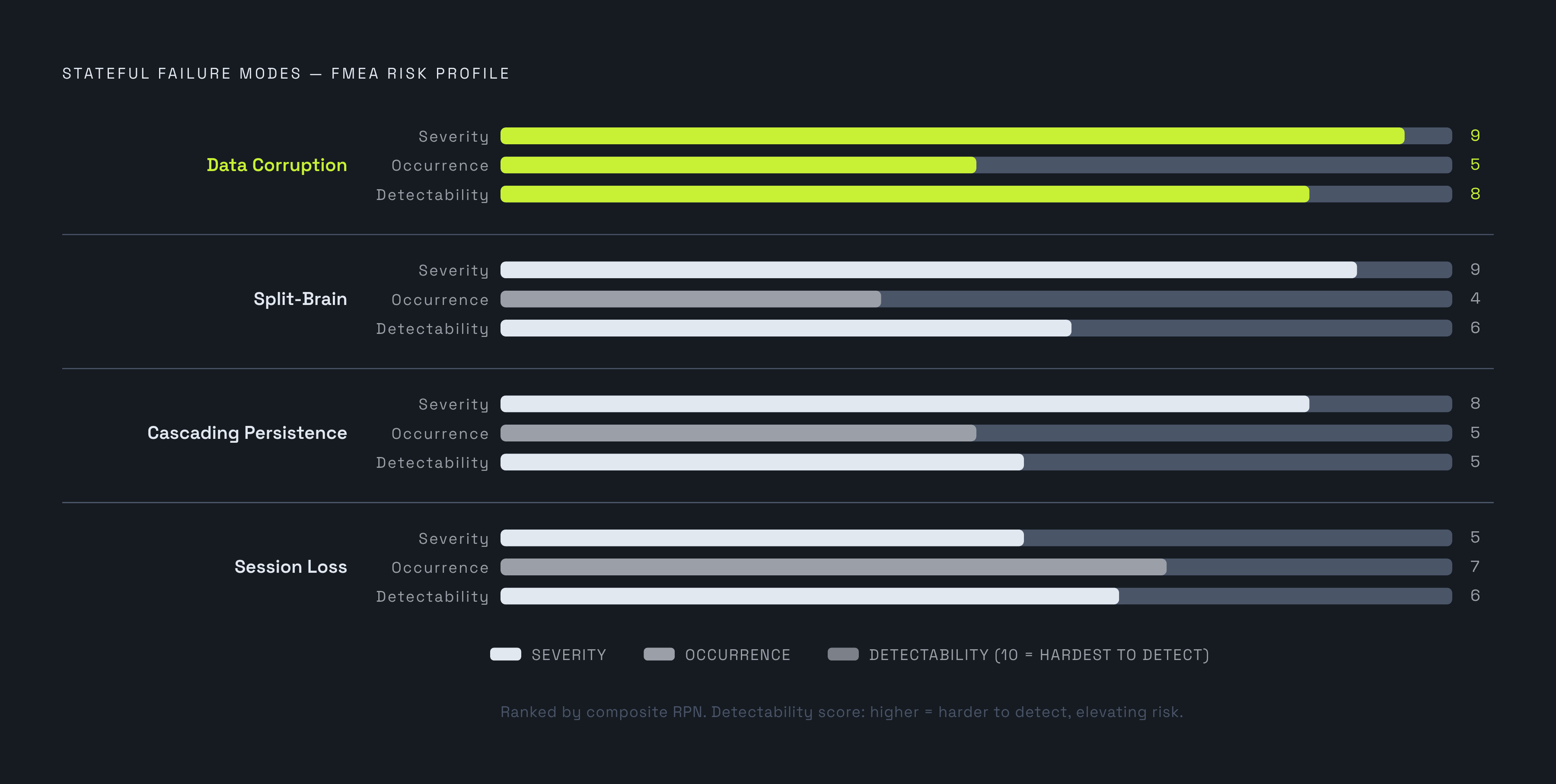
Score it out: severity sits moderate to high, since users lose real work, get logged out mid-task, or lose progress on a multi-step form. Occurrence runs high on any loosely configured platform-as-a-service setup, or on bare Kubernetes without StatefulSets managing pod identity. Detectability is where this failure mode really hides: it's low, because sessions just expire quietly. Nobody gets a stack trace. Nobody gets paged. The support ticket says "I got logged out," and that phrase doesn't point to a root cause the way an error code does.
That detectability gap is the actual risk. Teams fix what pages them. Session loss doesn't page anyone, it just eats users one at a time.
Fixing it usually means moving session state off the individual instance. Redis, Memcached, or a managed distributed cache let the session survive even if the pod serving it dies. Token-based auth, using JWTs, shifts state to the client and cuts server-side dependency, though logout and token revocation still tend to need some server-side memory. And observability matters here specifically: session creation, expiry, and forced invalidation need to be logged as explicit events, not left as a side effect nobody's watching.
Data corruption: the failure mode that doesn't announce itself
Data corruption is worse than data loss, because the data doesn't disappear, it just becomes wrong. A record gets written in a partial, inconsistent, or semantically broken state, and it can pass every validation check on the way in. It sits there looking fine until something downstream, a billing run, a compliance report, an analytics job, chokes on it or quietly produces a wrong answer.
A handful of infrastructure patterns invite this in:
- A write path with no atomicity guarantee, where a multi-step write can get interrupted halfway through and leave the database in a half-finished state.
- Missing or misconfigured transaction isolation, so two concurrent writes to the same row race each other.
- Rolling deployments paired with schema changes, where both old and new code versions are briefly live simultaneously and may have incompatible data expectations.
- Kubernetes deployments that skip StatefulSets, so pod identity and storage attachment are not reliably preserved across rescheduling events.
The RPN math here is brutal. Severity is very high, since corrupted records can be unrecoverable and downstream systems may ingest the bad version before anyone catches it. Occurrence is low to moderate under careful transaction handling, but rises during deployments and failovers, exactly the moments teams are busy doing something else. Detectability is very low: corrupt records clear write-time validation just fine and become visible only once a person notices a business-logic inconsistency, or a downstream job errors out. High severity paired with low detectability drives a particularly severe composite risk score, which is why data corruption ranks among the most dangerous failure modes in this analysis.
The fix starts with treating every multi-step write as a transaction candidate by default, enforced at both the application and ORM layer. Schema migrations should be structured to avoid destructive changes against live traffic. Integrity checks function as observability for corruption the same way error rates function as observability for crashes. And maintaining a reliable audit log supports recovery when derived state gets corrupted.
Split-brain state: what happens when two nodes disagree about truth
Split-brain happens when two or more nodes each believe they're the one authoritative primary, and both start accepting writes independently. The network partition that caused it eventually heals, but the writes that happened on both sides during the split don't reconcile themselves. Somebody, or something, has to decide which writes survive.
A few decisions set this up:
- Database replication that elects a primary by timeout instead of quorum, leaving a window where two nodes both think they've won.
- Cache layers with no coordinated invalidation, where replicas serve stale reads while the primary already has a different value, a softer version of split-brain that skews application logic without a hard network partition ever occurring.
- Multi-region active-active setups with no conflict resolution strategy, so both regions keep accepting writes during a cross-region network partition.
- Kubernetes clusters without stable network identity (no StatefulSets, no headless services), where coordination services like ZooKeeper or etcd can lose quorum mid-rolling-restart.
Severity is very high: financial transactions, inventory counts, user balances can all end up inconsistent, and fixing it may mean manual reconciliation by a human. Occurrence stays low under normal conditions but spikes during maintenance windows, node failures, and deployments, which is precisely when the team's attention is elsewhere. Detectability sits in the middle: split-brain on a primary database usually appears in monitoring fairly fast, but split-brain at the cache layer is much harder to catch without instrumenting staleness directly.
Mitigation leans on consensus. A consensus-backed election process, Postgres running Patroni against etcd, Consul, or ZooKeeper, or a managed database with automatic failover built in, closes the timeout-based election gap. Where strong consistency costs too much, design for eventual consistency on purpose and pick the conflict resolution strategy before the partition happens, not while it's happening. Fencing tokens stop a demoted primary from accepting writes even if it hasn't yet heard that it's been demoted. And replication lag, quorum membership, and leader-election events need to be first-class metrics, not things someone checks after the fact.
Cascading persistence failures: when one component's degradation becomes the whole system's outage
A cascading persistence failure starts small when one stateful component, a database, a cache, a message queue, degrades a little. That small degradation creates back-pressure, the back-pressure overwhelms services that depend on it, and the whole thing snowballs into a system-wide outage. The unsettling part is that every individual component downstream can be perfectly healthy. The failure lives in the chain connecting them, not in any one link.
A few patterns show up repeatedly:
- Database connection pool exhaustion: one slow query holds a connection open, requests queue up behind it, and the queue keeps growing until timeouts start cascading outward through every service waiting on that pool.
- Cache stampede: a cache node fails, or a hot key expires, and every upstream service suddenly queries the database at once, overwhelming it in the same instant.
Message queue backlog occurs when a consumer falls behind, the queue grows, producers start blocking, and write latency climbs across the whole application.
- Storage I/O saturation: a persistent volume hits its throughput ceiling, write latency climbs, application threads sit waiting, connection pools fill up, and the app looks unresponsive before a single error gets thrown.
Severity here is very high, because the outage that results is almost always way out of proportion to whatever triggered it, one slow query becoming a full outage. Occurrence is moderate: connection pool exhaustion and cache stampedes both happen regularly in production under real load, and storage saturation is a recognized risk on stateful deployments. Detectability runs low to moderate, since the trigger is usually subtle (one slow query, one expired key) and the cascade only becomes visible once it's already spread, which makes root-causing it under pressure genuinely hard.
The countermeasures share a theme: fail fast instead of piling up. Circuit breakers should return an error the moment a dependency is unreachable rather than let a thread sit and wait. Connection pool size needs to be treated as a real design decision, sized to what the database can actually serve rather than what the application feels like sending. Cache TTLs should carry jitter so expirations don't all land at once and trigger a stampede. Bulkheads keep one degrading dependency from draining the connection pool that unrelated services also rely on. The metrics to alert on are queue depth, connection pool wait time, and storage I/O latency, since error rates lag a cascade by minutes and tell you about the fire after it's already spread.
RPN scoring and prioritized action lists
Every failure mode above reduces to the same worksheet: component, failure mode, effect, then the three scores, severity, occurrence, detectability, each rated on a scale (commonly 1 to 10), multiplied together into an RPN.
Lining the four failure modes up side by side reveals a pattern immediately. Data corruption scores particularly high, because it pairs very high severity with very low detectability, the exact combination that makes a failure expensive precisely because nobody sees it coming. Split-brain and cascading failures also carry substantial risk scores, both severe, both prone to happening at the worst possible moment (during a deployment, a failover, a maintenance window) when attention is already stretched thin. Session loss usually scores lowest on severity, but its occurrence and detectability numbers are still bad enough that it deserves a real fix, not a shrug.
That ranking is the whole point of running the exercise. It turns a vague sense of "the database stuff feels risky" into an ordered list: fix transaction boundaries and schema migration strategy first, because that's where the corruption risk lives, then quorum-based failover, then circuit breakers and pool sizing, then session externalization. Each mitigation described in this piece maps to a specific score going down, either occurrence drops because the failure mode is now structurally harder to trigger, or detectability improves because someone finally instrumented the thing that used to fail in silence. FMEA doesn't stop stateful systems from failing. Nothing does. What it does is make sure the team already knows the failure mode by name before it becomes an incident, and that's the entire difference between a fire drill and a postmortem.