ISO 27001 Gap Assessment for Startups Without a CISO
Startups can run ISO 27001 gap assessments without a CISO.
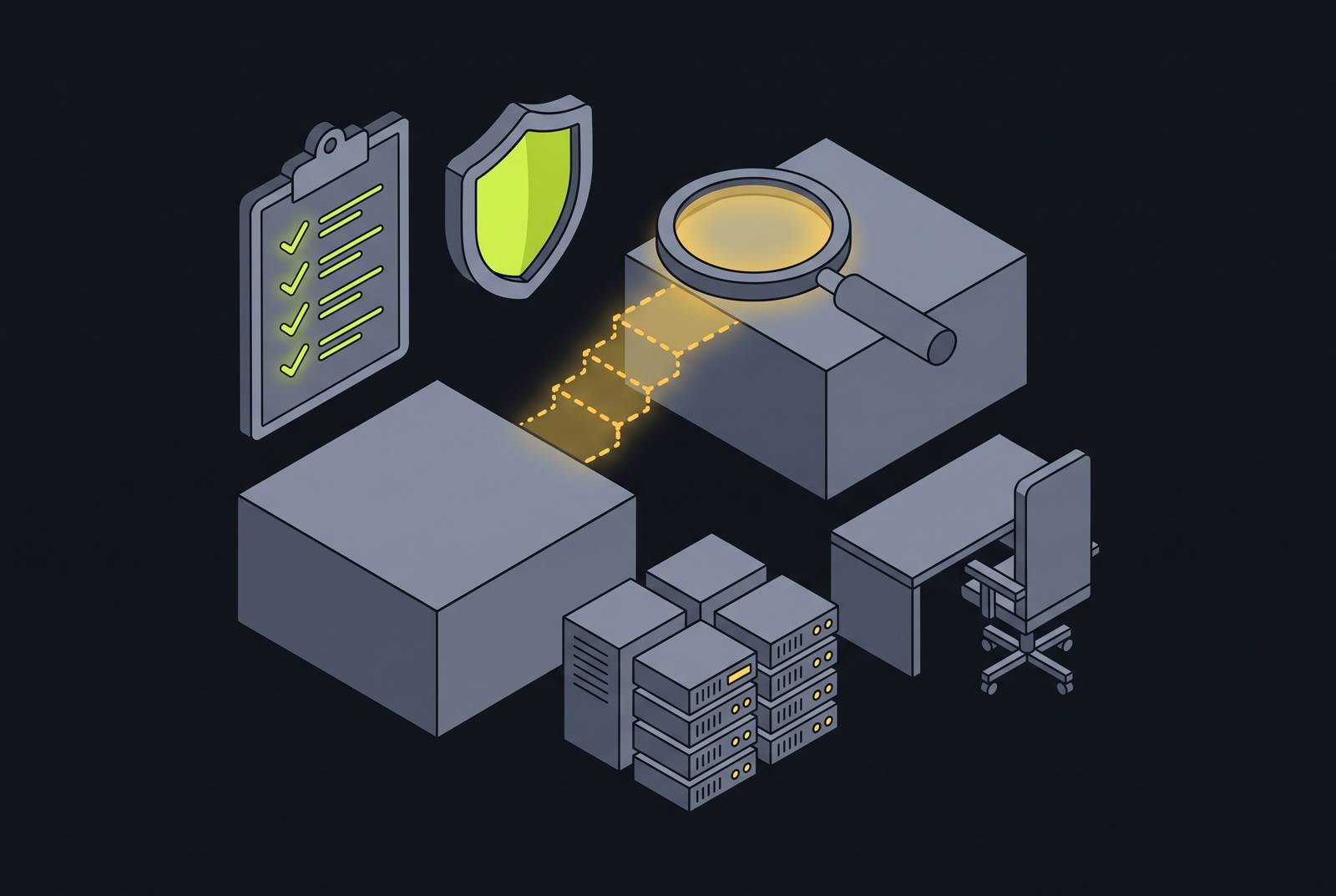
A startup without a CISO can run a rigorous ISO 27001 gap assessment by checking its management system and current controls against ISO/IEC 27001:2022. The same assessment can reduce duplicate work for SOC 2 and HIPAA readiness on AWS or GCP. Automation can collect evidence, but the team still has to judge risk, make scope decisions it can defend, and prove that its security processes work.
Why a gap assessment is the move that unlocks enterprise deals for CISO-less startups
An enterprise contract stalls because procurement needs proof of security maturity and another promise from engineering will not meet that need. A recognized certificate is now a baseline filter for many buyers, so proving security maturity affects revenue. ISO 27001 certification meets that filter through an external audit of the startup’s information security management system, or ISMS. Before that audit, however, the team needs to know whether its working practices match its written claims.
That is where the gap assessment earns its keep. Finding a non-conformity during an internal dry run gives the team time to fix it before it becomes an audit finding. Finding it during the Stage 2 audit can delay the certificate by months. A structured assessment also gives sales precise answers for security questionnaires. None of this requires a CISO title, but it does require executive sponsorship and clear control ownership, whether a founder, CTO, or head of engineering leads the work.
What the 2022 revision actually changed and why it is the only version that matters now
Certifications against ISO 27001:2013 expired after 31 October 2025, making ISO/IEC 27001:2022 the valid basis for this assessment. The revision reduced Annex A from 114 controls to 93 and added 11 new controls. That reduction reflects consolidation and reorganization while maintaining the strength of the requirements. The controls sit under four themes, which are organizational, people, physical, and technological. These cover policies and suppliers, screening and awareness, security zones and equipment, and technical measures such as access control and secure development.
For cloud-native startups, important additions include threat intelligence, configuration management, information deletion, data masking, data leakage prevention, monitoring activities, web filtering, and secure coding. Control A.5.23, Information security for use of cloud services, deserves particular attention. It calls for a formal process for selecting, using, and exiting cloud services, with documented risk acceptance for significant providers. Porter brings infrastructure, CI/CD, and deployment tooling into a unified platform deployed in the startup’s own AWS, GCP, or Azure account, which can simplify that work. The platform can reduce scattered evidence and vendor dependency chains, but the team still has to document its cloud decisions.
How to define scope before touching a single control
Start by defining the product being sold, including the data it processes. Then identify the cloud accounts, repositories, CI/CD pipelines, monitoring tools, and third-party services that support it. Establish who can access customer data and which teams can change production. Finally, record the legal and contractual obligations attached to that data, including GDPR, HIPAA, or sector-specific requirements. Together, those answers draw the ISMS boundary.
A narrow, well-documented scope keeps the assessment focused on the systems and people that matter. But even a narrow scope must include the dependencies that matter. When core infrastructure, CI/CD, and monitoring run in the startup’s own cloud account, as with Porter, the evidence chain stays under more direct team control. Shared-tenant systems can instead make the assessment depend on external vendor documentation that may not meet the auditor’s evidence needs.
The scope must also address how significant cloud providers and SaaS tools are selected, used, and exited under A.5.23. Those decisions feed the Statement of Applicability, or SoA, which records which of the 93 Annex A controls apply and explains exclusions. The SoA gives the assessment its frame and gives the auditor an early view of the team’s reasoning. A convenient exclusion without a defensible rationale is not a sound scope decision.
The two structural layers every gap assessment must cover
The first layer covers the management system requirements in Clauses 4 through 10. Clause 4 addresses organizational context, and Clause 5 addresses leadership. Clause 6 covers planning, while Clause 7 covers resources, competence, and documented information. Clause 8 sets out what is needed for day-to-day operation, Clause 9 for performance evaluation, and Clause 10 for improvement.
The second layer covers the 93 Annex A controls. For each control that applies, check whether it is fully implemented with evidence, partially implemented, or absent. The distinction between implementation and evidence matters because a written policy does not prove that anyone follows it. Management review notes containing decisions and follow-ups are stronger evidence than a polished policy binder that has never been used.
Keep the assessment’s purpose separate from the activities around it. A gap assessment compares existing policies and controls with requirements and produces a gap report and action plan. A risk assessment looks at assets, threats, and vulnerabilities to build a risk register and treatment plan. A certification audit is the registrar’s evidence-based evaluation, producing an audit report and findings. Treating them as interchangeable leaves either the risks or the operating evidence unexplored.
The five gaps a CISO-less startup almost certainly has right now
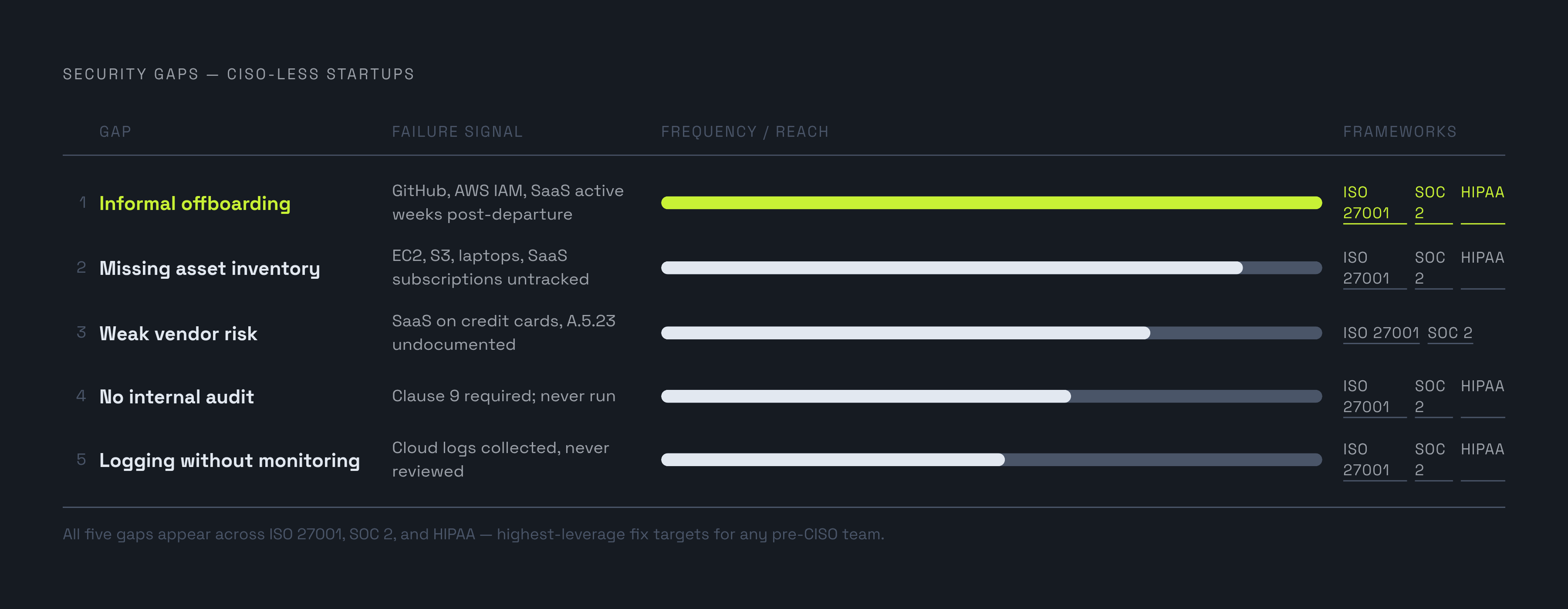
The first gap is informal offboarding. Slack access disappears, but GitHub accounts, AWS IAM roles, and SaaS credentials remain active for weeks. The access review log shows where offboarding remains incomplete despite the policy. This is a control failure that matters for both ISO 27001 and SOC 2.
The second gap is a missing asset inventory. AWS managing hardware does not remove the startup’s responsibility for virtual instances, S3 buckets, developer laptops, and SaaS subscriptions. Without that inventory, the risk assessment has an incomplete foundation. The third gap, weak vendor risk management, is closely linked to the second. Buying a SaaS tool on a credit card without reviewing its security posture leaves supplier requirements unmet, while A.5.23 makes documented cloud risk acceptance explicit.
The fourth gap is the absence of an internal audit function. Clause 9 requires internal audit, so a team that has never run one is missing a required process. The fifth gap is logging without monitoring. Collecting cloud logs does not demonstrate systematic review, calibrated alerts, or consistent action on findings. A.8.15 covers logging, while Clause 9 requires broader checks of how well the system around it works.
Teams that rely heavily on DevOps should also check secure development under A.8.25 and secure coding under A.8.28. Missing static code analysis, hardcoded secrets, unverified Docker images, and unclear separation between development, staging, and production are concrete warning signs. The controls call for secure ways to handle validation, access, and environment segregation. Running CI/CD in the startup’s own cloud account can make the evidence more directly auditable, but it does not make those practices automatic.
How to run the assessment without a CISO in four phases
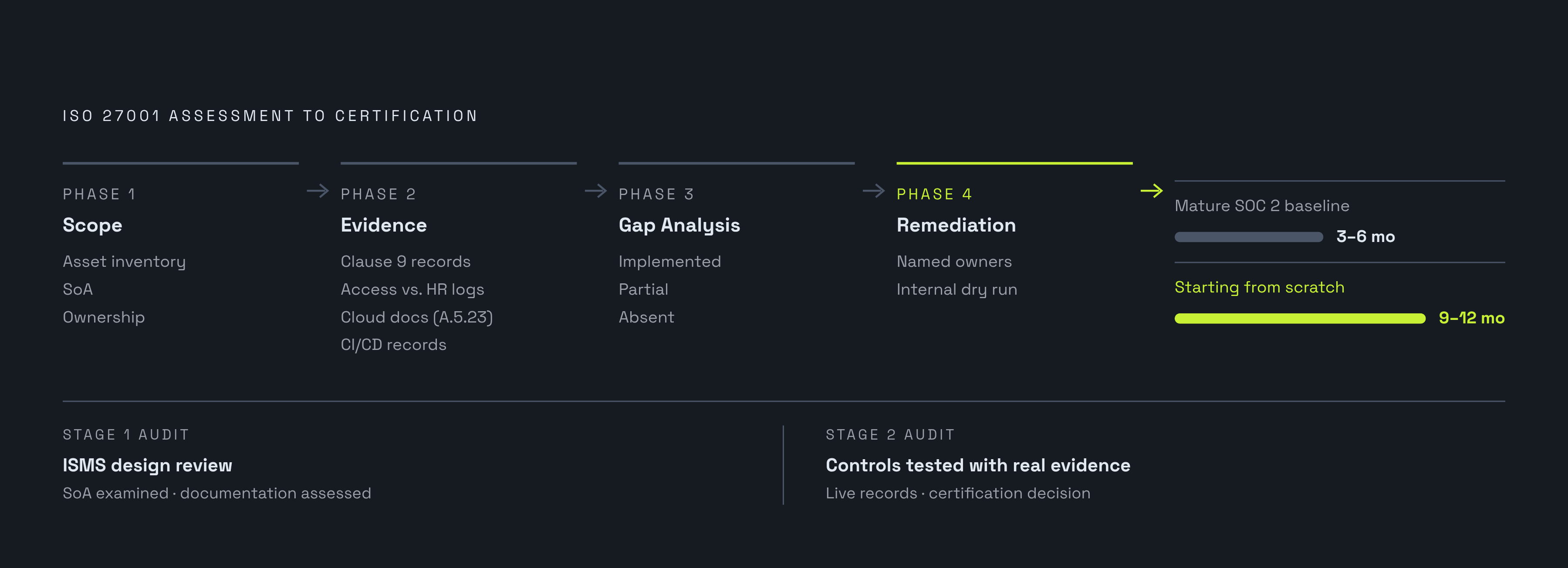
Phase one is to establish the assessment’s boundaries and accountability. Write the scope, assemble the asset inventory, and draft the SoA. Assign responsibility for the work rather than treating security as an unowned engineering task. Use the product’s cloud accounts, repositories, and supporting services to test whether the boundary is complete. Get expert help with the risk assessment and SoA decisions before weak assumptions shape the rest of the assessment.
Phase two is to collect evidence for both structural layers. For Clause 9, gather internal audit records and management review notes. For access management, compare the access review log with HR offboarding records. For A.5.23, gather the documented selection, use, exit, and risk acceptance process for significant providers. Cloud configuration records and CI/CD evidence belong in this phase too, but they do not substitute for records showing that people carry out their responsibilities.
Phase three is the gap analysis itself. Classify each applicable control as implemented with evidence, partial, or absent, and record the reason. Logs that exist without a working review process should not receive the same assessment as logs that are reviewed and acted on. A supplier policy also leaves a gap under A.5.23 if it lacks risk acceptance for the provider. Keep management system failures visible alongside technical findings.
Phase four turns those findings into a remediation plan with clear owners. Use the risk assessment to distinguish material exposures from lower-priority work, then connect each gap to the action and evidence needed to close it. The internal dry run should expose non-conformities before the external auditor does. An integrated platform such as Porter can make change management easier to demonstrate by bringing deployment, autoscaling, and infrastructure updates together. That leaves the team with less work to coordinate, though it still has to prove that controls work.
What a multi-framework gap assessment looks like when ISO 27001 overlaps with SOC 2 or HIPAA
Run one multi-framework gap assessment rather than separate sequential exercises when ISO 27001 overlaps with SOC 2 or HIPAA. SOC 2 and ISO 27001 share enough control territory that a mature SOC 2 program leaves a more bounded set of additional requirements. Teams should collect access reviews, supplier processes, and infrastructure evidence once even when they need them for different frameworks. Map the overlap once and keep the requirements that are specific to each framework in view.
ISO 27001:2022 also offers relevant overlap with HIPAA technical safeguards through A.8.10, Information deletion, A.8.11, Data masking, and A.8.12, Data leakage prevention. That overlap supports shared evidence work, with compliance established separately for each framework. On AWS or GCP, directly accessible IAM policies, access logs, and configuration records make that mapping easier to support. Tooling described as one-click SOC 2 and HIPAA compliance can reduce evidence collection when the underlying infrastructure is observable. It cannot turn cloud settings alone into a complete compliance program.
How to fill the CISO gap: what actually needs expert judgment versus what can be automated
Risk assessment and SoA review need help from an expert. Material risks depend on the startup’s business, data, and threat model. Excluding an Annex A control also requires a rationale that will withstand scrutiny. A senior engineer can execute much of the remaining assessment with structured guidance. The startup does not need to engage a fractional CISO for every evidence request or control update.
Rhymetec and Eden Data are options for that judgment-intensive support. Rhymetec covers ISO 27001, SOC 2, and HIPAA among its frameworks, while Eden Data offers hands-on implementation across those frameworks and others. For reusable management system content, ISMS.online provides policy and control libraries that teams can customize. Compliance automation platforms handle a different part of the job by collecting evidence from cloud configurations, access logs, and CI/CD systems.
The category’s limit is straightforward. A green status for a configured setting does not prove that the workflow around it works. Informal offboarding requires someone to compare access records with HR records rather than accept a configuration check as the answer. Automation cuts down on repeated prep work, while people check whether the process holds together. Neither removes the need for named owners.
What to expect after the gap assessment: timeline, cost, and what the remediation phase actually demands
A gap assessment takes two to four weeks for a startup with defined scope and basic controls already in place. Most startups reach certification in three to six months from kickoff, while teams starting from scratch should plan for 9 to 12 months. A mature SOC 2 program tends to move a team toward the faster end. These ranges provide estimates for planning assessment and certification timelines.
Remediation consumes much of the internal time and cost. IT, engineering, HR, and DevOps must write policies, collect evidence, run internal audits, conduct management reviews, and build vendor risk processes. DIY has the lowest direct cost but the greatest exposure to engineering-time loss and rework. Automation adds subscription costs but cuts down on repeated work, and having consultants lead the work costs the most directly but suits teams that lack the time to do it themselves. Ownership assigned during assessment is therefore also a resourcing plan.
Stage 1 examines the ISMS design and documentation, including the SoA. Stage 2 uses real evidence to test whether controls work as documented. Surveillance audits in years two and three cost roughly forty to sixty percent of the initial audit fee, but continued operation still needs people and attention. The goal is to build a system with repeatable work automated and human judgment assigned where it belongs.