SOC 2 Audit Timeline for a Growth-Stage Startup
Plan backward from deal close to avoid bottlenecks in the observation window.
SOC 2 Type II has stopped being a nice-to-have for startups selling into mid-market and enterprise accounts. A security questionnaire appears in a procurement portal that refuses to advance without a report attached, or legal adds a security addendum to the contract: these are the real triggers, not a funding round or a headcount number. SOC 2 is an attestation issued by a licensed CPA firm against the AICPA's Trust Services Criteria, with no legal requirement to obtain it; the report stays confidential, shared with buyers under NDA. Buyers now increasingly ask for Type II, which checks whether those controls actually operated correctly over time. That shift is what makes timeline planning matter: get the sequencing wrong, and a deal stalls in procurement for months.
Reading the two-track structure before planning dates
Before anyone sets a date, the first decision is which audit track the company is actually running, because Type I and Type II are not two stops on the same road. They are two different products with two different timelines, and treating them as interchangeable is the single most common planning mistake. Type I checks design at a single point in time, so fieldwork is short: there's no accumulated evidence to review, just a snapshot. Type II checks whether those same controls operated correctly over an extended window, and that window is the real driver of the schedule.
Most startups that need to move fast run both in sequence: get a Type I done quickly to unblock a live deal, start the Type II observation window at the same time, and deliver the Type II report before the enterprise renewal date comes due. That sequencing avoids the false choice between speed and rigor. Scope itself, meaning which trust service categories are included, is a separate lever from audit type, and reaching for more categories than a buyer is actually asking for is a reliable way to add months to a first audit.
Phase 1: Readiness assessment and gap remediation, where most delays originate
Most schedules fall apart in the readiness phase, because teams underestimate both the coordination it takes and the size of the backlog that a real gap assessment reveals. That assessment walks through every trust service criterion in scope, checks existing policies against it, and produces a list of what's missing. That list has to be worked down before an auditor ever gets involved.
How long this takes depends on company size, system complexity, and how far along existing controls already are. A company already running MFA, access reviews, and a documented incident response plan can expect the lower end. Each of those items touches more than one team. That is why readiness needs a technical owner, a compliance lead, and real participation from IT and HR from the start. The more cross-functional the effort early on, the less cleanup bleeds into the audit itself.
Infrastructure state plays a specific role here. Infrastructure decisions made early in a company's life have downstream consequences for exactly this reason: a team that deployed into its own cloud account with compliance guardrails built in from the start has a smaller remediation backlog to work through than one retrofitting controls onto infrastructure that was never built with an audit in mind.
Four stall points come up repeatedly in this phase. Compliance automation platforms such as Vanta, Drata, Secureframe, and Sprinto help compress this phase by automating evidence collection and flagging gaps on an ongoing basis. None of them shorten the observation window that follows, because that window is fixed by the audit itself, not by how fast evidence gets collected.
Phase 2: The observation window, the fixed constraint that shapes the whole plan
Once controls are designed and running, the audit moves into its one truly fixed phase. The observation window cannot be shortened by more effort, better tooling, or more budget. The AICPA doesn't set a formal minimum, but three months is the practical floor auditors will accept, and six months has become the standard for a first audit because it signals more operational maturity to buyers who know what they're looking at.
The window only starts once controls are actually implemented and operating, so any slippage in the readiness phase pushes the start of this clock back and compounds downstream. Periodic controls cause the most trouble here. A quarterly access review that slips, an annual policy review that was never documented, a vendor security review done informally instead of on paper: any of these becomes a finding if it isn't run on schedule during the window.
Continuous monitoring tools and GRC platforms make evidence collection less painful during this period, but they don't move the calendar. A team using automation still runs the full observation period end to end; what changes is how many engineering hours it costs to get there. For sales planning, the math is direct: if a deal is set to close in month X, a six-month observation window means working backward at least nine months, and a three-month minimum window means working backward at least six months. The shorter window carries more risk, because any evidence gap found during that compressed period needs an explanation an auditor has to accept. Renewal cycles run on a twelve-month observation period, and letting a report lapse between periods opens a gap that procurement teams will ask about directly.
Phase 3: Audit fieldwork and infrastructure's effect on auditor review
Fieldwork, once the observation window closes, is shorter and more predictable than everything before it. But the systems it touches run deep into the engineering stack, so infrastructure decisions made months earlier shape how smoothly this phase goes. Auditors review controls, interview key people, and test the evidence that accumulated across the full observation period. For Type II, that's a review of the entire window, not a single snapshot in time.
Three systems sit squarely in scope: the production cloud account (AWS, GCP, or Azure), the source control system holding the production codebase, and the CI/CD pipeline that ships code to production. These get audited together as part of the security control environment. Infrastructure that was stood up ad hoc requires someone to manually document all of it after the fact.
Startups running production workloads inside their own cloud account, rather than on shared-tenant platforms where infrastructure configuration is abstracted away, tend to produce cleaner audit evidence, because IAM, logging, and network configuration are owned and instrumentable at the account level. Porter's model deploys production environments into a customer's own AWS, GCP, or Azure account, with SOC 2 and HIPAA compliance tooling built in and CVE patching handled automatically, so the infrastructure itself generates evidence as a separate layer bolted on afterward would not.
Fieldwork also includes a step teams routinely forget to plan time for. The management response to the draft report is the startup's own document, not the auditor's, and the system description that makes up Section III of the final report needs internal review and sign-off before anything gets issued. Teams that treat this as a formality tend to underestimate their timeline by several weeks.
Phase 4: Report delivery, validity window, and the annual renewal cycle
Getting the final report issued is not the end of the project. It opens a twelve-month validity window, and the startup now has to plan to renew that window without a gap, which turns what felt like a finite project into an ongoing operational commitment. Once fieldwork wraps, the auditor compiles findings and sends a draft report for management review. The startup confirms the system description is accurate, and only then does the final report get issued. That review-and-issuance step adds real weeks to the calendar that teams consistently forget to budget for.
Most enterprise buyers treat a SOC 2 report as valid for twelve months. A report that lapses before a renewal gets issued creates a visible gap, and procurement teams and enterprise legal departments will ask about it directly. The same discipline applies whether the company also needs HIPAA coverage for health-tech customers; the compliance posture either runs as ongoing infrastructure or it doesn't.
The actual work after report delivery is evidence collection that never stops: quarterly access reviews, annual policy reviews, and vendor security reviews, run on schedule every cycle. Companies that treat SOC 2 as a single achievement, then scramble again when renewal approaches, are the ones who end up with gaps and late reports. The report itself is a recurring asset that has to be maintained, not a trophy to file away.
The total timeline and what moves it
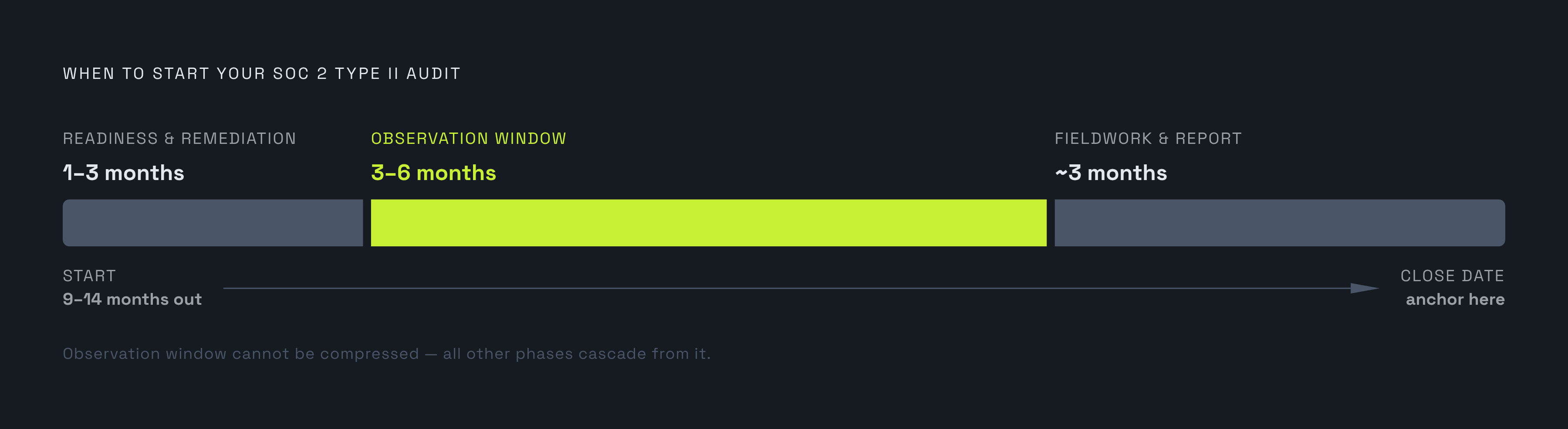
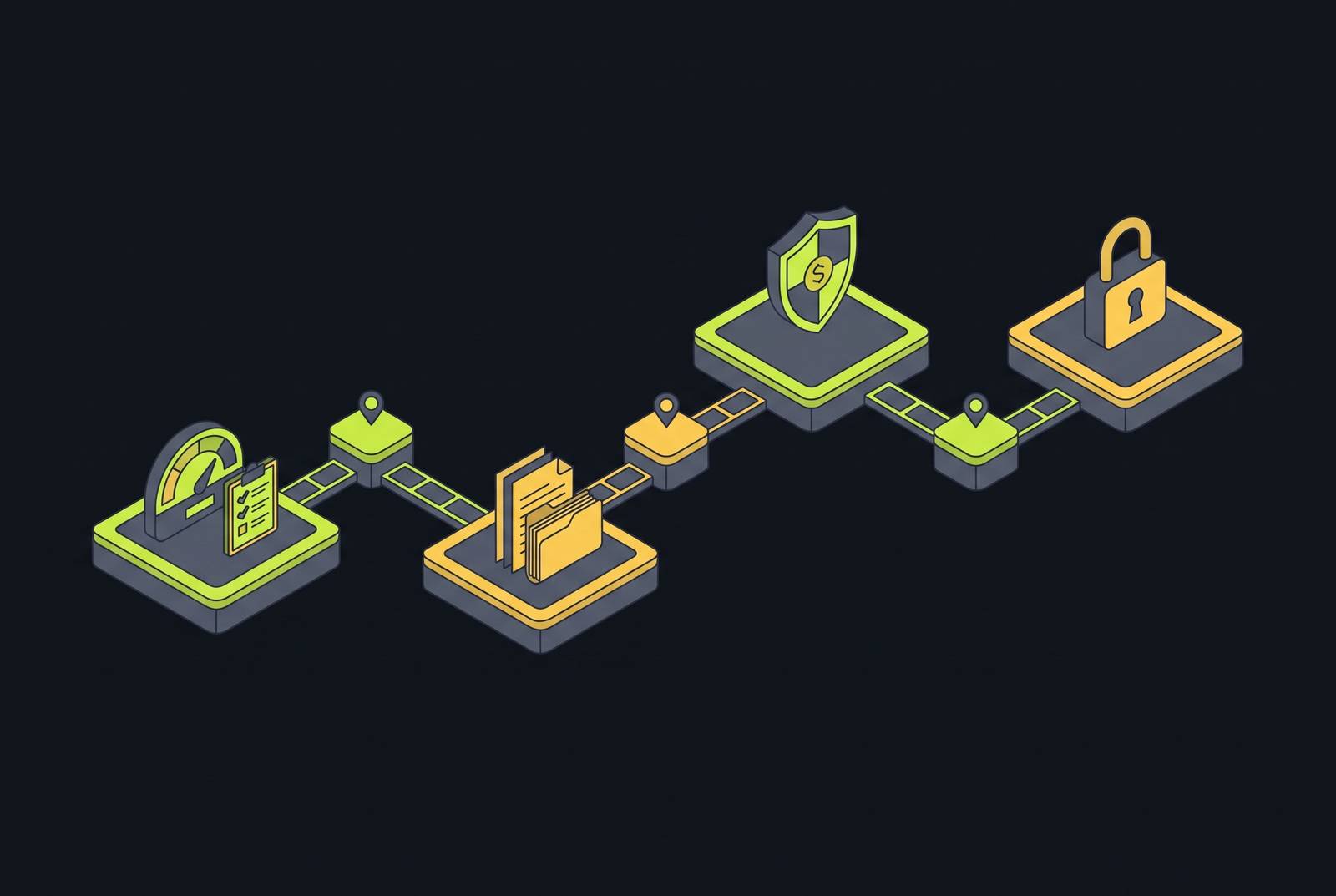
Put the phases together: the end-to-end timeline for a first SOC 2 Type II report runs roughly nine to fourteen months from kickoff to final report for most startups. That range comes from three pieces stacked together: a readiness phase with real variance depending on where the company starts, an observation window fixed at three to six months, and fieldwork and report delivery on top. A typical path looks like this: months one through three cover readiness, gap remediation, and, if a live deal demands it, a fast Type I audit to keep the sales pipeline moving. Months four through six, sometimes stretching to month nine, cover the Type II observation window itself. Months ten through twelve cover fieldwork, management review, and report issuance.
Certain decisions pull that timeline in, and certain decisions stretch it out. Automation platforms help with the readiness phase and reduce the ongoing burden of evidence collection, but they cannot shorten the observation period itself, because that clock is a structural feature of the audit, not an administrative bottleneck to optimize away.
Infrastructure architecture compresses the timeline in a different way, and it works across every phase at once. A production environment instrumented from the start with continuous logging, automated CVE patching, and IAM controls managed at the cloud-account level produces audit evidence as a natural byproduct of how it already runs. That shrinks both the readiness remediation backlog and the amount of work fieldwork requires later. For teams working backward from a sales deadline, the math is straightforward: take the close date, subtract twelve weeks for fieldwork and report delivery, subtract the observation window of three to six months, and subtract one to three months for readiness. Whatever date that leaves is the latest credible point to start. Starting later pushes a company into a three-month observation window, which carries more risk, or causes it to miss the deadline.
The first-year investment and internal engineering time as the real variable
The auditor's invoice is the most visible cost in a SOC 2 engagement, but it's usually the smallest piece of what the first year actually costs. The bigger variable is internal engineering time, and that's where infrastructure and tooling choices have the most room to make a difference. Without a compliance platform, engineering and IT teams absorb a substantial block of hours over the first year, collecting evidence, documenting policies, and chasing down periodic reviews by hand. With a compliance platform in place, ongoing monthly maintenance drops sharply once the initial setup is done.
Renewal years cost meaningfully less than the first year, because the control framework, the policies, and the relationship with the auditor are already established. The right way to evaluate a GRC platform is by how many recurring engineering hours it actually removes, not by the sticker price on the contract.
Infrastructure that generates compliance evidence automatically, continuous logging, automated access reviews, CVE patching, and network monitoring instrumented at the cloud-account level, cuts the engineering-hours line throughout the observation window and again at every renewal, and that's where the real savings compound year over year. Porter's approach to deployment, running production environments inside a customer's own AWS, GCP, or Azure account with SOC 2 compliance tooling built in and CVE patching handled automatically, is built around this same idea: evidence generation should be a byproduct of how the infrastructure already runs, not a separate engineering project layered on top of it.
The trigger question: when a growth-stage startup should start the clock
The right time to start is tied to pipeline signals and deal economics, and the whole phase model above only becomes useful once a company can name the actual sales deadline it's building backward from. The concrete trigger is a named customer making SOC 2 a condition of the contract: a security questionnaire, a procurement portal that won't move forward without a report attached, or a security addendum on a deal worth roughly $50,000 or more a year. Below that threshold, starting the process is a bet on demand that hasn't shown up yet.
Starting too early carries real cost: a report sitting on the shelf with no enterprise buyer asking to see it still comes with annual renewal fees and no pipeline value to show for it. Starting too late carries a different cost. Once a deal is already sitting in procurement, a Type I can unblock it quickly, but the Type II that follows now runs on an expedited basis, with fewer safe options for the observation window and more strain on the engineering calendar than a planned timeline would have required.
Infrastructure readiness is part of this timing decision, not separate from it. The cleanest path for a growth-stage company is to treat compliance readiness as infrastructure built into production from the beginning, start the formal audit process the moment a real enterprise deal makes it contractually necessary, and run the phased Type I to Type II sequence to keep deals moving while the observation window accumulates in the background.