Continuous Compliance Monitoring for Kubernetes Environments
Kubernetes compliance drifts continuously, making annual audits obsolete and automation essential.
Kubernetes compliance is no longer a state you prove once a year. It is an operating discipline that must hold continuously, because the environment drifts continuously. The gap between business frameworks like SOC 2 and PCI DSS and the Kubernetes objects that satisfy them is where most teams fail without automation.
Why Kubernetes compliance has moved from annual audit to continuous operating requirement
The core tension is structural. But Kubernetes is unusually poor at proving those controls held over time. Nothing in a default cluster records that a control existed last March, who verified it, or what happened when it briefly stopped passing. The environment gives you a language for stating intent and almost nothing for demonstrating persistence.
Periodicity fails because the environment changes faster than any review cycle can track. The requirements are already moving in this direction. SOC 2 Type II attests over a period of typically six to twelve months, so point-in-time screenshots do not satisfy auditors. They ask for recurring, dated checks, because that is the only evidence that a control was in place throughout the period.
The shared-responsibility misunderstanding compounds the problem. A managed cluster such as EKS, GKE, or AKS inherits the provider's infrastructure certifications only for the control plane and physical hosts. That includes RBAC, Pod Security Standards, NetworkPolicies, secrets encryption, and audit logging. It is precisely what auditors examine. One compliance guide puts roughly 80% of the technical controls an auditor checks on the customer side of the line.
A cloud posture scan cannot substitute for Kubernetes-specific coverage. An AWS account can pass every account-level check, but a cluster inside it can still run a service account with cluster-admin rights. That is why Kubernetes Security Posture Management, or KSPM, exists as its own distinct layer. Account-level visibility does not reach into the cluster.
How the major compliance frameworks translate into concrete Kubernetes controls
The gap between business frameworks and Kubernetes configuration is not conceptual. Each framework criterion maps to a specific, verifiable cluster object or flag. Knowing that mapping is the prerequisite for automation, and once you have it, the work becomes mechanical.
The CIS Kubernetes Benchmark is the technical floor. It is the most widely adopted configuration-hardening framework written specifically for Kubernetes, with audit commands and remediations for each check. SOC 2, ISO, and PCI auditors all accept CIS results as evidence of configuration hardening. That makes CIS the common currency across every framework discussion.
SOC 2 Common Criteria land on Kubernetes in specific ways. If you need logical access criteria, CC6.1 through CC6.3 map to RBAC least privilege and the absence of standing cluster-admin roles. CC8.1 maps to GitOps-style change management, which gives auditors a versioned record of what changed and who approved it.
ISO 27001 in its 2022 revision maps through Annex A controls. A.8.2 and A.8.3 point to RBAC for privileged and general access. A.8.15 and A.8.16 point to API audit logs and alerting. About two-thirds of the relevant Annex A controls are scannable. The rest are organizational.
PCI DSS 4.0 is contractually mandatory when cardholder data touches the cluster, and it is the most prescriptive of the frameworks. Requirement 1 demands genuine CDE segmentation, which means default-deny NetworkPolicies and often dedicated node pools or clusters. Requirement 10 demands API-server audit logs that are shipped to durable storage and retained for the audit period. The Cloud Computing Guidelines supplement exists to scope these requirements.
The point is that HIPAA compliance is not just encryption. It is a monitoring and access-control discipline.
The NSA/CISA Kubernetes Hardening Guidance addresses five areas: pod security, network separation and hardening, authentication and authorization, log auditing, and upgrades. Across every framework, six control families cover most of the surface: RBAC least privilege, Pod Security Standards, default-deny NetworkPolicies, secrets encryption and external secret management, API audit logging with retention, and recurring configuration scanning with tracked remediation. When these controls are declared and monitored continuously in the deployment layer itself, rather than bolted on after clusters are running, compliance becomes a continuous operating state instead of a quarterly scramble.
Why continuous scanning catches what periodic reviews miss, and where scanners themselves fall short
Continuous scanning is necessary because the three events that most often silently break a passing control occur on no predictable schedule. The cadence has to be tied to those events, not to a calendar. Manifest-only scanning in CI is valuable for prevention but insufficient for attestation. Auditors ask about the running environment, drift included.
The CVE database reliability problem shows why scanning alone is not enough. In June 2026, the Kubernetes Security Response Committee confirmed that CVE records had been wrong for years on four CVEs. Scanners ingesting those records had been clearing clusters that were never actually clean. They were producing false negatives silently, for years.
The practical consequence is that an affected version does not necessarily mean a cluster is exposed. Each unfixed CVE depends on a particular combination of permissions, cluster features, and network access. CVE-2026-66794 in Red Hat Multicluster Engine carried a CVSS score of 9.3.
The signal from both events is that continuous, runtime-aware monitoring is not optional. Scanners operating on stale or structurally incorrect CVE databases produce false negatives, and a compliance program that trusts scanner output uncritically is not actually in control. Runtime reachability analysis is what separates actionable risk from noise, and it typically reduces actionable CVE counts by 90% or more.
The open-source tool stack that forms the foundation of policy-as-code enforcement
Effective Kubernetes compliance-as-code requires layering specialized tools by function. No single open-source tool covers admission control, configuration auditing, and runtime detection simultaneously. The architecture is the point.
Policy engines form the admission control layer. Rules live in version-controlled repositories, follow the same review and approval workflows as application code, and produce an immutable audit trail of every change.
Configuration auditing occupies the benchmark layer. kube-bench measures compliance posture against CIS Benchmarks. Kubescape, from ARMO and the CNCF Sandbox, is purpose-built for Kubernetes. It covers CIS benchmarks, NSA/CISA hardening guidance, and MITRE ATT&CK for containers. It scans RBAC, network policies, and workload configuration in one pass, and includes a host scanner for node-level checks.
Image and infrastructure-as-code scanning has largely consolidated around Trivy from Aqua Security. A single binary scans container images, filesystems, Kubernetes manifests, Helm charts, and Terraform for vulnerabilities and misconfigurations. Its CVE database updates frequently, and that matters given the reliability problems described earlier.
Runtime detection falls to Falco from Sysdig, a CNCF graduated project. It uses eBPF or kernel module instrumentation to detect anomalous behavior such as unexpected shell execution inside a container, sensitive file reads, and privilege escalation attempts as it happens, not after the fact. Its graduated status means a mature rule ecosystem sits behind it.
The GitOps compliance model ties these layers together. When policies live as declarative code in Git, you gain a complete, version-controlled audit trail of every policy change. That is the same traceability model that satisfies CC8.1 for SOC 2 change management. But the key limitation has to be stated plainly. The MITRE ATT&CK matrix for Kubernetes surfaces the adversarial techniques these tools must be tuned to block, including weak cloud credentials, corrupted registry images, cluster-admin bindings, and privileged containers.
What commercial compliance platforms add beyond the open-source baseline
Commercial compliance platforms are not simply bundled versions of open-source tools. Their differentiating value is audit-ready evidence generation, cross-framework mapping, and unified posture management across multi-cloud clusters. The open-source stack does not provide these out of the box.
Palo Alto Networks Prisma Cloud covers container image scanning, Kubernetes posture management, cloud security posture management, code security, identity risk, and runtime defense. It is best suited for large enterprises managing multi-cloud environments with mature compliance programs. Teams should plan for implementation time and policy governance, because the platform is complex to deploy and tune, and alert fatigue is a real risk without careful configuration.
Wiz takes an agentless approach with graph-based risk prioritization that shows whether a vulnerability is reachable, exposed, and connected to sensitive data. Its strengths are cloud asset inventory and cross-environment compliance dashboards. If you need deep runtime blocking or highly granular container process enforcement, check whether a dedicated runtime tool is needed alongside it.
Aqua Security covers the full lifecycle from image scanning through runtime anomaly detection. Its strength lies in enforcement. Sysdig Secure provides evidence of what workloads are actually doing in production rather than relying only on pre-deployment scanning. That distinction matters for audits requiring ongoing control effectiveness, not just point-in-time assessments.
Microsoft Defender for Cloud is a practical option for Azure-invested organizations. It provides container image scanning, Kubernetes posture recommendations, workload protection, regulatory compliance dashboards, and integration with Microsoft Sentinel. It fits naturally where Azure is already the operating environment.
Porter approaches the problem from the infrastructure layer. It handles CVE patching automatically and provides one-click SOC 2 and HIPAA compliance. If you keep the compliance surface within your own cloud account, you avoid the shared-tenant exposure that complicates audits on opaque infrastructure.
Above posture scanning sits the GRC evidence-collection layer. One identity-provider export can simultaneously satisfy HIPAA §164.312(a), HITRUST 01.q, and SOC 2 CC6.1. Drata's approach has autonomous agents that continuously scan infrastructure, collect evidence against pre-mapped controls, flag drift, and surface remediation tasks without waiting for a request. This is the layer that turns raw scan output into something an auditor can read.
The scan-fix-evidence loop: turning continuous posture into audit-ready proof
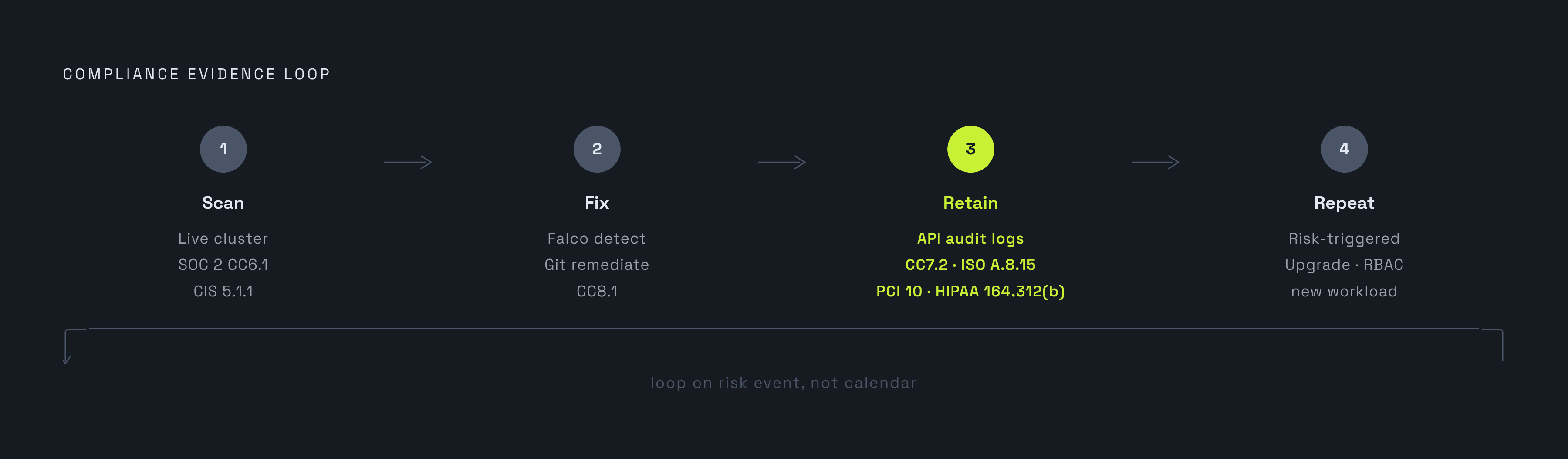
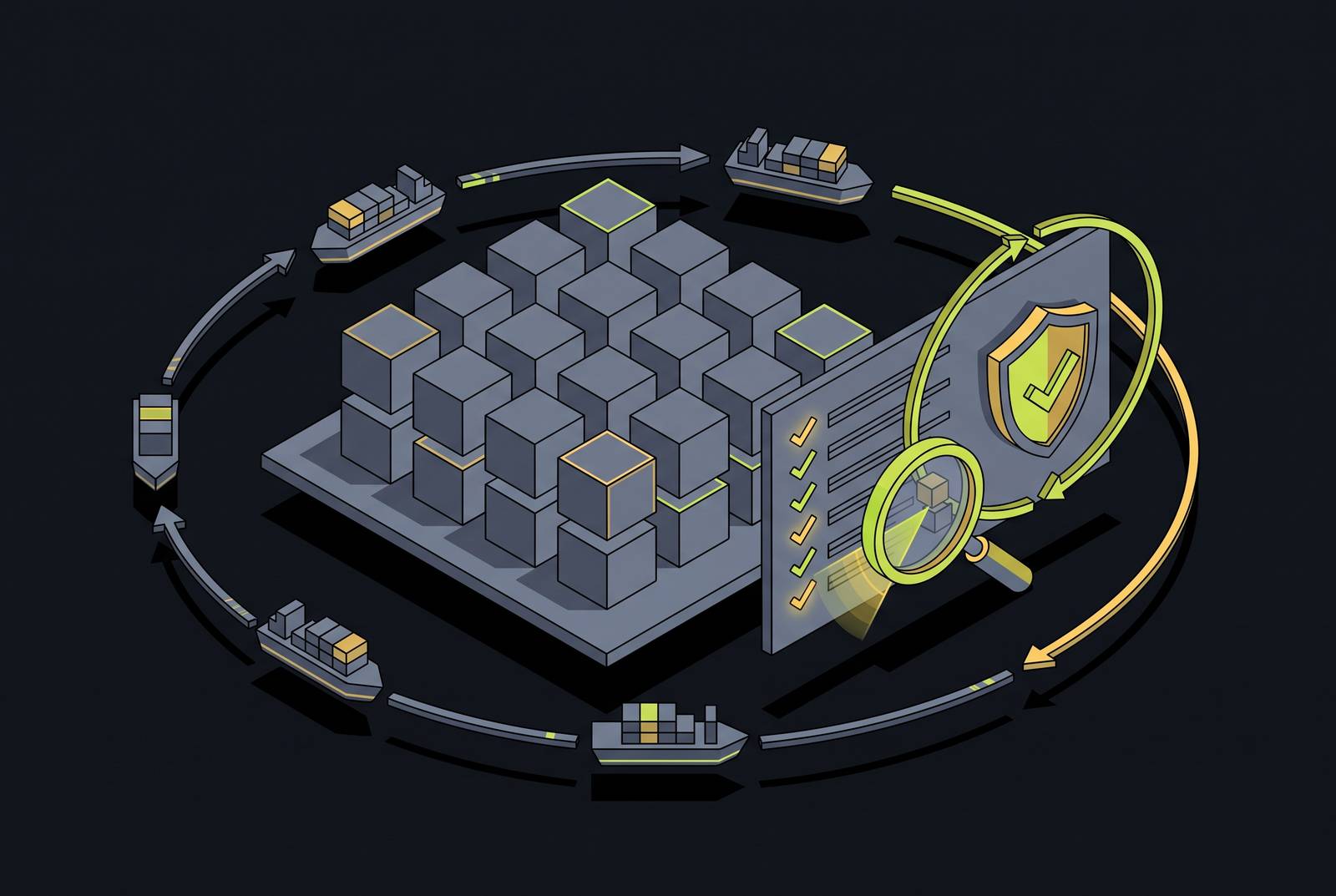
A passing scan is not compliance evidence. Compliance evidence is a dated, attributable record that a specific control was in place throughout the audit period. Producing that record requires a deliberate loop, not just a tool.
Step one is to scan against the live cluster, mapped to framework controls, not a generic CVE list. Each finding should map to the framework criterion it represents. A cluster-admin binding failure maps to SOC 2 CC6.1 and CIS 5.1.1, and that mapping is what gives the finding audit meaning.
Step two is to fix at the right layer. Detection happens through runtime tools like Falco, which surface drift that bypassed or predated admission control. Remediation happens in the same Git workflow as the policy itself, producing the change-management evidence CC8.1 requires.
Step three is to collect and retain dated evidence. You must enable API-server audit logs, ship them to durable storage, and retain them for the audit period. This is the single control that appears in every framework: SOC 2 CC7.2, ISO A.8.15, PCI Requirement 10, HIPAA 164.312(b). GRC platforms like Drata or Vanta can ingest these signals automatically and surface them against the specific control citations an auditor will examine.
Step four is to repeat on a schedule tied to risk, not convenience. Additional scans follow every cluster upgrade, new workload deployment, and RBAC change. The MITRE ATT&CK matrix provides a reference for updating threat models as new Kubernetes vulnerabilities are disclosed, keeping remediation priorities current.
The efficiency argument for this approach at small scale is control overlap. If your team handles SOC 2, you are likely already meeting a substantial portion of HIPAA and ISO 27001 technical requirements. The loop is manageable because the underlying controls are shared.
What continuous compliance looks like for teams without a dedicated security or DevOps function
For a small team, the difference between a compliance program that holds and one that collapses under audit pressure is almost entirely a function of how much of the loop runs automatically versus how much depends on someone remembering to do it. The manual compliance model breaks in two ways. And when no one owns the compliance cadence explicitly, the quarterly scan simply stops happening after a missed cycle.
The infrastructure architecture decision matters as much as the tooling decision. Porter's model, deploying clusters directly into the customer's AWS, GCP, or Azure account with automatic CVE patching and one-click SOC 2 and HIPAA compliance, is designed for this constraint. The platform handles the undifferentiated compliance overhead so the engineering team can focus on the product.
The GRC platform efficiency argument applies most strongly here. Once compliance controls are expressed as code and evidence collected automatically, layering a second or third framework requires adding controls you are likely already meeting. Adding HIPAA on top of SOC 2, or ISO 27001 on top of PCI, is not rebuilding the program from scratch.
Regulatory pressure continues to drive Kubernetes security investment. AI applications are becoming mission-critical, but many organizations lack the right access controls and protections. The same RBAC and audit-logging discipline that satisfies SOC 2 CC6.1 also closes the most common AI workload access-control gaps.
The operating model does not change with team size. Three engineers and thirty face the same loop. The investment in automation pays compound interest, because each audit cycle becomes cheaper than the last once the loop is running.