Replacing a Compliance Team With Deployment-Layer Automation on AWS and GCP
Automation at deployment time catches compliance violations before they reach production.
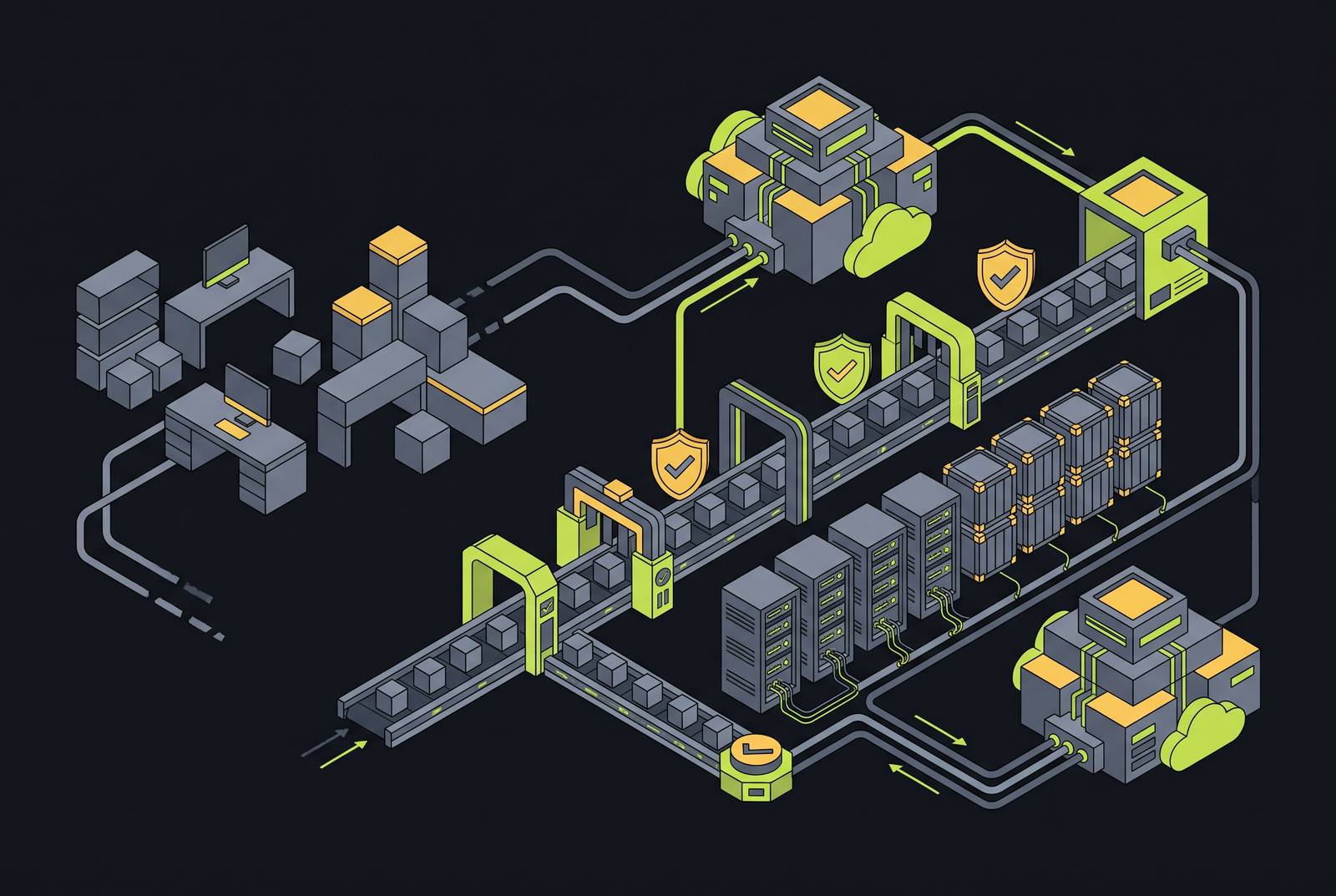
Deployment-layer automation on AWS and GCP can let a startup prepare for SOC 2 and HIPAA without a dedicated compliance team by enforcing technical controls and collecting evidence continuously. This uses cloud policies, pre-deployment checks, and tools that collect evidence automatically. “One-click SOC 2 and HIPAA compliance” describes infrastructure automation while people retain responsibility for processes, organizational controls, and the audit itself.
Why the deployment layer has become the natural home for compliance enforcement
An engineer runs a script, screenshots S3 encryption status, and pastes the image into a spreadsheet. Two weeks later, someone creates an unencrypted bucket. The screenshot still shows the bucket as it was, when it was compliant. The evidence is stale before the next review. A team can follow its evidence-gathering procedure perfectly and still miss the live violation because the procedure records a moment without enforcing a rule.
Reviews that happen more often make that gap shorter but leave it open. Moving the check to the point where a resource is defined or deployed changes the failure mode instead. A deployment gate can reject a configuration before it reaches production, rather than leaving someone to discover and repair it later. Compliance becomes part of engineering. That is an architectural change, because the system responsible for creating infrastructure also becomes responsible for rejecting configurations that break its rules.
The two control types that define deployment-layer compliance: preventive and detective
Preventive controls stop a prohibited action before it creates a violation. Detective controls identify a violation after it happens. The distinction determines where each requirement belongs. Hard security requirements need prevention wherever the action can be blocked, while tagging, cost optimization, and other softer requirements can often use detection. Treating every requirement as a finding to resolve leaves the same violations free to recur.
Detection still has a role behind prevention. It checks whether the guardrails are working and exposes conditions they do not cover. A layered design therefore uses preventive controls to restrict what can happen and detective controls to evaluate what actually exists. Together, they separate rules that must block deployment from findings that need review.
The rollout needs the same care as the design. Teams should start in audit mode where it is available, learn what violations are already there, and fix them before turning on denial. Otherwise, a sound security requirement can interrupt a workload that depends on its current configuration. Where a control has no audit mode, non-production testing must come first on the path to prevention.
The AWS enforcement stack: Config, Security Hub, Audit Manager, CloudTrail, and Inspector working together
AWS Config supplies continuous configuration evaluation. Its baseline managed rules cover S3 encryption and public access, encrypted volumes and RDS storage, restricted SSH, root-account MFA, password policies, CloudTrail, and virtual network flow logs. Config can trigger SSM Automation runbooks when it finds a violation. For example, AWS-EnableS3BucketEncryption configures default AES256 encryption on a named bucket when invoked. Remediation still needs a safe rollout, starting with an SNS notification, human review, and approval before automatic changes.
CloudTrail documents activity while Config evaluates state. Organization-wide logging, with logs stored in a dedicated security account, establishes the audit trail behind the findings. SOC 2 calls for system operations monitoring under CC7, and HIPAA calls for audit controls under 164.312(b). Logging helps meet those requirements, but compliance takes more than logs alone. A configuration finding and an activity record answer different audit questions.
AWS Audit Manager packages evidence from Config evaluations, CloudTrail, Security Hub, and API calls against control frameworks, including SOC 2 and HIPAA. Availability changes the implementation choice. The service closed to new accounts in April 2026 and is in maintenance mode, so a new startup cannot make it the foundation of its plan. AWS’s availability-change guidance points to Config Conformance Packs but notes no equivalent pack for SOC 2.
Security Hub shows findings from GuardDuty, Inspector, Macie, and third-party tools in one posture view. Amazon Inspector adds continuous CVE scanning for EC2 instances, ECR container images, and Lambda functions to this connected workflow of five products.
The GCP enforcement stack: Organization Policies, Security Command Center, and Cloud Audit Logs
GCP Organization Policies add the preventive layer by applying constraints when a resource is created or updated. They work like AWS Service Control Policies, which limit the actions allowed as well as report findings. On either cloud, prevention belongs at the organization boundary as well as in deployment checks. That gives hard requirements an enforcement point beyond the pipeline itself. The constraints still need to fit the resources and actions they control.
Cloud Audit Logs provide the activity record. Admin Activity logs capture user-driven API calls and actions that change resource configuration or metadata, serving the auditability role that CloudTrail serves on AWS. Security Command Center shows the findings and posture, and Security Health Analytics detects misconfigurations. Most of those detectors work in real time, but a subset scans periodically. That distinction leaves a detection window for some resource changes, so tighter Organization Policy constraints are appropriate for the highest-risk resource types.
GCP Assured Workloads adds a baseline for regulated environments. It preconfigures organization policies and access controls through control packages that include FedRAMP, HIPAA, and IL4 at environment creation. This puts the regulated baseline into the environment’s setup rather than leaving every requirement for later remediation. It does not replace the activity record or finding review. The GCP stack divides the work in the same way as AWS, though the services and when they evaluate resources differ.
Wiring compliance checks into the CI/CD pipeline so violations never reach production
Cloud-native evaluation begins with a resource that exists. A CI/CD policy gate can inspect its definition before provisioning, moving the decision ahead of both detection and remediation. Policy-as-code expresses requirements as version-controlled, testable rules against Terraform, CloudFormation, or Pulumi definitions. The deployment process evaluates them before resources reach the cloud account.
A Terraform module that enables public S3 bucket access can fail a pipeline check before the pull request merges. An encryption policy can reject a definition that fails its encryption requirement. These are separate checks against separate risks. New workloads then inherit compliant defaults and avoid adding another batch of cleanup tasks. Finding a misconfiguration at pull-request time costs minutes, while discovering it during a post-deployment audit can cost days of engineering work and produce an audit finding.
Static application security testing handles application code, while infrastructure-as-code scanning handles infrastructure definitions. Policies kept with application code also go through review and approval, so changes to requirements leave a record that can be audited. For teams deploying through a platform into their own cloud account, the platform can handle infrastructure generation and policy enforcement under the same enforcement requirements.
Automated evidence collection and why it makes audit readiness a continuous state
The enforcement workflow also produces the material an auditor needs. Automated compliance tools connect to cloud APIs, collect configuration snapshots, evaluate them against CIS Benchmarks or internal baselines, and generate timestamped evidence. Each artifact no longer needs a human collector. Evidence becomes an output of operating the controls, rather than a separate project that begins when an audit approaches. That removes the manual handoff between checking a resource and documenting the result.
Cloud configuration is only part of that record. Identity providers, ticketing systems, and endpoint management platforms can supply much of the remaining evidence automatically. Some controls still need semi-automated collection, where the system schedules and routes a task that a person completes. Teams already using Audit Manager can map evidence to frameworks and package it within the AWS workflow. New accounts need an evidence-collection or GRC layer that does that work, because a complete audit package needs more than Config evaluations alone.
Centralized dashboards bring findings, remediation progress, and compliance status into one view for technical teams, executives, and auditors. Teams then spend their time reviewing exceptions and closing gaps in place of rebuilding spreadsheets. People still need to carry out some controls, but routine technical evidence can be collected before an audit request comes in. For that evidence, the pre-audit scramble is an architectural problem that continuous collection removes.
The compliance gap that automated tools still cannot close on their own
Ephemeral infrastructure exposes a real limit in scan-based coverage. Containers, serverless functions, and spot instances can come and go within minutes, so tools that check only from time to time can miss them. Scanning ECR images at the registry level through Inspector helps with part of that problem. Runtime drift is a harder gap to close. A clean image does not make periodic scans a reliable account of every change in an orchestrated environment.
If teams follow different access-provisioning procedures, automation cannot make the evidence consistent when the processes differ. Access reviews, security awareness training completion, and vendor contract reviews still need human processes or a GRC layer. Judgment remains with the people operating the business. Automating first can leave teams spending months configuring a platform around broken procedures, only to rebuild it after standardization.
Shared responsibility also survives every automation decision. AWS’s SOC 2 Type II report covers the infrastructure and services AWS manages. Customers remain responsible for identity management, encryption, and logging in their environments. Running Config does not transfer that responsibility. The staffing argument is narrower and stronger than complete replacement, because automation removes repetitive enforcement and evidence work while people retain process design, exceptions, and organizational controls.
How to sequence the implementation so automation builds on solid foundations
Implementation starts with standardization, followed by visibility and enforcement. On AWS, that starts with organization-wide Config baseline rules and CloudTrail logging into a dedicated security account. On GCP, it starts with Cloud Audit Logs and Security Command Center. Detective findings reveal the current state. Teams can then resolve differences in access provisioning, secret rotation, and encryption before encoding a common procedure as policy.
Verification must connect to the systems where controls operate. A written requirement to rotate production secrets on a schedule is not evidence that rotation happened. Once that connection exists, preventive controls can target hard requirements with the appropriate SCPs or Organization Policy constraints. Non-production testing precedes production enforcement, especially because SCPs have no audit mode. Automatic remediation should begin with safe, stateless fixes, while stateful resources retain notification, review, and approval until automation is safe.
Pipeline gates come next, extending the established requirements into infrastructure definitions before provisioning. With version-controlled policies, those requirements go through the same review process as application changes. Evidence packaging then connects the technical record to the relevant framework, using Audit Manager only where it remains available and a GRC layer for organizational evidence. Dashboards show findings to technical teams, risk officers, and executives. The order prevents automation from hardening inconsistent processes into the deployment system.
What a small engineering team can realistically own with a deployment platform handling the infrastructure layer
The engineering work does not disappear because it is automated. Config rules, SCPs, organization-wide logging, framework mapping, and pipeline gates all need implementation. Teams must decide who builds and operates them. A 50-person startup can pursue SOC 2 Type II with a standalone GRC tool and quarterly manual reviews, while continuous deployment and obligations under multiple frameworks call for controls that run continuously. The operating model must fit the workload.
A deployment platform can take responsibility for the infrastructure layer inside the customer’s own AWS or GCP account. Cluster management, CVE patching, network configuration, and technical control implementation are not differentiating product work. Moving them to the platform changes the staffing calculation. A small engineering team can own its compliance posture without hiring a platform engineer or compliance engineer to build the enforcement stack from scratch.
The team retains process standardization, organizational control documentation, and auditor relationship management, while the platform handles the agreed mechanical enforcement and evidence work. “One-click” can describe provisioning only those technical foundations for SOC 2 or HIPAA. Owning the cloud and outsourcing its operational complexity is the architecture that makes this division possible.