Post-Mortem Template and Blameless Culture for Startups
Blameless postmortems find system problems, not scapegoats.
Six weeks after a bad incident, the same failure mode recurs. Then the system breaks the same way it broke before, and the team is back in a room asking questions that sound familiar because they are the same questions. That recurrence is the tell. A postmortem template can produce a clean, thorough document and still fail at its actual job, which is to change what the team does next.
When admitting involvement in a failure carries professional risk, engineers protect themselves, which is the cause that produces this pattern. Each low-trust postmortem teaches the team to hide a little more at the next one, and over time the incident review process turns into a system that suppresses exactly the information the organization needs most.
A postmortem is a mechanism for making the truth easier to say out loud than the fear that normally keeps people quiet. The template is scaffolding built around that mechanism. Scaffolding without the thing it's meant to support produces a very convincing imitation of learning, which is often worse than no process at all, because it gives leadership false confidence that the problem is being handled.
What blameless means, and what it does not
Blameless does not mean consequence-free. Engineers remain accountable, just for a different outcome: not for having failed, but for helping fix the conditions that let the failure happen. Google's SRE Book, in Chapter 15, defines a blameless postmortem as a structured review that focuses on the contributing causes of an incident without indicting any individual or team, built on the assumption that everyone involved had good intentions and acted on the information available to them at the time.
The most common objection deserves a direct answer. The accountability question itself changes shape under a blameless model: it becomes "who owns the fix, and by when?
There's a structural reason the search for a single guilty party fails on its own terms. Incidents rarely trace back to one root cause. Once that stacking pattern is understood, hunting for a scapegoat stops looking unfair and starts looking like bad systems analysis.
Etsy's John Allspaw made this concrete in 2012, writing that engineers are "very much on the hook for helping Etsy become safer and more resilient." The template that follows exists to make that responsibility operational, field by field.
The postmortem template, field by field, and what each field is for
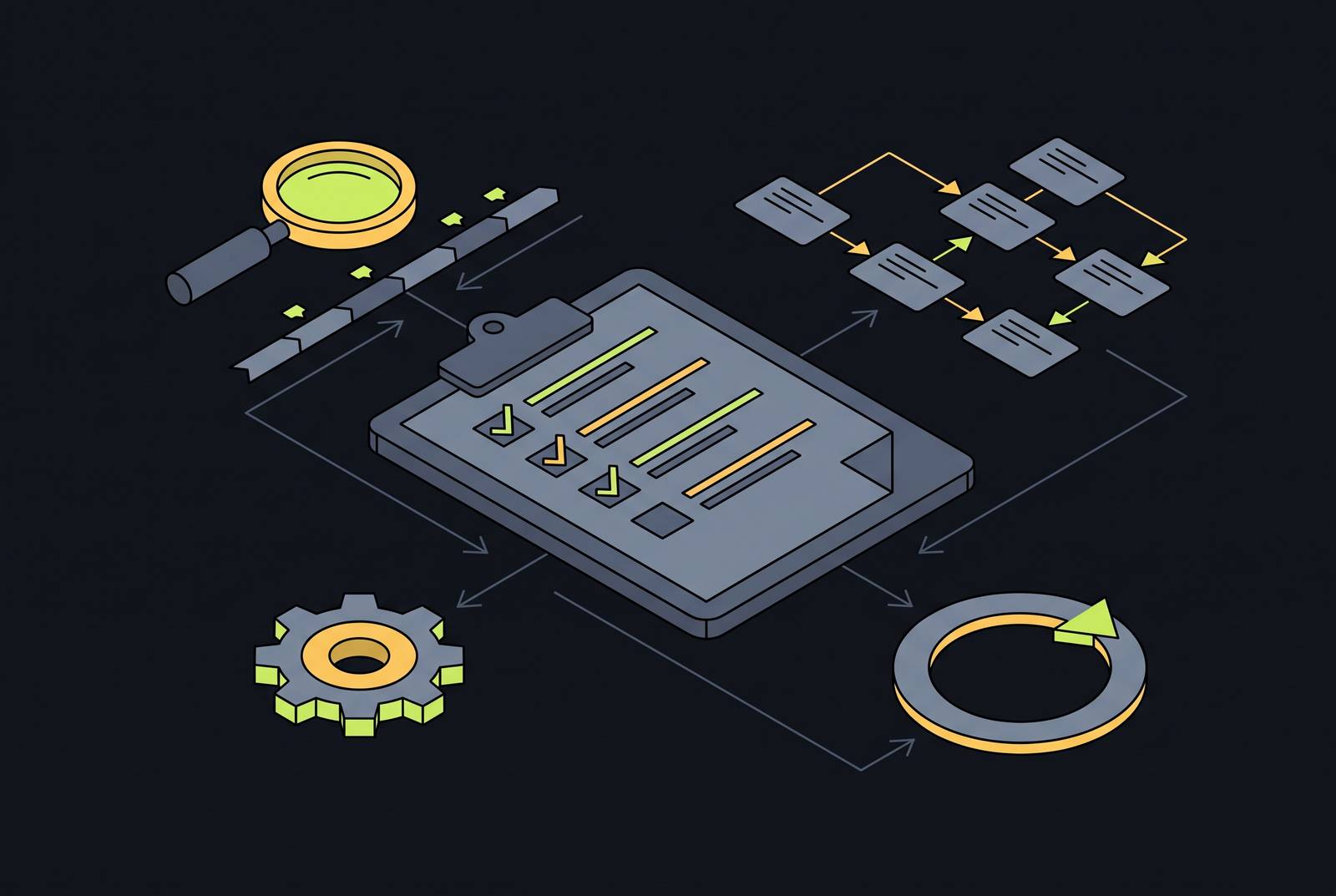
A complete postmortem template runs through eight fields, and the two most often skipped turn out to be the ones that generate the most useful learning.
The Summary states what broke, for how long, and what fixed it, in two or three sentences written for anyone in the company, not just engineers. The Timeline reconstructs onset to verified recovery with timestamps and evidence, built from logs and chat history before the meeting rather than from memory during it, written in neutral language: "the config change deployed at 14:02," not "Sam pushed the bad config."
Root Cause names the deepest systemic condition behind the failure; it does not name the person who happened to be at the keyboard when it broke. What Went Well covers detection, response, and tooling that helped, not as a morale exercise but as a record of what to preserve and keep investing in.
What Was Difficult is the first of the two under-used fields. It captures the friction that slowed the response down: a dashboard showing wrong data, access nobody had in the moment, a runbook that was out of date. Written well, this field becomes a concrete queue of work to remove friction, not a general complaint session. Action Items record owned, dated, verifiable changes, and they get their own full treatment later in this piece. Lessons Learned captures the broader, transferable takeaways for teams beyond the one that lived through the incident.
A postmortem should trigger on a defined set of conditions, not a manager's gut feeling: user-visible downtime or degradation beyond a set threshold, any data loss, on-call intervention like a rollback or traffic reroute, resolution time above a threshold, a monitoring failure, a repeated incident pattern, or a high-potential near miss. The right window to run the meeting is 24 to 72 hours after resolution, close enough that memories are fresh and logs have been reviewed, far enough out that the team has recovered and can think clearly rather than running the review in a state of adrenaline. If filling in the template takes days instead of hours, the team will quietly stop doing it.
What the Cloudflare and Anthropic postmortems show about doing this in public
Public postmortems from well-resourced, technically sophisticated organizations make the same point the template is built around: a genuinely investigative review surfaces the systemic lesson, while one written to manage reputation does not.
On November 18, 2025, Cloudflare's core network returned errors for a large share of its traffic for approximately two hours and ten minutes. The public postmortem went out the same day, under the CEO's name. Publishing the postmortem the same day as the incident is itself a signal: it says the review exists to find the system problem, not to manage the story afterward.
Between August and early September 2025, three separate infrastructure bugs intermittently degraded the quality of Claude's responses over the course of a month. The lesson here lands directly on AI startups scaling their own inference workloads: even an organization with deep engineering talent can lose control of response quality because of infrastructure issues that look minor in isolation. Infrastructure is not a solved problem at any scale, and subtle, compounding failures of this kind are exactly the class of incident a defensive postmortem culture would bury.
At Atlassian, one engineer made one syntax error in a configuration file, and the entire company went dark for 45 minutes, at a cost running into the hundreds of thousands of dollars. Because the fear wasn't there, the organization learned something much more useful: that a single syntax error should never have been able to reach production without a safeguard catching it first.
How to run the meeting without blame collapsing the conversation
The facilitator's real job in a postmortem meeting is holding the line every time the conversation drifts toward blame, and it will drift, usually within the first ten minutes.
Whoever facilitates should be trained in the format and should not have been central to the incident. Rotating trained facilitators across teams works for most incidents; for higher-stakes incidents where trust is already damaged, bringing in an outside facilitator is worth the cost.
The meeting should open with a stated contract, read aloud every time even when the team has heard it before, because the repetition is the point: the group is there to understand what happened, not to grade anyone; everyone is assumed to have acted reasonably given the information they had; the discussion covers roles and timelines, not personalities; nothing said in the room gets used in a performance review. Facilitators should not promise absolute confidentiality if the document will be shared more broadly or if legal, regulatory, or security obligations apply, and the rules on access, retention, and redaction should be stated accurately up front.
The core facilitation skill is converting blame questions into learning questions, live, as they come up. "Who owns the failure?" becomes "Which teams own the contributing conditions, and which own the resulting actions?"
Senior participants need to be held to this standard just as much as junior ones. When someone says "I should have caught it," the right response is "what would have made it catchable?" which redirects the conversation toward system design without dismissing what the person just admitted.
Skip the hunt for a single root cause; real incidents come from several conditions lining up at once, so aim for three to five contributing factors. Each of those teams has a different view of when the incident became real for them, and their timestamps make the impact section honest in a way engineering timestamps alone cannot. Their presence in the room also signals something important: this is a company-level learning event, not an engineering department ritual.
Choosing the first pilot postmortem shapes whether the team trusts the process going forward, so it deserves as much care as the review itself. Trivial incidents don't test the culture, and incidents entangled in litigation or suspected misconduct need a different forum and different expertise.
Writing action items that change something, not just document something
Most postmortem action items are never completed because of a structural gap in how they're defined. They lack a single accountable owner, a realistic due date, and a way to verify they actually happened.
Every action item needs all three. And the verification method has to be checkable: "add dashboard" cannot be verified, while "reduce MTTR for this failure mode from 45 minutes to under 15 minutes by automating rollback and validating via game day" can.
The gap between a weak action item and a strong one is the clearest signal of whether a postmortem produced real change. "Be more careful," "retrain the engineer," "remind the team," and "improve monitoring" all describe intentions rather than changes, and they make the whole review feel ceremonial. A strong action item alters a default instead: it adds automation, a guardrail, a policy, a clearer ownership boundary, or a new SLO, rather than leaning on someone's memory or willpower to not make the same mistake twice. "Block cross-region promotion when replication lag exceeds the service threshold, with an emergency override that is logged" is the kind of item that holds up under that test.
Action items belong in the same backlog as the rest of the engineering work, prioritized against everything else rather than parked in a postmortem document nobody reopens. A reasonable target is 90% of P1 action items closed within 14 days. None of this works without capacity set aside for it: a standing reliability budget per team, or a rotating stability sprint, keeps these items from competing directly against feature work and losing every time.
Most teams don't actually have a postmortem problem. They have a behavior change problem: the document gets written, the meeting happens, and the same class of incident recurs anyway, which is exactly what the action item section is built to break.
The cultural practices that make honesty feel safer than silence over time
Psychological safety has a tendency to erode as teams grow, and junior engineers in particular become more risk-averse and less likely to surface problems as headcount increases.
Leadership behavior is the single variable that matters most here. Delegating all of that to a facilitator and staying silent sends the opposite signal from the one intended.
What happens after the meeting carries as much weight as what gets said during it. Engineers who come to treat every incident as a potential career event grow risk-averse, defensive, and eventually disengaged, which is a reliability problem as much as a people problem: a disengaged on-call engineer responds slower and less accurately than one who feels safe.
Postmortem triggers should be published before an incident happens, not decided afterward at a manager's discretion. Incidents that almost tipped into full failure but didn't should trigger lightweight reviews of their own, because on low-trust teams, most close calls go unmentioned. Those are the early warnings someone noticed and sat on.
The long-term goal is organizational memory: new engineers reading through incident history as part of onboarding, and past postmortems actively shaping how future systems get designed. Three metrics make the health of this culture visible from the outside: repeat-incident rate (the same failure mode recurring within 90 days), action-item completion rate measured against due dates, and MTTR trend by incident class. A compliance-theater program shows flat or worsening numbers despite a long list of postmortems on file.
What this looks like in practice for a startup without a dedicated reliability team
A startup without a dedicated DevOps or SRE team can run this practice well, but only if the infrastructure underneath it cuts down the amount of manual reconstruction the team has to do after every incident.
Choosing the first pilot postmortem well avoids setting the culture back further than never having a process at all, so pick something meaningful enough to be worth the exercise, with enough evidence to reconstruct and multiple contributing conditions worth discussing, and with participants who are actually willing to try the format, rather than the most politically charged incident on record or one too trivial to test anything.
The cost of reconstruction itself is where the connection to infrastructure is most visible. The time it takes to piece together what happened during an incident is real and measurable, and tooling that automates deployment tracking, alert routing, and rollback cuts both the time to recover from an incident and the time it takes to reconstruct it afterward, lowering the overhead of running a postmortem. The team closest to that kind of failure usually senses something is wrong before any formal trigger fires, and they will only say so in an environment where saying so doesn't put them at risk.
Platforms that run production environments directly inside a customer's own AWS, GCP, or Azure account, with automated CVE patching, deployment tracking, and one-click compliance, cut down the archaeology that makes postmortems feel expensive in the first place, and reduce the operational surprises that tend to generate the most damaging incidents to begin with.
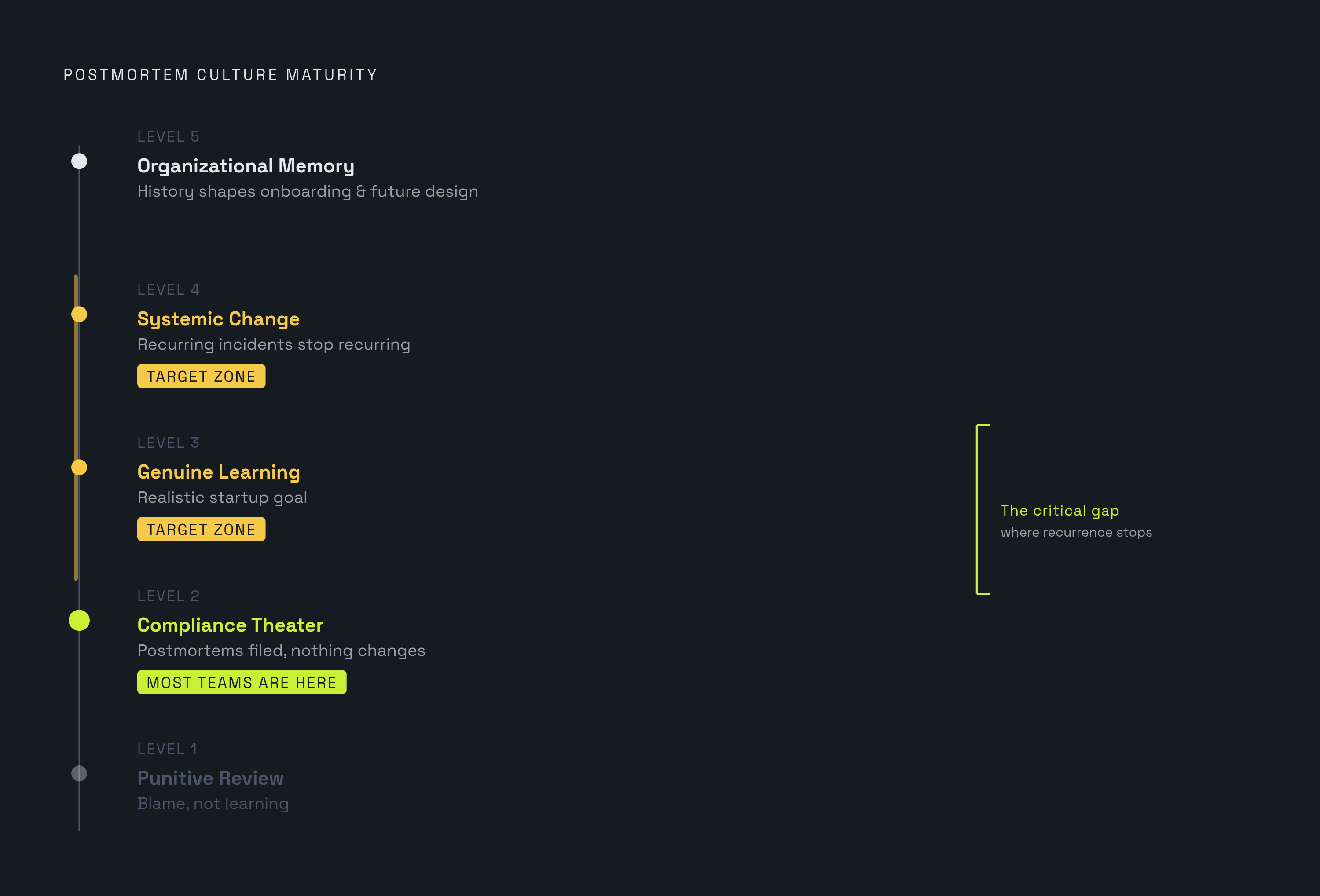
The maturity ladder this entire practice moves along runs from Level 1, punitive review, through Level 2, compliance theater, where most teams actually sit. Level 5 is organizational memory, where incident history actively shapes onboarding and future design decisions. For a startup building this practice from scratch, the realistic goal is reaching Level 3 consistently and building toward Level 4, since that's the level where recurring incidents actually stop recurring.