Autoscaling Configuration for Unpredictable Traffic Spikes
Tune reactive scaling's levers to handle traffic your system can't predict.
How reactive scaling works and where its configuration levers are
Autoscaling has one job: match capacity to demand without a human touching a dial. It fails at that job constantly, because no single scaling mechanism covers every shape of traffic spike. The fix is layering three mechanisms, reactive scaling, predictive provisioning, and pre-warming, so each one catches what the others miss.
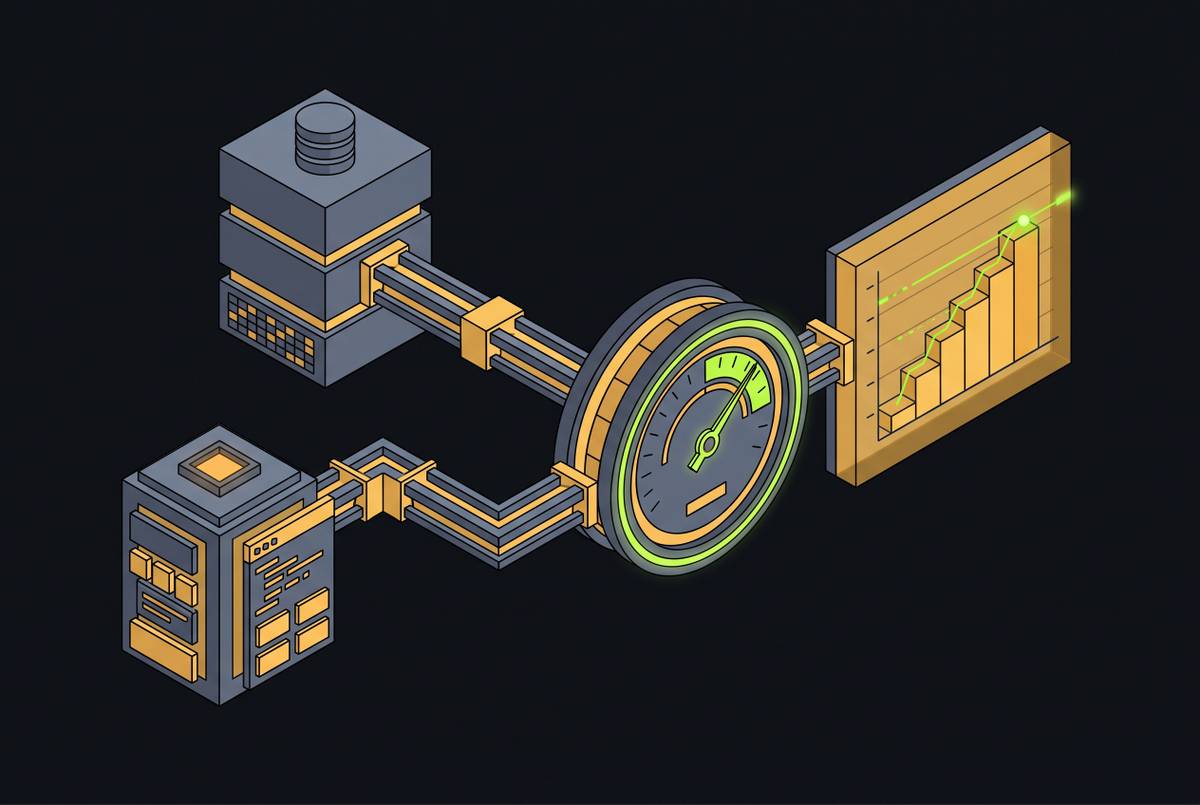
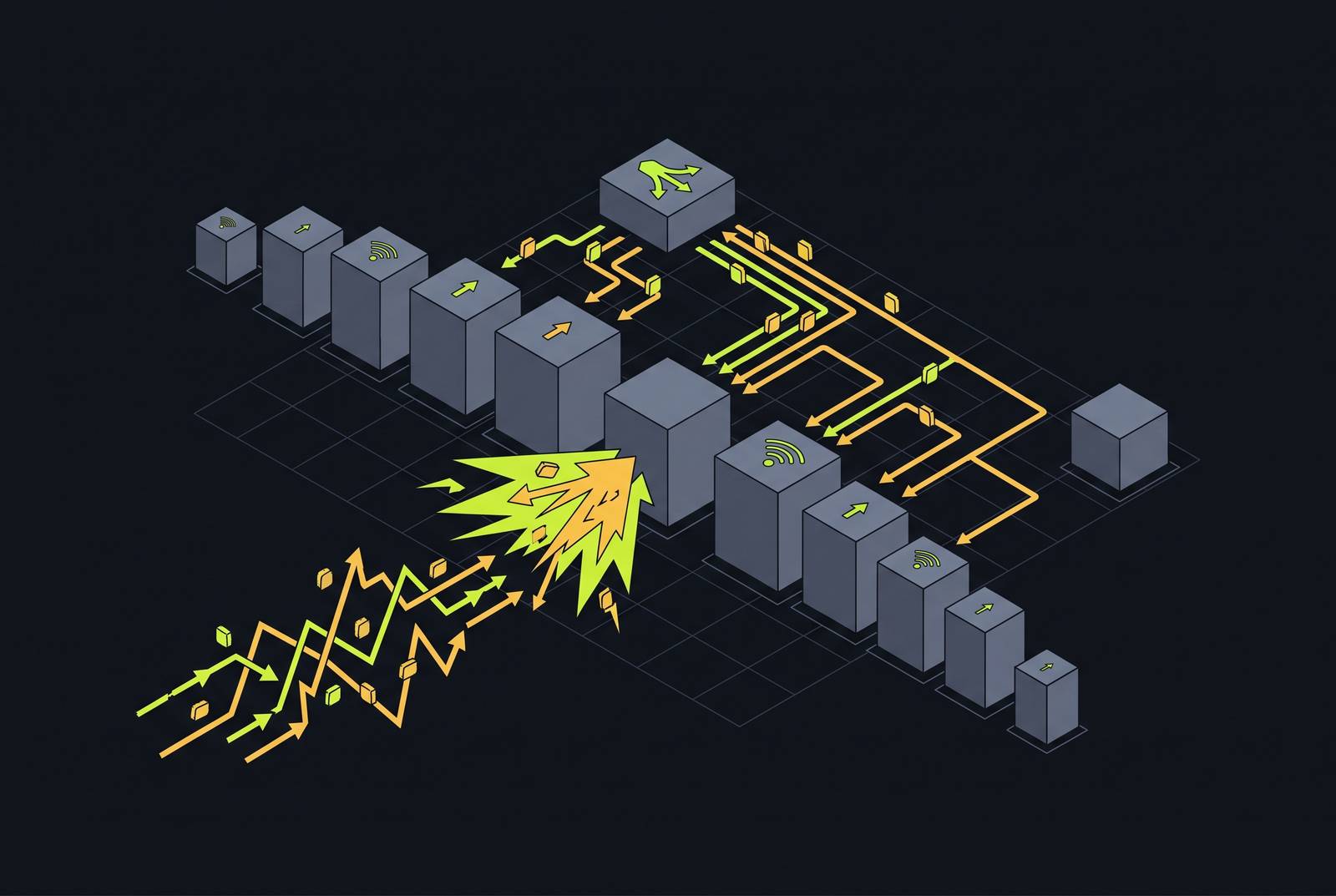
Start with the feedback loop, since it explains everything downstream of it. Autoscaling reacts to a metric that already moved. Traffic rises, CPU or request count crosses a threshold, and only then does a scaling decision fire. That decision doesn't produce capacity instantly, either. A new instance has to launch, boot, run its bootstrap scripts, and pass health checks before it takes a single request. A common container orchestration platform checks metrics every 15 seconds by default and waits a 300-second stabilization window before scaling down, and that sluggishness is deliberate, built to stop the system from thrashing up and down. Managed inference endpoints can take anywhere from 30 seconds to a few minutes just to load a model into memory before a new replica serves anything. By the time fresh capacity is healthy, the spike that triggered it has often already passed, or the error rate has already climbed past the point anyone's happy with.
Whether that lag matters depends on the workload, and here's where most teams get the tradeoff backwards: they tune every service for speed when only some of them need it. A batch pipeline can shrug off a 5 to 10x latency swing during a burst and still come out ahead on cost. A login endpoint can't. A stalled auth service doesn't just annoy the people trying to sign in, it backs up every downstream call waiting on that token, and a slow spike turns into a full lockout.
Spikes come in three flavors, and only one of them plays nice with reactive scaling. Scheduled events, a product launch or a marketing push, are known in advance, so the lag is avoidable if someone acts early. Recurring patterns, business hours, weekend lulls, seasonal peaks, appear in historical data and can be forecast with a reasonable model. Then there's the genuinely unpredictable spike: a post that goes viral, breaking news, a competitor's outage sending its traffic your way. No historical signal exists for that one. Reactive scaling alone gets treated as sufficient far more often than it should. Only a system built from multiple layers has a real shot at absorbing it.
Reactive scaling, stripped down, is a loop: check a metric on some interval, compare it to a threshold, fire a scaling action if it's crossed, then wait for new capacity to come online. A handful of levers set its behavior. Min and max replica counts set the floor and ceiling the autoscaler can move within. The utilization target, CPU or GPU, decides when a scaling event actually triggers. Cooldown and stabilization windows exist to stop the system from flapping every time a metric wobbles, but that protection comes at the direct cost of responsiveness.
Very different treatment is warranted for scale-up and scale-down. Scale-up should be aggressive: a stabilization window of 0 paired with a policy that doubles pod count every 15-second window gets capacity online fast. Scale-down should be cautious: removing at most two pods at a time with a 300-second stabilization window keeps a temporary dip in traffic from gutting capacity that'll be needed again ten minutes later.
The metric picked to trigger scaling matters more than how tightly the threshold gets tuned. CPU utilization works fine for steady, request-driven services, but it lags on anything bursty, since CPU rises after load hits, not before. Request count responds faster for web traffic and worker queues, scaling on something concrete like a custom metric set at a fixed requests-per-second threshold. For inference workloads, GPU duty cycle reflects actual model saturation in a way CPU never will, because a GPU can sit nearly maxed out while CPU barely registers.
Configuration should match the traffic shape it's built for. Bursty, unpredictable traffic wants a lower CPU target, around 40%, so scaling kicks in early, plus a high max replica ceiling so there's runway once it starts. Latency-sensitive services want a higher floor, several minimum replicas held warm at all times, a conservative target, and bigger machine types, so existing capacity absorbs the first wave before anything new has to spin up. Predictable daily patterns can run a more relaxed target, with min sized to baseline load and max sized to known peak.
Scheduled scaling: eliminating lag for spikes you can see coming
Scheduled scaling skips the feedback loop entirely for events already on the calendar. Instead of waiting for a metric breach, a scheduled action changes minimum size, maximum size, and desired capacity at a fixed time, setting a floor before traffic shows up rather than after.
The discipline that makes this work is timing the trigger early enough. Scaling up at the exact moment traffic arrives defeats the purpose, since instances still need to launch and pass health checks. The scale-up has to fire with enough lead time that capacity is already healthy by the time the wave hits, not still booting when the first request lands.
Recurring scheduled actions handle weekly rhythms well: bump minimum and desired capacity every weekday morning, scale back down in the evening, leave weekends at a lower floor. One-time scheduled actions cover singular events. A major seasonal traffic surge might raise both minimum and maximum well above normal, starting a defined window before the event actually begins.
Scheduled and reactive scaling aren't competing strategies. Scheduled and reactive scaling aren't competing strategies; they stack. The scheduled action sets a hard floor, and dynamic target-tracking handles whatever variance shows up above it. If a scheduled action sets the minimum to 10, reactive scaling can't pull the fleet below 10, even if CPU utilization drops to zero. That's the right division of labor: scheduled scaling owns the predictable baseline, reactive scaling handles the deviation on top of it.
Predictive scaling: using historical patterns to provision before the signal exists
Predictive scaling picks up where scheduled scaling can't reach. It doesn't need someone to type in a specific date and time. It learns recurring patterns from historical metrics and pre-provisions capacity ahead of the breach, based on what usually happens at that hour on that day.
The major cloud providers now ship native ML-driven forecasting, though the data requirements differ. All of them require a meaningful baseline of historical data before their forecasts are useful, and all of them get more reliable with more history behind them, CPU, request rate, custom business metrics, stored in a time-series system, and patterns become genuinely trustworthy only once a substantial body of observability data has built up. Trying to lean on predictive scaling with a week of noisy data is how teams end up with a forecast that's confidently wrong.
Kubernetes doesn't ship this out of the box: native HPA has no forecasting layer built in. KEDA, paired with external scalers, can pull ML forecasts from a Prometheus adapter to approximate predictive behavior, but that's a deliberate bolt-on, not a default anyone gets for free.
Pre-warming: eliminating cold-start penalties for the capacity you've already provisioned
Pre-warming solves a problem that's easy to wave away: an instance can exist and still not be ready to do anything. Warm pools and provisioned concurrency keep capacity initialized ahead of time, so there's no cold-start tax the moment a spike lands.
Warm pools exist for exactly this reason. Launching a fresh instance from a base image, then running bootstrap scripts, can leave it unable to serve traffic for several minutes after the scaling decision fires. A warm pool holds pre-initialized instances that skip that entire boot-and-configure sequence, so they're ready almost immediately instead of minutes later.
Provisioned concurrency does the equivalent job for serverless functions: it keeps execution environments initialized, removing the cold-start delay that would otherwise hit the first request after any stretch of idle time.
For known events, pre-warming can also just be a scripted routine run ahead of time. Thirty to 60 minutes before a scheduled traffic event, scale deployments up manually to the expected peak, confirm the rollout is actually live, then hit key endpoints directly to warm caches. Confirm readiness before traffic shows up. Scrambling to confirm it during the spike defeats the point.
How the three layers compensate for each other's blind spots in a production configuration
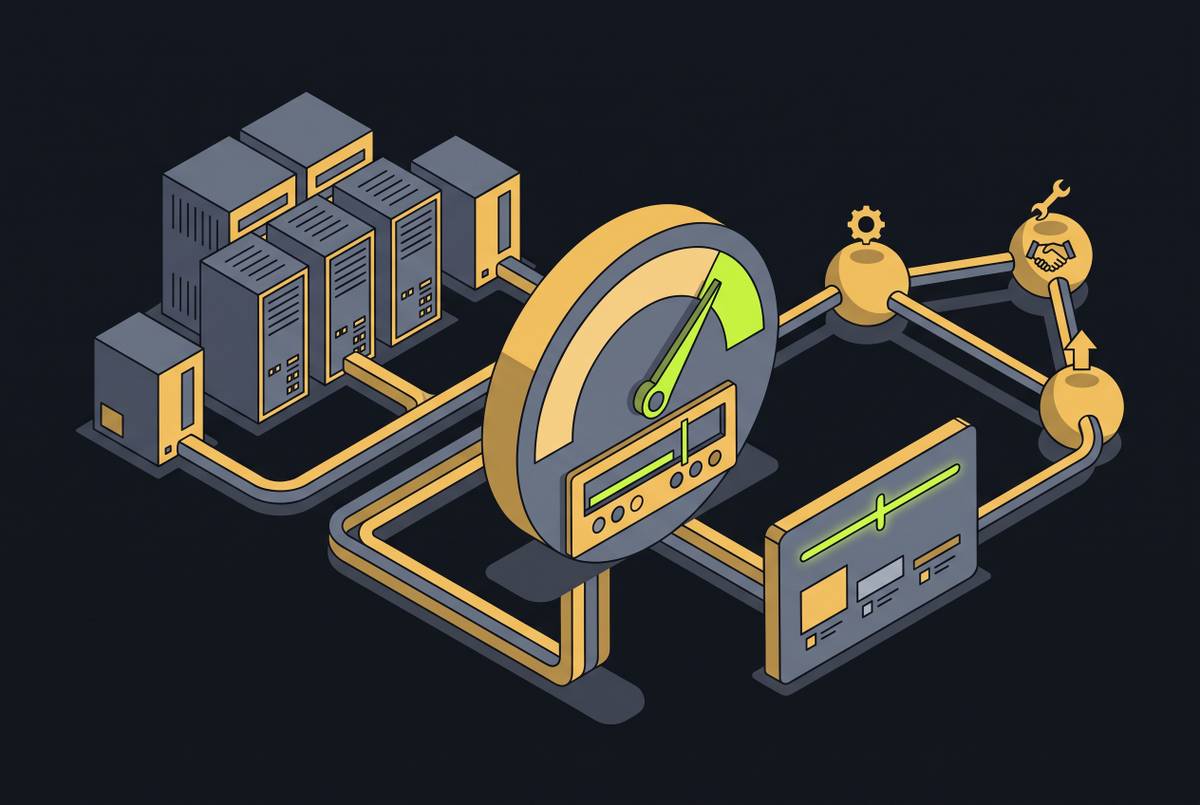
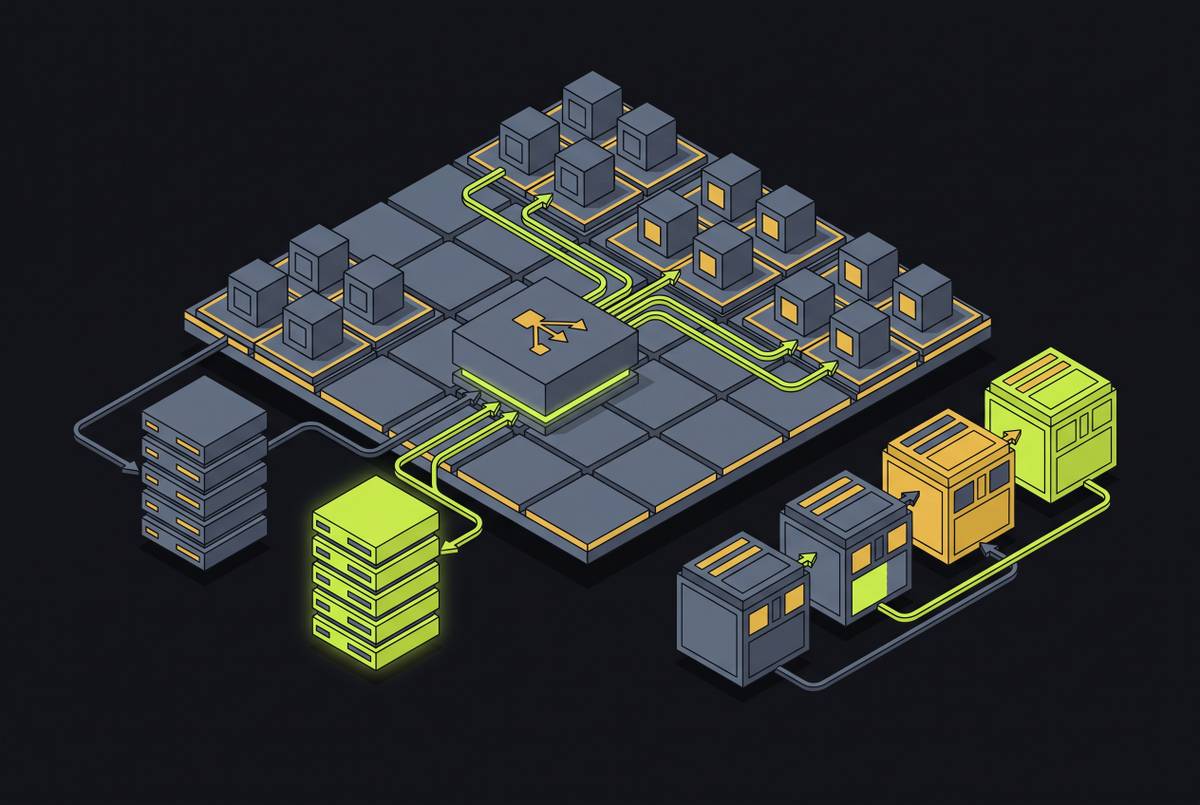
Scheduled scaling sets a floor for events known ahead of time. Predictive scaling catches recurring patterns that don't fit a fixed schedule. Reactive scaling absorbs whatever deviates above that floor. Pre-warming makes sure whatever capacity the first three layers stood up is actually ready to serve the moment traffic lands, not still booting somewhere in the background.
A hybrid setup, baseline capacity held steady, predictive scaling for known patterns, reactive scaling as the fallback for anything unexpected, tends to match the response speed of a pure predictive approach while holding onto the cost efficiency of a pure reactive one. The tradeoff is real added complexity, since three systems now need to agree on exactly where the floor sits, and nobody should pretend that coordination is free.
Each layer has a specific blind spot only another layer can cover. Predictive and scheduled scaling both fail when an event has no historical signal and no defined start time, which is what a viral spike looks like from the inside. Reactive scaling alone fails because its feedback loop only starts after the spike begins, and provisioning lag makes the response arrive late no matter how tightly it's tuned. Pre-warming by itself isn't a scaling strategy at all: it only produces value for capacity that's already been provisioned, and without the right floor set beneath it, warm instances just run out faster than expected. Running all three together puts the floor at the right level, lets reactive scaling absorb the variance on top of it, and lets pre-warming guarantee that floor is actually serving traffic from the first second the spike arrives, not five minutes into it.
A scheduled action's minimum size becomes the reactive controller's lower bound. These aren't independent settings sitting side by side on a dashboard. They compose in a strict hierarchy, and treating them as separate knobs to tune in isolation is how gaps open up between them.
Autoscaling for GPU and AI inference workloads, where the stakes are higher
Inference, not training, has become the dominant cost center in AI infrastructure, and treating GPU capacity like any other compute resource raises the bill first. GPU capacity runs several dollars an hour depending on the hardware class. Sized for peak demand and left running idle the rest of the time, that's not a rounding error. It's a real, compounding cost that grows every month a fleet sits oversized.
GPU-backed endpoints need their own scaling signal, full stop. CPU utilization doesn't reflect how saturated a GPU actually is: a model can run the accelerator flat out while the CPU barely registers anything. Scaling on GPU duty cycle instead, with a target around 70%, leaves enough headroom to absorb a burst before the endpoint hits its ceiling.
Model load time is inference's version of the cold-start delay, and it's worse than the software cold starts most engineers are used to. A new replica can take 30 seconds to a few minutes just to get a model loaded into memory before it serves a single request. That fact alone makes pre-warming and a non-zero minimum replica count close to mandatory for anything latency-sensitive. Setting the minimum replica count to 0 to save on idle GPU cost sounds reasonable on a spreadsheet. In practice it turns every cold start into a multi-minute stall, which is a far heavier penalty than a typical application cold start ever imposes, and no cost savings on paper is worth an inference endpoint that takes three minutes to answer its first request.