Incident Severity Classification for Small Engineering Teams
Small teams need severity rules that eliminate guesswork when alerting matters most.
It's 2 AM. The on-call engineer is staring at a dashboard, trying to answer one question: how bad is this? That question, asked under stress, with half-formed context and no one else awake to help, is where most severity frameworks quietly fail. Small engineering teams don't fail at incident severity classification because the concept is wrong; they fail because the frameworks they inherit assume infrastructure they don't have: dedicated on-call rotations, a full SRE function, layers of escalation that route a problem to the right person automatically.
The failure shows up in a specific way. The process exists on paper. A document somewhere lays out severity levels, response times, escalation paths. But paper doesn't help a stressed engineer at 2 AM who is context-switching between the dashboard, the incident channel, and a half-remembered runbook. If a process depends on someone remembering to follow it, it breaks at the worst possible moment, and that moment is always the one where the stakes are highest and the margin for error is lowest.
The quieter, more common failure doesn't look like a catastrophic outage. It looks like erosion. Without written severity definitions, everything gets marked high priority, and once that happens, the label stops carrying information. The 2026 Incident Response Benchmark names exactly this as the dominant failure at this stage: no written severity definitions, everything is "high priority," and the label means nothing. Engineers either freeze, unsure how seriously to treat an alert, or over-escalate, waking people who didn't need to be woken. The matrix that was supposed to guide decisions lives in one person's head instead, and when that person is out sick or on vacation, the system has no memory.
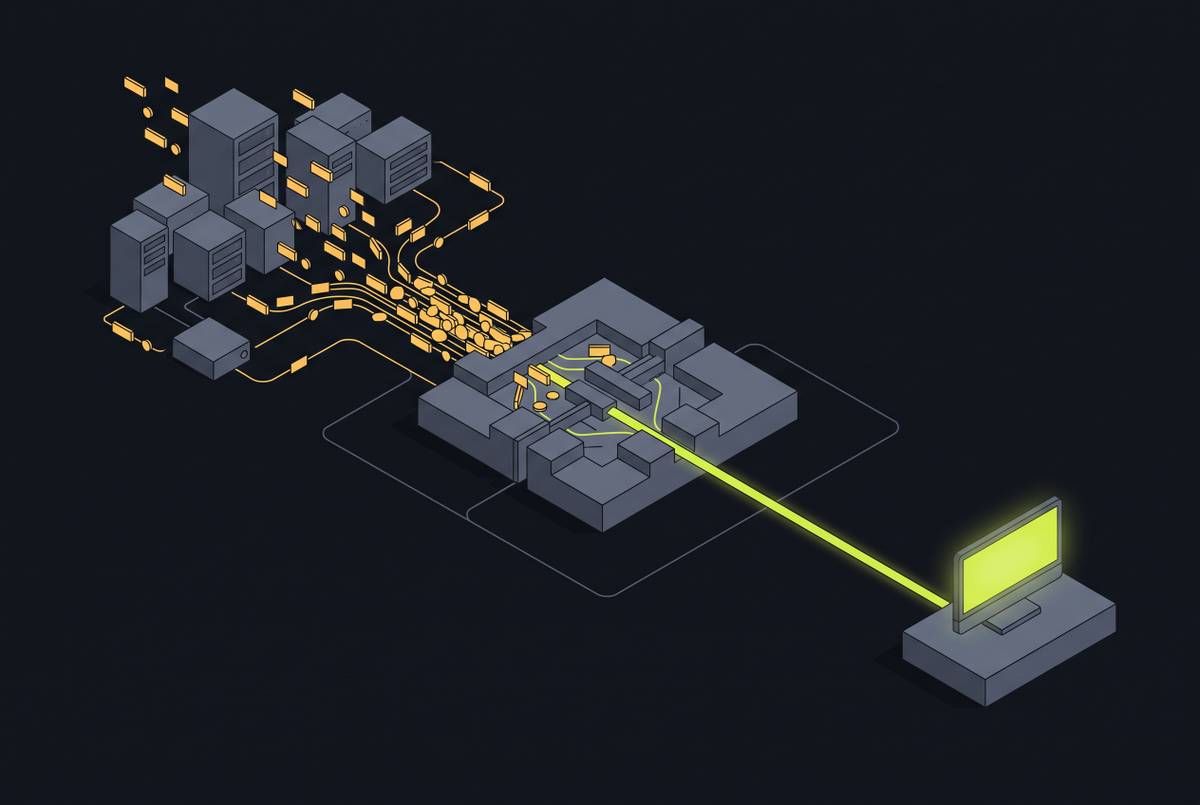
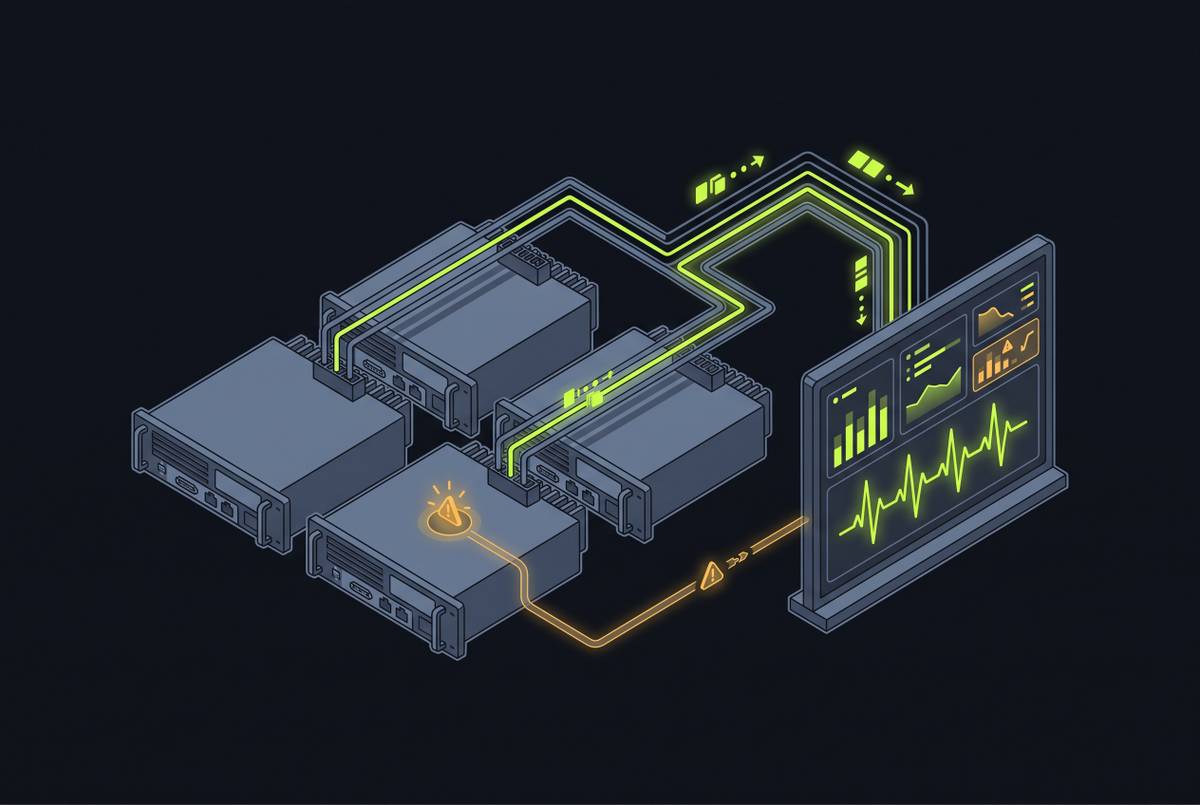
Two forces make this worse for lean teams specifically. Alert volume has outrun what a small team can manually triage, so a high weekly volume of alerts, where only a fraction actually demand immediate action, buries the real signals under noise. When there's no severity discipline to separate the two, the result is alert fatigue, and alert fatigue is exactly the condition under which a genuine SEV1 blends into the background. A county IT team illustrates the pattern clearly: alerts got redirected into Slack, the team was too exhausted to tell false positives from real ones, and a breach went undetected. That's a failure of classification, not vigilance, built up alert by alert until the system couldn't distinguish signal from noise anymore.
What a severity framework must do
A severity label that only answers "how bad is this" isn't doing enough work. Tell a team that something is a SEV1 and leave it there, with no attached consequence, and the label is decoration. A real severity framework has to serve five distinct jobs at once, and most of the frameworks small teams inherit only attempt the first.
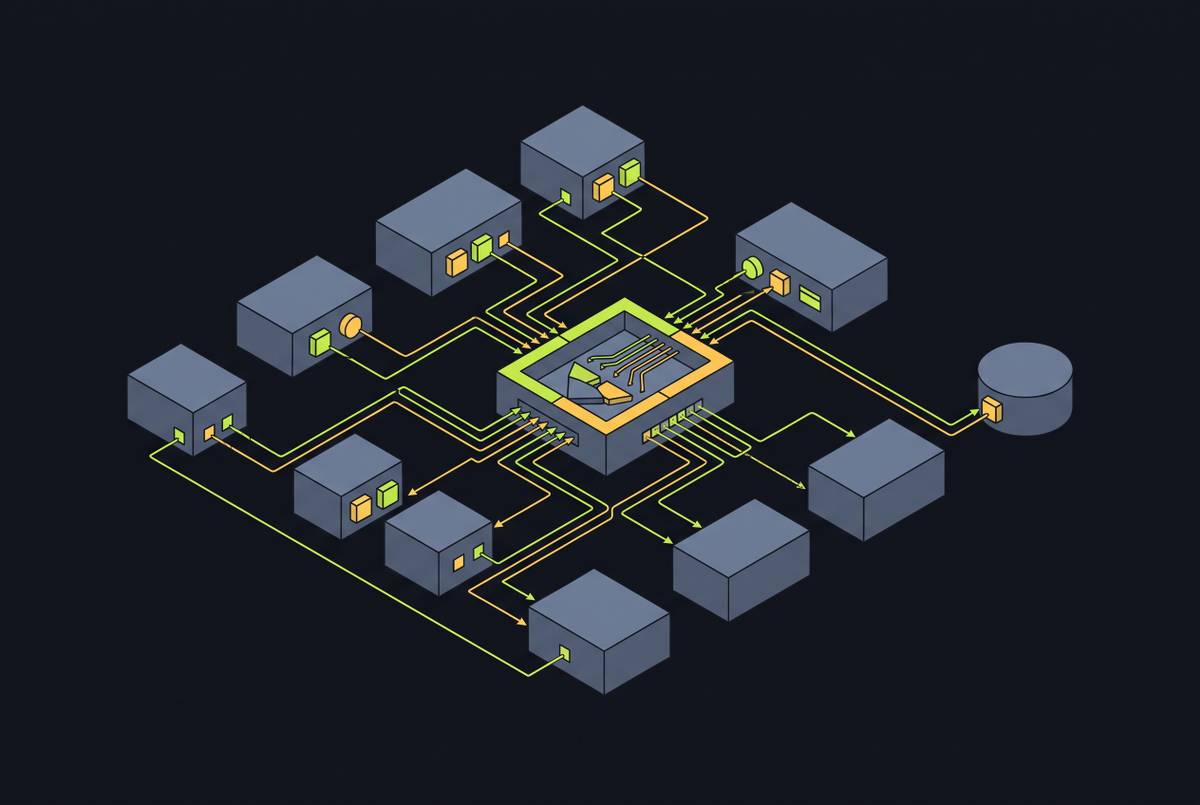
The first job is calibrating the response automatically. Severity should determine who gets paged, what gets communicated, which runbook applies, and whether an incident commander gets pulled in. If the severity level doesn't change any of that, it isn't functioning as a severity level, it's just a tag.
The second job is consistency across engineers. Two engineers looking at the same incident, independently, should land on the same severity. When they don't, the criteria are too subjective, or there are too many categories with boundaries that blur into each other. That inconsistency doesn't stay contained to the moment of classification either: it corrupts MTTR numbers downstream, making response times look like they varied when really it was the severity assignment that varied.
The third job is resisting severity inflation. Teams drift. What was a SEV2 six months ago starts getting treated as routine, and the next incident that looks like it gets quietly upgraded to SEV1 because the team's baseline for "serious" has shifted. A framework built on anchor criteria, fixed points that don't move with the team's mood or fatigue, is what keeps that drift from happening.
The fourth job is managing expectations outside engineering. When a SEV1 gets declared, product, customer success, legal, and leadership should already know what that means: who gets involved, what gets communicated, what the timeline looks like. None of that should need explaining in the moment. It should be agreed on in advance, in language everyone already understands.
The fifth job is enabling honest post-incident analysis. "SEV1 incidents by quarter" is a useful number only if a SEV1 in the first quarter means the same thing as a SEV1 in the fourth. Severity inflation doesn't just annoy people in the moment, it quietly invalidates every trend report built on top of it.
Give the same incident description to three engineers, one from the affected service, one from an adjacent team, one from somewhere else entirely, and ask each to classify it independently, as a test of whether any of this is actually working. If all three land on the same severity, the framework is doing its job. If they diverge, the framework carries more subjectivity than it looks like, and everything built on top of it, metrics, escalation paths, stakeholder trust, is less reliable than it appears.
Why qualitative criteria fail the consistency test
When two engineers classify the same incident differently, the cause is almost always the same one: the criteria are written as opinions instead of measurements, and opinions diverge under pressure.
Take a phrase like "significant user impact." It's a judgment call that the engineer has to form from scratch, at 2 AM, under stress, with incomplete information, not a real criterion. Different engineers, even good ones, form different judgments from the same facts. It's a design problem built into the wording itself, not a training problem.
Qualitative thresholds force every single classification decision to be rebuilt from first principles by whoever happens to be on call that night. That rebuilding is exactly the cognitive load a severity framework exists to remove. A framework that still requires judgment at the moment of maximum stress has shifted the hard part of the job onto the person least equipped to do it well in that moment.
The fix is to anchor severity to numbers wherever numbers exist. An error-rate threshold sustained for a defined duration on a tier-1 service is measurable straight from a dashboard. The engineer reads a number off a screen and compares it to a line that's already drawn, instead of interpreting a feeling about how bad things seem.
Severity also needs to track impact, not effort. A one-line config fix that resolves a SEV1 doesn't retroactively make it a smaller incident. It was a SEV1 the moment the impact occurred, and it stays a SEV1 on the record even after the fix takes thirty seconds. The same logic runs the other way: a SEV3 that takes a week of refactoring to properly resolve doesn't become a SEV1 just because the fix is slow. Keeping severity tied to impact instead of effort closes off a tempting shortcut: the instinct to think "I can fix this in a few minutes" and use that as a reason to avoid declaring a SEV1. That instinct, left unchecked, quietly erodes the whole system from the inside.
Fully quantitative criteria are harder to write up front, and some failure modes resist clean numeric thresholds. That's a fair objection, but it argues for partial quantification, not none. Anchor the thresholds that matter most, revenue impact, the percentage of users affected, sustained error rates, even if some edge cases still need judgment. Document those edge cases as worked examples rather than trying to write a rule for every possible scenario. A framework that's mostly numeric with a smaller share left to judgment is still far more consistent than one that's entirely a matter of feel.
How many severity levels a small team needs
The most common way severity frameworks fail isn't carelessness, it's complexity. Too many levels, with boundaries that blur into each other, recreate the exact classification paralysis the framework was supposed to eliminate.
For a team under roughly 50 people, three levels are enough to start: SEV1, SEV2, SEV3. SEV0 and SEV4 can be added later, once the team's operational maturity and incident volume justify the extra granularity. One CTO voice captured the principle bluntly: don't over-engineer day one, SEV0 and SEV4 can always be added later. Every level a team adds before it's needed is another boundary someone has to argue about at the worst possible time.
Start the scale at zero instead of one. SEV0 meaning zero room for error reads more intuitively than SEV1 sitting at the top of a one-indexed scale, and teams that adopt this convention report fewer arguments over what belongs at the top category. A SEV0 through SEV4 scale is clearer for this reason than a SEV1 through SEV5 scale carrying the same five levels.
The distribution a healthy framework produces is lopsided on purpose: a small share of incidents is SEV1, a moderate share is SEV2, and the bulk is SEV3 and below. When that distribution inverts, something has gone wrong with the classification, not with the team's luck. A 2025 study on microservice decomposition found that roughly 61% of incidents got classified as high-severity. A distribution like that is a sign of severity inflation, not a uniquely dangerous system, and it strips the framework of its analytical value entirely, because "high severity" has stopped meaning anything specific.
A criteria-driven SEV0–SEV3 matrix built for lean teams
Every severity level needs four things nailed down before an incident ever fires: the customer impact that triggers it, who responds and how fast, whether anyone outside engineering gets notified, and the single question that marks the boundary with the level below it.
SEV0 covers the catastrophic cases: a complete outage, data loss, a confirmed security breach, or a critical failure hitting revenue directly, with no workaround available. Everyone gets woken up. A war room opens immediately. External communication goes out without delay. Concrete examples include database corruption with data loss, a multi-region outage where the backup region also fails, authentication completely broken so nobody can log in, and payment processing down. The useful anchor here is quantitative: define a revenue-loss-per-hour threshold, or a percentage of users affected, that triggers SEV0 automatically, so the judgment call is already made before the incident happens. For a lean team, SEV0 is specifically the level that pre-authorizes waking up the CEO. That decision belongs in the runbook, decided in advance, not negotiated at 3 AM while the clock is running.
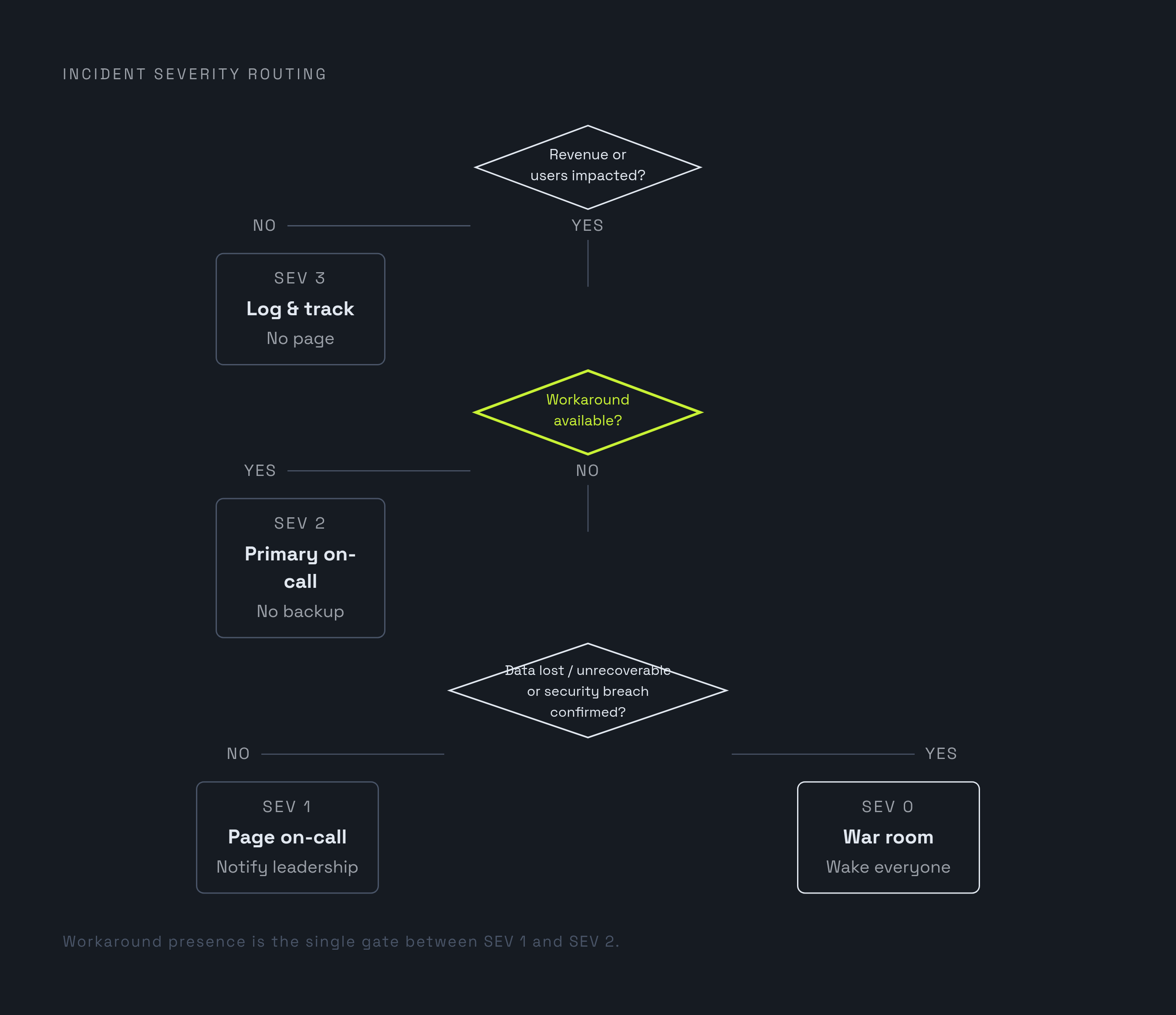
SEV1 covers a core service going down: major impact, the core service unavailable for most or all customers, no workaround available. On-call gets paged immediately, leadership gets notified, and customer communication is likely. Examples include checkout completely broken, an API totally down, or authentication failing intermittently for a meaningful chunk of users. The boundary question that separates SEV0 from SEV1 is simple: is data lost or unrecoverable, or is a security breach confirmed? If yes, the incident escalates to SEV0 regardless of anything else.
SEV2 covers degraded service with a workaround still available: a meaningful subset of customers affected, or core functionality degraded but still usable. Primary on-call handles it without waking the backup, and stakeholder updates can wait for business hours. The single question that separates SEV1 from SEV2 is whether a workaround exists. Checkout completely broken is a SEV1. Search down while category browsing still works is a SEV2. Other examples include checkout failing for some users because of a payment gateway issue tied to specific cards, file uploads broken while existing files stay accessible, and an API that's materially degraded but still lets users complete key workflows.
SEV3 covers minor, partial failures with limited impact and no urgency: fixed during business hours, no paging, logged and tracked like any other backlog item. Examples include broken profile pictures, intermittent errors that resolve on their own, and delayed reporting. SEV3 also acts as a pressure valve for the whole system. A team that can confidently downgrade an incident to SEV3, without second-guessing itself, has a framework that's actually working. A team without a credible SEV3 option defaults everything upward instead, and that's how severity inflation starts.
SEV4, added once a team is ready for it, covers proactive work: a pre-emptive fix for something that could break, treated as a backlog item with a due window and no paging attached. Many incident management tools built for startups skip SEV4 tracking entirely, because most teams haven't reached the operational maturity needed to track "could break" work systematically. Many teams reasonably defer this. Adding SEV4 before a team has stable practice with SEV0 through SEV3 just adds another boundary to argue over.
Pre-making every decision that would otherwise be made under pressure
A severity matrix only earns its keep if the decisions it's meant to replace, who gets paged, when to escalate, whether to tell anyone outside engineering, are already settled and attached to each level before anything breaks. The matrix itself is static. Its value comes entirely from how automatically it gets applied in the moment.
Every severity level needs pre-attached answers to at least four questions. Who gets paged, and in what order, primary on-call, then backup, then the engineering lead, then an executive if it escalates that far? What communication goes out, to whom, and within what window of time? Which runbook applies, and where does the responding engineer find it without searching? And when does the incident commander role switch on?
Getting an incident classified quickly matters as much as classifying it correctly. A fast triage shortcut comes down to two questions: is revenue or are users impacted, and is there a workaround? Those two questions, answered in sequence, route an engineer to the right severity level without requiring a judgment call built from scratch. That's the entire purpose of building the matrix in the first place: to make sure the hardest thinking happens in a calm room, in advance, instead of at 2 AM, with a dashboard glowing and a decision that can't wait.