Runbook Design for Common Production Failure Scenarios
Build runbooks for specific failures with executable steps, not architectural explanations.
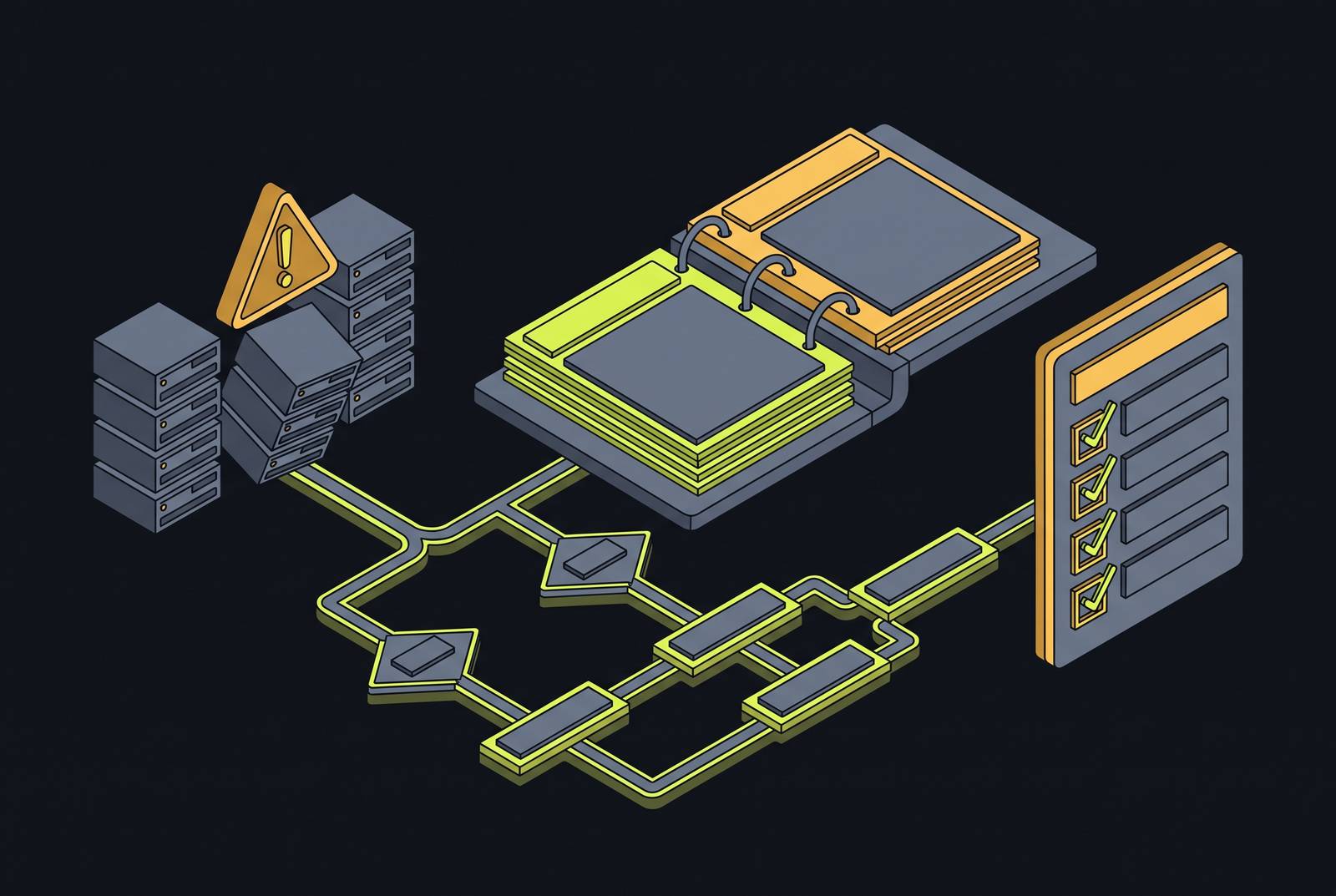
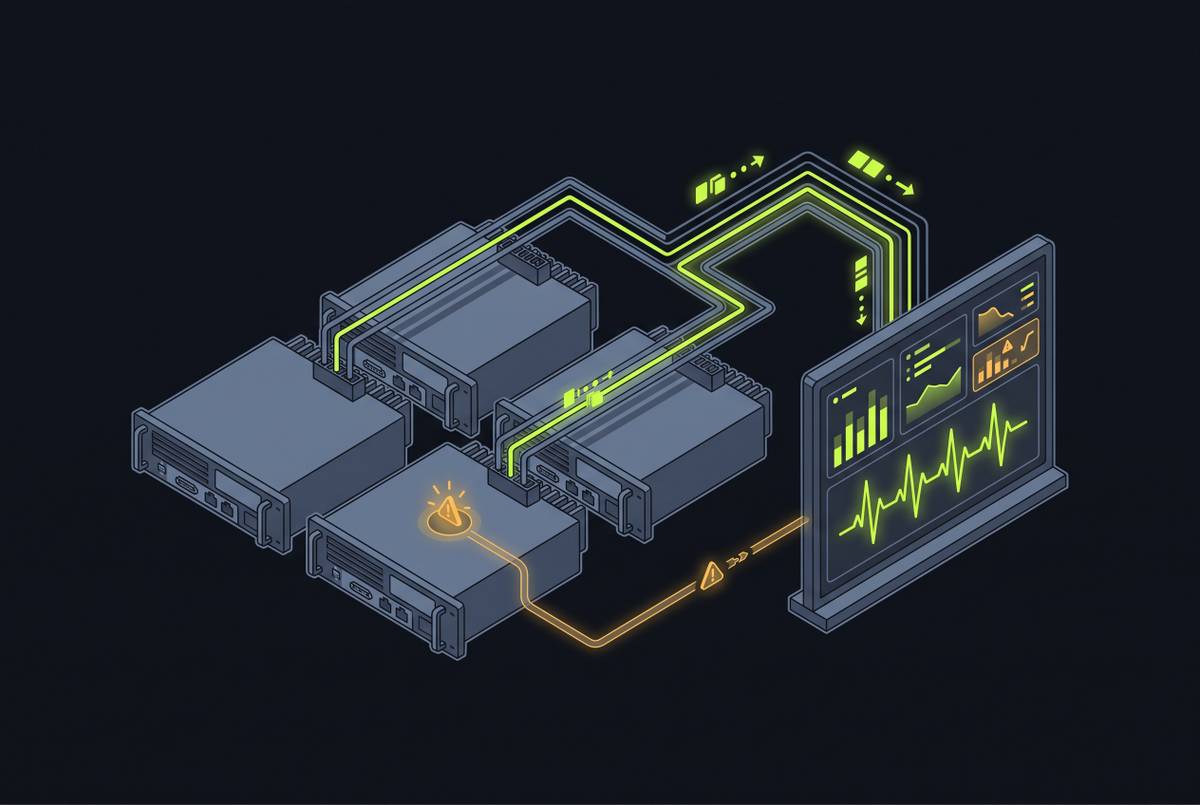
The pager fires at 2 AM. The dashboard is red. The on-call engineer opens the runbook and the first line reads "check the primary database health," except the database connection is already timing out and the next three steps assume a healthy connection to run diagnostic queries against. The document was written to explain the system, not to get someone through a failure. That's the actual problem with most runbook programs: not that teams lack documentation, but that the documentation on hand was built for comprehension instead of execution.
A document written for comprehension can afford architectural background, the history of why a service was designed a certain way, the tradeoffs considered two years ago. An engineer holding a pager at 2 AM skips it, and in skipping it, misses the setup step buried in paragraph three that the rest of the procedure depends on.
Incident duration measures the cost: a connection pool exhaustion event that should take twenty minutes to resolve stretches into hours because the fix lives in one engineer's head and nowhere else in a form a second person could follow under pressure. That gap between what a team knows and what a team has written down in executable form is the entire argument for runbooks done right. Everything that follows in this piece is about closing it.
One failure mode per document
A runbook that covers one failure mode can be followed start to finish without interpretation. An on-call engineer needs that when the alert fires at 2 AM and the next sixty seconds decide whether the fix lands clean or makes things worse.
One document, one failure mode, means zero time spent figuring out which part of the document is relevant.
Four categories of operational documents exist for a reason: diagnostic, remediation, deployment, and maintenance. Runbooks, playbooks, and SOPs (the policy-level documents that govern a process rather than a single technical event) each serve a different purpose, and grabbing the wrong one during a P1 incident costs real time at the worst possible moment.
The structural components every scenario-specific runbook must carry
A runbook missing any of the pieces below has a gap that appears at the worst possible moment, because each piece exists to prevent a specific, documented way runbooks fail without it.
Every runbook needs a metadata header: a title, a version number, an owner (a named individual, not "the team"), a risk level, an estimated duration, the alert name it's tied to, and the paging channel. A runbook owned by "the team" is owned by no one, and nobody will be on the hook to keep it current.
Before step one, the runbook needs trigger conditions and prerequisites: the specific alert or threshold that activates it, the access and tools required, and pre-flight checks that confirm the baseline state before anyone touches anything.
Commands need to be copy-pasteable, with the expected output shown next to them. Asking an engineer to reconstruct command syntax from memory while stressed is one of the fastest ways to introduce a typo that makes things worse. Each command should show what success looks like and what failure looks like, so the responder isn't left guessing whether the step worked.
Validation has to follow every significant step, and it has to be specific. "Verify the service is running" tells the responder nothing. A specific command with an exact expected output, confirming the problem is actually resolved, is what closes the loop. A runbook that tells someone what to do without confirming it worked is incomplete by design.
Rollback instructions need the same level of detail as the forward procedure.
Decision gates and escalation logic belong inside the runbook itself, not in a separate escalation policy document. Escalation guidance needs to sit at the exact point in the procedure where a responder might otherwise freeze: a time trigger, the current impact stated in plain language, what's already been tried, the scope affected, and the specific person to page. An engineer six months into the job shouldn't have to personally decide whether a situation justifies waking up a principal engineer. The runbook makes that call in advance.
A runbook that assumes SSH access will be available fails exactly when the system is too broken for that access to exist.
Building a database connection pool exhaustion runbook
Connection pool exhaustion is a good first scenario to work through because the signal, the diagnosis, and the fix are all well understood. It's a remediation runbook in its clearest form.
The document opens with a diagnostic gate before any action is taken: check current connection counts against the pool limit, and whether idle connections are the source of the exhaustion. That single check branches the rest of the procedure. If idle connections are the problem, the runbook routes to a termination sequence. If the pool is sized correctly and traffic has genuinely outgrown capacity, it routes to a replica scaling path instead. Neither path gets guessed at; the gate decides it.
From there, the remediation steps follow the anatomy laid out above: copy-pasteable commands for terminating idle connections, followed by steps for scaling replicas if that's the path taken, each with the output expected and a validation command confirming the step worked. The validation gate that closes the incident is a specific query or dashboard reference showing connection count back under the threshold and application error rate returned to baseline.
The rollback decision gate in a deployment regression runbook
A deployment regression runbook is built around a different kind of decision than exhaustion runbooks. The hard question isn't what to do, it's when to stop trying to fix forward and roll back instead. That decision needs to be written into the runbook as a gate with explicit conditions, not left to whoever's holding the pager to judge in the moment.
Symptom-based alerting, meaning latency spiking or error rates climbing, gives earlier warning than cause-based alerting like a CPU usage spike, so the trigger should be built on symptoms where possible.
Once the regression is confirmed as deployment-caused, by correlating the error rate change against the deploy timestamp, the runbook needs to present a binary choice: attempt a forward fix within a defined time box, or roll back immediately if that time box runs out or the failure touches a critical path like payments or authentication. That time box belongs written into the document itself, not left to an incident commander's judgment in the moment. If the issue hasn't resolved after the specified elapsed time, the runbook says escalate and roll back, and that removes the debate that otherwise delays action.
Most deployment runbooks put real care into documenting the forward path and treat rollback as an afterthought, a one-line note at the bottom. That's backwards: engineers who don't know how to undo a change hesitate to use the runbook at all, and that hesitation is what leads to delayed decisions and improvised rollbacks that cause more damage than the original regression.
Encoding conservative defaults as a decision gate in an autoscaling misconfiguration runbook
Autoscaling misconfiguration is the most dangerous of these three scenarios to document poorly, because the obvious fix, raising limits or tightening thresholds aggressively, can cause resource thrashing that makes the original failure worse. A badly written remediation step here doesn't just fail to help. It can start a second incident on top of the first.
Before any configuration change happens, the runbook needs a diagnostic gate that identifies the actual root cause: a mistuned threshold, a missing cooldown period, or a genuinely anomalous traffic pattern. Each of those three calls for a different fix, and the runbook has to route the responder to the right one before anything gets touched.
The conservative default step is where this runbook earns its structure. Before adjusting thresholds to their intended final values, the responder sets a temporarily conservative min and max along with a cooldown period. This isn't an optional best practice tacked on for safety. Skipping it means applying a permanent fix to a system that hasn't been confirmed stable, and that's how one misconfiguration becomes two.
Once the system is stable under conservative settings, the runbook walks through adding a target tracking policy as the final configuration step, with a validation command confirming the policy is attached and the relevant metric sits within the expected range. Rollback means reverting to the previous scaling configuration, which only works if that previous configuration was captured as a prerequisite step before any change was made. And the escape hatch covers what happens if the scaling control plane itself is unreachable: the runbook routes to manual capacity adjustment through the cloud provider console rather than assuming the autoscaler API will respond when the cluster is already degraded.
What makes runbooks go stale
A stale runbook causes more damage than no runbook. An automated runbook executing outdated steps can cause an outage on its own. A manual runbook pointing at a service that's been decommissioned sends the responder to a dead end exactly when they can least afford one.
The fix isn't a calendar reminder to review documentation once a quarter. Review needs to be tied to events in the system, not to a date on a calendar. Three triggers matter most: a deployment that touches the service the runbook covers, a post-incident review that reveals a gap in the procedure, and a chaos engineering exercise where an injected failure exposes a runbook that doesn't actually resolve it. Updates following an incident should happen within seven days, while the finding is still fresh and the team still holds the context that made the gap visible. Wait longer than that and the details fade along with the urgency to fix them.
Ownership is what makes any of this actually happen. A runbook assigned to a named individual has someone accountable for reviewing it after an incident, updating it after a deployment, and retiring it when the system it describes changes underneath it. A runbook assigned to "the team" has none of that, because accountability spread across a group tends to land on no one in particular.
Game days, sessions where the team deliberately runs runbooks against broken staging environments, catch bad assumptions before a real incident does. A runbook with no alert hits in roughly ninety days either describes a failure mode that no longer happens, or it was never properly linked to its alert. Either way, leaving it in the library adds clutter and makes engineers trust the whole runbook program a little less.
Extending runbooks with automation and AI assistance without replacing decision gates
The same components that make a manual runbook usable, explicit decision gates and validation steps with exact expected output, are what make it possible to automate. A runbook that tells someone to "check the logs and see if anything looks wrong" can't be handed to an automation agent any more reliably than it can be handed to a junior engineer at 3 AM. The vagueness is the failure in both cases.
AI-assisted drafting can eliminate the blank page for failure modes that are well understood and deterministic. Novel failures, the kind nobody's written a runbook for yet, still need a human reasoning across live system signals before any procedure gets selected or run.
Think of automation as a ladder: plain documentation, then script collections, then orchestrated workflows, then fully automated execution. A workable middle ground has automation handle the deterministic, repetitive steps while a human keeps decision authority at the branching points, the same gates that protect against compounding failures in the manual version. Any automated runbook should run through a staging environment before it's wired to production alerts, the same progressive validation logic behind game days, just applied one layer down.
What the infrastructure platform determines about how much runbook work a small team needs to write
Everything above describes necessary work. It's also not fixed in size. How many runbooks a team needs to write and maintain scales directly with how much operational surface area its infrastructure exposes. A platform that handles cluster upgrades, CVE patching, autoscaling, and cost optimization on its own removes entire categories of failure modes from the runbook queue before anyone has to write a document about them.
The autoscaling scenario above is a useful example of why. It needs a carefully gated runbook precisely because the configuration is managed by hand, with a human deciding thresholds and cooldowns. A platform that manages autoscaling policy automatically, with conservative defaults built in rather than left to a responder to set under pressure, lowers the odds of that failure mode happening.
For a startup or growth-stage team without a dedicated DevOps function, the runbooks worth the time to write well are the ones covering what the platform doesn't handle: application-layer failures, degradation in a downstream API, credential rotations, and the new failure modes that appear as the product grows into shapes it wasn't originally built for. The infrastructure layer can absorb a lot of the operational burden. It can't absorb the parts of the system that are unique to what a given team has built.
The design principles here don't change based on what platform sits underneath. One failure mode per document. Decision gates instead of narrative, and validation steps that confirm the fix actually worked, not just that an action was taken. What changes is the count: a team running on infrastructure that automates away cluster upgrades, patching, and scaling writes fewer runbooks, and spends that saved time on the failure modes that are actually specific to their product.