SLA Commitments in Enterprise Contracts
Outage costs dwarf what SLA contracts actually pay out in credits.
SLA Commitments in Enterprise Contracts is the subject at hand.
Why enterprise SLA contracts cost more than most teams think when they fail
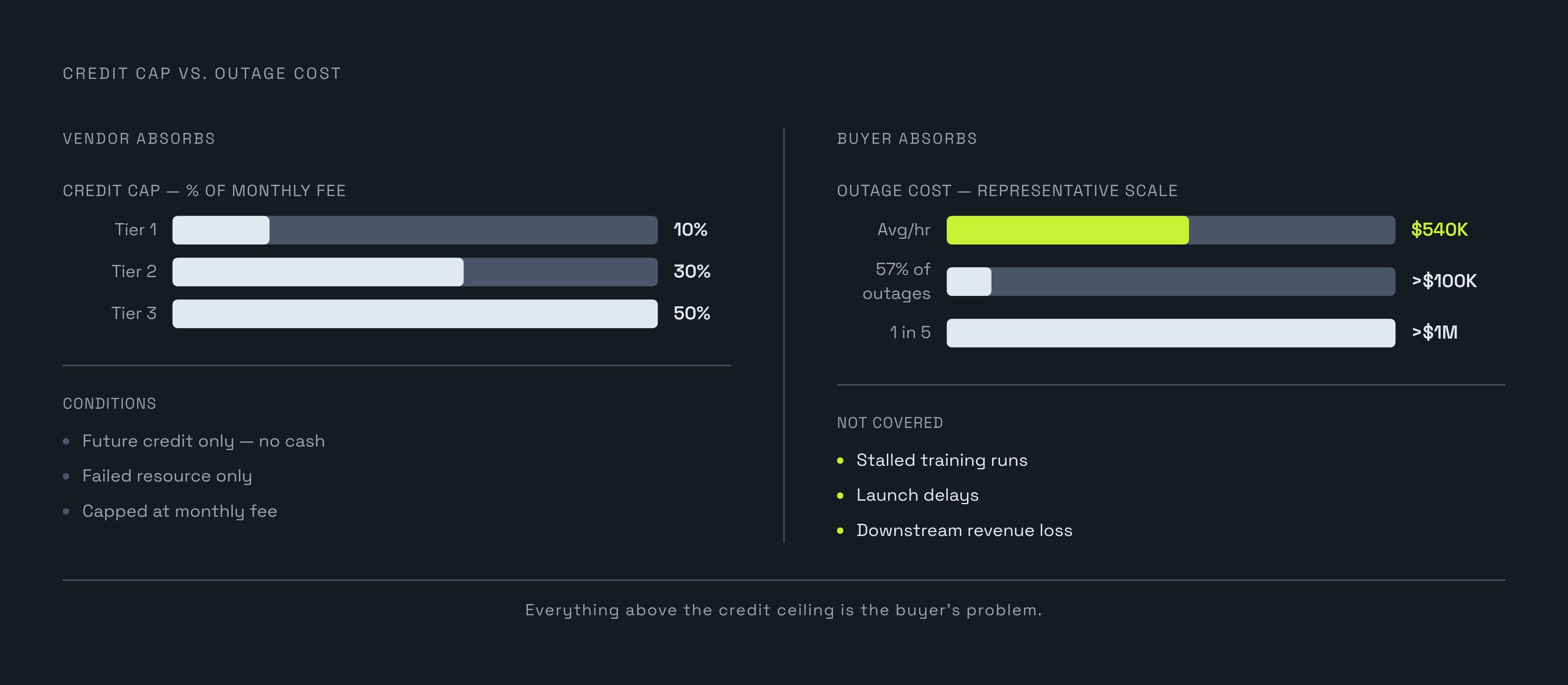
An outage does not stay contained to an engineering incident. It becomes a financial event, and the numbers back that up. In the Uptime Institute's annual survey, 57% of respondents put the cost of their most recent major outage above $100,000, and one in five put it above $1 million Uptime Institute 2025. Oxford Economics, working from a separate set of surveyed organizations, landed on roughly $9,000 a minute in unplanned downtime, which works out to about $540,000 an hour.
None of that exposure is what an SLA remedy actually pays out. The contract and the balance sheet are measuring two different things entirely, and the gap between them is not an accident of bad drafting helpware.com Foundation Model Vendor Strategy: What Enterprise SLAs Actually Guarantee - TianPan.co. The contract measures one thing and the balance sheet measures another, and this gap appears in specific clauses: how uptime gets defined, what latency exclusions leave out, where credit caps sit, and how handoff language handles multi-party failures. Understanding that gap, clause by clause, is what separates a contract that actually protects a business from one that just feels like it does.
What an enterprise SLA measures, and what it deliberately leaves out
Stripped down to its function, an SLA answers three questions: what's covered, how performance gets measured, and what happens when it isn't met. A well-formed one lays out service scope (including what's explicitly excluded), performance metrics with their own clock logic for when measurement starts, pauses, and stops, a monitoring and reporting cadence, and the remedies themselves, whether that's service credits, penalties, or termination rights.
What it does not commit to is just as telling. Output quality, business outcomes, downstream customer impact, revenue lost during an outage: none of that appears as a contractual obligation. SLAs have shifted over the years from static paperwork into something closer to an operational control, a document teams actually manage against day to day. But what gets measured under that operational lens is still narrow, and it was never designed to widen.
"Service," in this context, is a precisely bounded term. The boundary lines are drawn by the vendor, not the buyer, and that's exactly where the expectation gap starts. Nobody is hiding anything here. The definition is right there in the document. It's just narrower than most buyers assume before they've read it closely.
The arithmetic behind 99.9% uptime and what that number hides
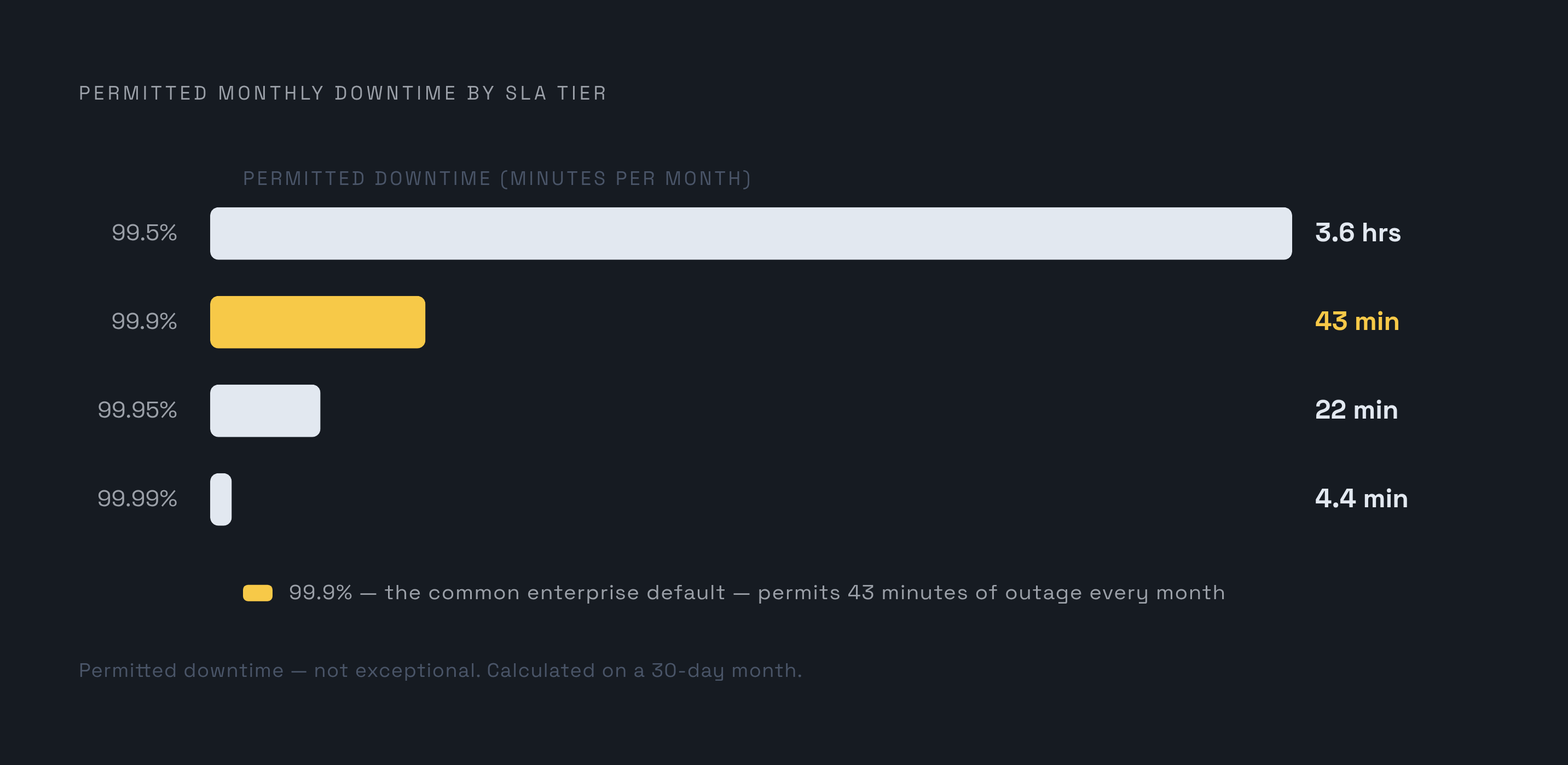
99.9% monthly uptime comes out to about 43 minutes of permitted downtime a month helpware.com Foundation Model Vendor Strategy: What Enterprise SLAs Actually Guarantee - TianPan.co. That's the number most buyers think they're getting when they see "99.9%" on a pricing page helpware.com Foundation Model Vendor Strategy: What Enterprise SLAs Actually Guarantee - TianPan.co.
Most SaaS vendors guarantee at least 99.5% uptime, 99.9% is standard among the leading providers, and anything below that should read as a signal worth asking about OpenAI Foundation Model Vendor Strategy: What Enterprise SLAs Actually Guarantee - TianPan.co. But the harder problem isn't the percentage. It's what "uptime" is actually measuring. In most agreements, uptime means the API endpoint is reachable and returning a response, full stop. It says nothing about whether that response arrives fast enough to be useful, or whether it's even correct. A model timing out at the 90th percentile, or quietly producing degraded output, still counts as "up" under most standard definitions ReadMe.
That gap is sharpest in AI vendor agreements specifically helpware.com. As of early 2026, fewer than 20% of AI vendor agreements include AI-specific SLAs covering model availability, API response time, and throughput helpware.com. Output-quality commitments are almost never offered, because vendors know LLM outputs are probabilistic and they're not willing to put a number on something that inherently varies helpware.com.
The hyperscalers show the same pattern. OpenAI's Scale and Priority tiers commit to 99.9% monthly uptime Foundation Model Vendor Strategy: What Enterprise SLAs Actually Guarantee - TianPan.co. Azure OpenAI Service matches that figure Foundation Model Vendor Strategy: What Enterprise SLAs Actually Guarantee - TianPan.co. AWS Bedrock typically runs at 99.9% as well OpenAI Foundation Model Vendor Strategy: What Enterprise SLAs Actually Guarantee - TianPan.co. CoreWeave publishes a 99.9% monthly uptime SLA too, but that number applies to AI Object Storage, not GPU compute OpenAI Foundation Model Vendor Strategy: What Enterprise SLAs Actually Guarantee - TianPan.co. Four vendors share the same headline percentage, and four different definitions of what's actually being guaranteed produce that appearance helpware.com.
Teams on lower-tier plans never get access to any of this. Many SaaS vendors reserve contractual SLAs for Enterprise tiers, which means teams on Starter or Growth plans often have no formal guarantees at all.
Latency commitments: expensive, rare, and narrower than they appear
Latency SLAs barely exist in standard enterprise agreements. Getting a formal commitment at the p95 or p99 level takes custom negotiation, and it usually comes bundled with provisioned capacity rather than sitting on the shared, pay-as-you-go tier. Where a latency commitment does appear, it's frequently pegged to the median, p50, which means by definition that half the requests can run slower than the target without tripping any breach at all helpware.com.
Azure's Provisioned Throughput Units are the clearest example of how buyers actually get consistent latency: reserve a fixed throughput allocation, and in exchange for predictable response times, pay for that capacity whether it's used or not. That trade-off changes the cost model in a real way, shifting spend from variable to fixed regardless of demand.
A team that reads "p50 latency guarantee" and assumes every request will land under that number has misread the contract, and this is one of the most common expectation gaps in AI infrastructure procurement helpware.com. It matters more for inference workloads than almost anywhere else. Some systems need to respond in under 50 milliseconds while loading a multi-gigabyte model into memory, and a standard "the API is up" SLA offers zero protection against that specific failure mode helpware.com.
None of this is a case of vendors hiding the ball. These are standard commercial SLA structures, and most of them are negotiable if a buyer knows to ask. The problem is that most don't.
How service credit remedies work, and why they rarely cover actual losses
A service credit is the entire remedy. Not a starting point, not a floor, the whole thing, and it does not open the door to claiming business losses on top of it.
Credits are capped at 10 to 50% of the monthly fee for the affected service AWS Foundation Model Vendor Strategy: What Enterprise SLAs Actually Guarantee - TianPan.co. They're paid out as future usage credit, not cash. They apply only to the specific resource that failed, never to the buyer's broader business costs. And even at catastrophic sub-95% availability, the credit still tops out at 50% of that month's fee AWS Foundation Model Vendor Strategy: What Enterprise SLAs Actually Guarantee - TianPan.co.
What that structure doesn't touch: a training run that stalled halfway through, a product launch that slipped, a customer escalation the outage triggered, any revenue lost downstream. None of it is covered, and none of it was ever going to be. That's not a hidden trap. It's standard cloud SLA architecture, and the teams who miss it tend to be the ones who haven't had to file a credit claim yet.
Some parts of the remedy structure have moved, though. Automatic credit application, where the vendor issues the credit without the buyer filing a claim, now appears in roughly 35 to 40% of enterprise SaaS agreements, up from around 20% in 2022 helpware.com. That shift tracks with buyers pushing harder in negotiation.
Read the credit cap as a signal, not a formality. It tells a buyer how much continuity risk the vendor has priced in, and by extension, how much is left for the buyer to absorb on their own. Standard credit mechanics are set out per the research brief and tianpan.co.
Five operational patterns that cause SLA breaches before a vendor is ever at fault
Coverage gaps come first: stretches of time, nights, weekends, volume spikes, that were never actually staffed to hit the SLA target in the first place. Second is the handoff with no internal clock. When there's no operational level agreement governing a handoff between teams, hours of potential breach time simply disappear into the gap, unowned. An OLA fixes this by turning that handoff into a defined step with a named owner and a time target attached to it.
Third, severity gets misclassified right at intake. A P1 routed in as a P3 quietly burns through its entire response window before anyone notices something's wrong, which means severity tiers need enforcement at the moment a ticket lands, not later. Fourth is queue design that hides at-risk work: reporting SLA compliance as one blended percentage can show green across the board while a specific account, or a specific severity tier, is failing consistently below that average.
Fifth, and maybe the most avoidable: targets negotiated above real staffing capacity. Sign that target without running the staffing math first, and the breach risk is baked in from day one Heroku outage.
Alert on the clock, not on the breach: monitoring should fire when a ticket is approaching its deadline, not after it misses. Measuring only after the fact turns SLA compliance into a reporting exercise instead of something a team can actually manage in real time. Per helpware.com, five patterns lie behind most enterprise SLA failures before a vendor is ever at fault.
Where handoff clauses and multi-party dependencies create exposure the main SLA doesn't cover
Workloads run across AWS, Azure, and GCP at once, and overall availability depends on all three holding up together. An individual SLA signed with each vendor doesn't add up to a guarantee on the combined system, and the agreements have to be layered deliberately to close that gap.
Language inside enterprise support tiers deserves a closer read too. "Response" almost always means acknowledgment, not resolution and not even triage. That distinction bites hardest with AI services, where the root cause is often a model behavior change rather than an infrastructure failure helpware.com. Even a fully engaged support team may not have an answer within the SLA window, because the problem isn't one they can fix on demand. Response time is acknowledgment, resolution time is the actual fix helpware.com.
Support that's outsourced or co-delivered across parties adds another layer. The measurement window, the rules for pausing the clock, and who owns the severity definition end up mattering more than the headline compliance number ever will. And this is where the real exposure sits: a vendor can hit every single clause in their own SLA while a buyer's product is still down, because the actual outage lives in the handoff between parties, in a dependency that neither agreement governs explicitly.
The fix mirrors the internal one. Operational level agreements define handoff ownership and time targets inside an organization, and equivalent escalation-path clauses do the same job across external vendor relationships.
What is negotiable in an enterprise SLA and what is not
Most enterprise buyers treat a vendor's standard SLA as a fixed document. It isn't. Vendors that take enterprise business seriously will negotiate, though only across a fairly narrow set of terms.
What's genuinely on the table: latency commitments at p95 or p99, though these require custom negotiation and usually provisioned capacity to back them up. Automatic credit application without a claim requirement, now present in roughly 35 to 40% of enterprise agreements helpware.com. And explicit data processing clauses: a prohibition on training on customer inputs has to be added to the contract by name. It is never automatic.
What stays fixed, regardless of how hard a buyer pushes: the definition of uptime itself, meaning what actually counts as the service being available. Credit caps run between 10% and 50% of monthly fees, along with the cash-versus-credit structure AWS Foundation Model Vendor Strategy: What Enterprise SLAs Actually Guarantee - TianPan.co.
Pricing structure itself can shift beneath a contract too, separate from the SLA terms, because vendors renegotiate pricing independently of the SLA. Anthropic split seat licensing from token usage starting in November 2025, with the transition completing by March 2026, pulling bundled token allowances out of enterprise plans entirely. Teams now pay a per-seat fee and API tokens as two separate line items. That made cost modeling more predictable, but it also removed a buffer that some teams had been leaning on to absorb spiky, unpredictable usage.
The real value in a negotiation isn't just landing better terms. It reveals which risks a vendor flatly refuses to absorb, so a buyer can decide, with eyes open, how to cover that risk operationally instead. Termination rights for chronic SLA failure appear in roughly 55–60% of enterprise agreements, typically triggered by 2–3 misses in 6–12 months, according to helpware.com and the Foundation Model Vendor Strategy: What Enterprise SLAs Actually Guarantee report from TianPan.co Foundation Model Vendor Strategy: What Enterprise SLAs Actually Guarantee - TianPan.co. Dedicated technical contacts and defined escalation paths for model behavior regressions are provided for AI vendors.
What infrastructure ownership changes about SLA exposure for scaling teams
Shared-tenant infrastructure adds a structural wrinkle that's easy to miss until it happens. When the vendor's cluster runs into a problem, every customer sharing that cluster gets hit at the same time, and the credit structure in the SLA turns that shared failure into an individual financial problem for each buyer.
Running workloads directly inside an owned cloud account, AWS, GCP, or Azure, changes that dynamic. The team is operating under the hyperscaler's SLA directly rather than through an intermediary layer, which means there's no extra credit cap sitting between the buyer and the underlying provider absorbing part of the remedy.
For compliance-sensitive workloads, SOC 2 or HIPAA environments especially, the data processing clauses in an SLA carry as much weight as the uptime number does. Buyers need to confirm, explicitly, that input data handling prohibitions are written into the agreement rather than assumed to be standard practice.
And for AI and GPU workloads specifically, the uptime guarantee a vendor advertises may not even reach the resource that matters most OpenAI Foundation Model Vendor Strategy: What Enterprise SLAs Actually Guarantee - TianPan.co. CoreWeave's only published numeric uptime SLA applies to AI Object Storage, not to GPU compute itself, which means the exact capacity a buyer is renting for training or inference can sit entirely outside the one number the vendor is willing to put in writing OpenAI Foundation Model Vendor Strategy: What Enterprise SLAs Actually Guarantee - TianPan.co.