GCP-Native Tools That Automate SOC 2 and HIPAA Controls for SaaS Startups at Deployment
Automate SOC 2 and HIPAA controls at deployment, then map evidence on a compliance platform.
GCP-native tools can automate deployment-time SOC 2 and HIPAA controls, but they cannot make a startup compliant in one click. The practical route is to build access rules, encryption, logging, and security checks into deployment, then use a compliance platform to map the evidence and manage human-side obligations. A PaaS layer can run that infrastructure pattern without a dedicated infrastructure operations team.
Why GCP's shared responsibility model changes the compliance starting point for SaaS startups
Linford & Co.'s 2025 SOC 2 guide explains that GCP undergoes independent SOC 2 Type II audits, with reports covering rolling six-month periods and bridge letters extending assurance to interim months. That gives an auditor a foundation for assessing the infrastructure beneath a startup's application. The startup does not start from zero. In SOC 2 terms, GCP is a subservice organization whose controls and operational health affect the startup's audit scope.
Under the shared responsibility model, Google handles physical data centers, hardware, and the base OS, while the startup owns its configurations, application logic, user access, and data handling. Properly configured cloud controls can therefore support a meaningful share of requirements before fieldwork begins. Terraform module links and policy screenshots help show how that foundation applies to the startup's own environment. But HIPAA capability is not compliance by default. The platform provides safeguards that the startup must configure and operate correctly.
Which GCP-native services map to which SOC 2 and HIPAA controls
Cloud IAM addresses logical access controls through least-privilege permissions. Resource Manager and Organization Policy add organization-level and project-level boundaries, giving auditors configuration evidence of access governance. These tools enforce the access decisions a startup makes. They do not decide who should have access.
Cloud Audit Logs addresses logging and monitoring. Admin Activity logs record changes to the configuration, while Data Access logs record when data is read or changed, including access to ePHI. The distinction is important at deployment. Data Access logs are not enabled by default for all services, and default retention does not automatically meet the brief's six-year HIPAA audit-documentation requirement. Both collection and retention require configuration.
Cloud KMS and Customer-Managed Encryption Keys, or CMEK, support encryption and control over authorized access to ePHI. GCP encrypts data at rest using AES-256 by default, but strict enterprise or HIPAA designs can require more control than Google-managed encryption provides. The HIPAA pattern uses CMEK for BigQuery, Cloud Storage, and databases handling ePHI, with separate responsibilities for keys, data, and deployment. Automated rotation and just-in-time permissions complete that pattern. Encryption does not replace access governance.
VPC Service Controls closes a different gap. It creates perimeters that keep even authorized users from moving ePHI to external resources they are not allowed to use. This supports HIPAA protections against unauthorized network access and SOC 2 access and change-management controls. Security Command Center, or SCC, addresses ongoing posture through asset inventory, threat detection, and misconfiguration findings. Google's Assured Workloads documentation places SCC within a centralized process for reporting problems and identifying, prioritizing, and verifying vulnerability remediation.
Assured Workloads adds HIPAA-specific project scaffolding, residency rules, service restrictions, and organization policies. Its base US Data Boundary for Healthcare and Life Sciences package is free. The package with Support is Premium-tier and adds a percentage surcharge on Google Cloud spend within the folder. These guardrails bring infrastructure closer to HIPAA-ready defaults. The startup is still responsible for administrative and physical safeguards.
Where inherited compliance coverage ends and the startup's own controls begin
GCP's audit report covers Google's infrastructure controls, while the startup remains responsible for its application settings, access decisions, and operating procedures. It is supporting evidence. An auditor still tests how the startup grants access to new staff, changes permissions when roles change, and removes access when people leave. Change management, incident response plans, tabletop evidence, and vendor risk management also remain in scope.
The same boundary applies to data handling. A logging service may exist, but the startup must enable the required logs and explicitly configure retention. Choosing more SOC 2 criteria also adds work beyond what Security, the baseline Trust Services Criterion, requires. Availability, Confidentiality, Processing Integrity, and Privacy require more than native infrastructure services can provide on their own.
That makes the customer-side gap a defined set of responsibilities. Some require people to make decisions or demonstrate a process. Others, including permissions, retention, and deployment checks, can be expressed as infrastructure rules.
How to wire GCP controls into the CI/CD pipeline so compliance evidence is continuous
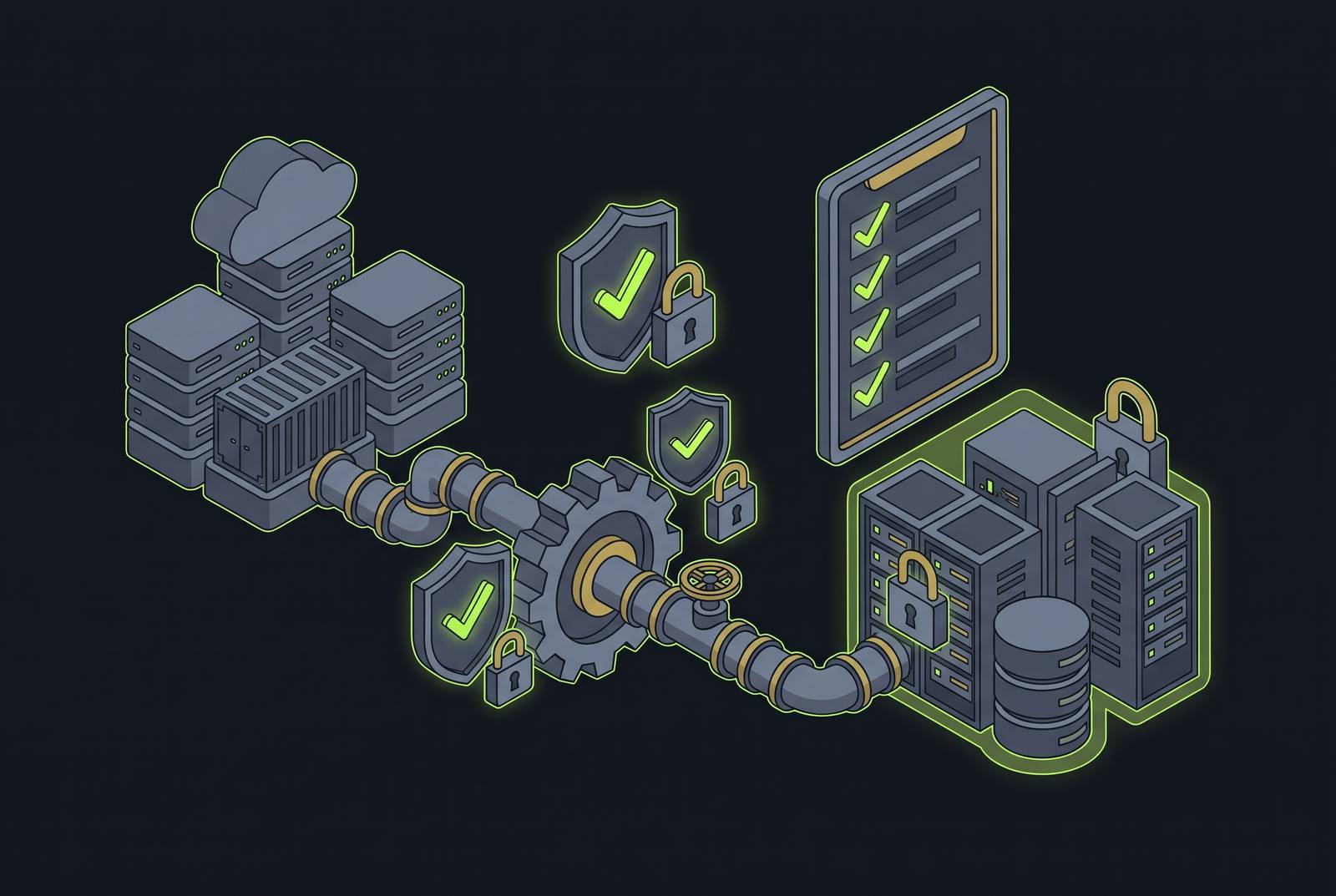
Container Analysis scans for vulnerabilities, Artifact Registry stores images, and Cloud Deploy handles rollouts. The pipeline scans the container and validates its structure before pushing a passing image to the registry. Cloud Build then requests a Binary Authorization attestation, stored as a cryptographic signature, so only attested images can reach production.
The signature gives the security check a precise subject. It is evidence that the required scan passed for a specific artifact at a specific time. Without that connection, having a scanner says less about the image actually deployed. The attestation turns a deployment rule into reviewable evidence.
Changes to infrastructure go through a similar process in Terraform. Cloud Build executes plan and apply workflows, while Cloud Storage holds state and plans, with state locking and an approval gate protecting production changes. Policy checks using OPA/Gatekeeper in the Terraform plan stage can block an apply when a guardrail fails. The check produces evidence of what was tested and when. Drift alerts then flag changes between deployments so the auditor does not have to discover where the configuration has decayed.
Pipeline access and log retention belong in that same design. Service accounts should use least privilege and rotate credentials often where they are used, while Workload Identity Federation removes the need for long-lived service account keys. Secrets should be kept in Secret Manager instead of in environment variables or configuration files. Terraform modules should also create sinks that send Admin Activity and Data Access logs to Cloud Storage or BigQuery, where retention policies keep them for the required time. Together, these controls generate continuous evidence from deployment onward, which a compliance platform can then organize against the relevant frameworks.
What a PaaS layer adds to GCP-native compliance when the startup has no DevOps team
The pipeline pattern assumes someone can configure and maintain it. Many seed and Series A startups lack that infrastructure capacity. A partially applied Assured Workloads configuration, a sink pointing to a bucket with the wrong retention policy, or CMEK enabled for storage but not an ePHI dataset can leave an audit gap. Each failure sits between services. Diagnosing it requires knowledge of the whole environment.
A PaaS that deploys into the startup's own GCP account can supply that missing operational layer. Its environment scaffold can apply VPC settings, least-privilege IAM, log routing, and CMEK at first deploy. Account ownership also makes audit scope clearer. The startup can demonstrate its own log access and residency controls.
The useful meaning of “one-click compliance” is automated infrastructure posture. A platform that handles cluster management, CVE patching, and networking defaults can maintain technical controls after initial setup. Human-side obligations still need an owner. For a startup without infrastructure operations staff, the value is a maintained deployment pattern rather than another console that someone must learn to operate.
How do startups choose a compliance platform for GCP, SOC 2, and HIPAA?
A compliance automation platform sits above the infrastructure, mapping log exports, attestations, and configuration screenshots to SOC 2 criteria and HIPAA safeguards. It also keeps track of evidence that GCP cannot produce, including training records, incident response documentation, and vendor BAA tracking. A connected cloud account is useful only if the platform collects the evidence needed for the startup's controls.
Vanta and Drata both provide a GRC layer that abstracts across AWS, GCP, and Azure. Both can map evidence to multiple framework controls, making them options for a startup that wants one control-management layer across clouds. That shared capability does not establish a winner. The startup should choose based on how well the platform brings infrastructure evidence and human-side gaps into a single audit trail.
For a team making that decision, the checks should be specific. The GCP integration should pull Cloud Audit Logs, SCC findings, and IAM configuration. HIPAA coverage should include administrative and physical safeguards alongside technical mappings. Audit fees also need a separate budget. Both platforms charge for the independent CPA examination outside the base subscription, so getting audit-ready costs more than the software alone.
GPU and AI workloads on GCP and how compliance defaults extend to inference infrastructure
GPU workloads do not get a separate compliance exemption. Inference and training environments that handle sensitive data need the same access, encryption, perimeter, and logging controls as other production infrastructure. The choice of compute changes how those controls are applied. It also changes which operational tasks remain with the startup.
GCP's G2 series uses NVIDIA L4 24GB GPUs optimized for inference and is its most cost-effective GPU option for models fitting within 24GB VRAM. Cloud Run GPUs suit variable or bursty inference because they scale to zero, bill per second of actual request processing, and avoid VM management. Compute Engine GPUs suit training, fine-tuning, persistent storage, or full OS control. That flexibility brings explicit configuration checks. The persistent disk must have the CMEK coverage it is meant to have, the instance must be inside the VPC perimeter, and Data Access logs must be turned on for the storage it reads.
For Cloud Run GPU environments, the deployment scaffold can apply the same CMEK, VPC Service Controls, and audit-log pattern used elsewhere. The compliance benefit comes from consistent configuration. Larger training choices introduce cost tradeoffs. The a3-highgpu-8g uses multiple 80GB GPUs at a high on-demand rate, while preemptible A100 instances can cut costs for fault-tolerant training. TPU v4 pods are cost-effective for large-model training on JAX or TensorFlow.
Idle GPUs create both spending and oversight problems. Auto-shutdown policies should sit in the same IaC configuration as compliance controls, reducing unused environments and the access events that later need explanation. Vertex AI Training adds a managed-service surcharge to the underlying Compute Engine rate, making its operational benefit worth modeling against raw compute. Neither choice resolves AI-specific data governance. Enterprise reviews ask about prompt retention, training data isolation, and third-party LLM APIs beyond standard SOC 2 scope, while HIPAA's minimum necessary standard applies to both what the model can access and what the application transmits.
The real switching cost of GCP-native compliance tooling and how to manage it
Assured Workloads policies, SCC workflows, CMEK key hierarchies, and VPC Service Controls perimeters create genuine switching costs. Evidence artifacts and log-retention configurations are also tied to GCP. Moving to AWS or Azure means re-establishing the control environment. A customer requirement or acquisition can therefore turn a cloud migration into a compliance migration as well.
Vanta and Drata can keep the same framework-mapping layer across clouds, even when the controls beneath it have to be rebuilt. Terraform provides the other hedge. Defining infrastructure that affects compliance as code keeps its configuration documented, version-controlled, and reproducible, so a future migration is easier to understand but still costly.
For most SaaS startups from seed through Series B, that tradeoff favors the GCP head start. Manually managing equivalent controls does not create portability by itself. Native tooling, a GRC subscription, and an independent CPA examination form a budget that belongs in Series A planning. A startup that builds controls into its first deployment, maps the evidence through GRC, and documents configuration through IaC reaches its Series B or enterprise customer conversation with an audit trail.