Cross-Cloud Data Portability for Multi-Cloud Architectures
Open formats and storage abstraction let teams move data between clouds without getting locked in.
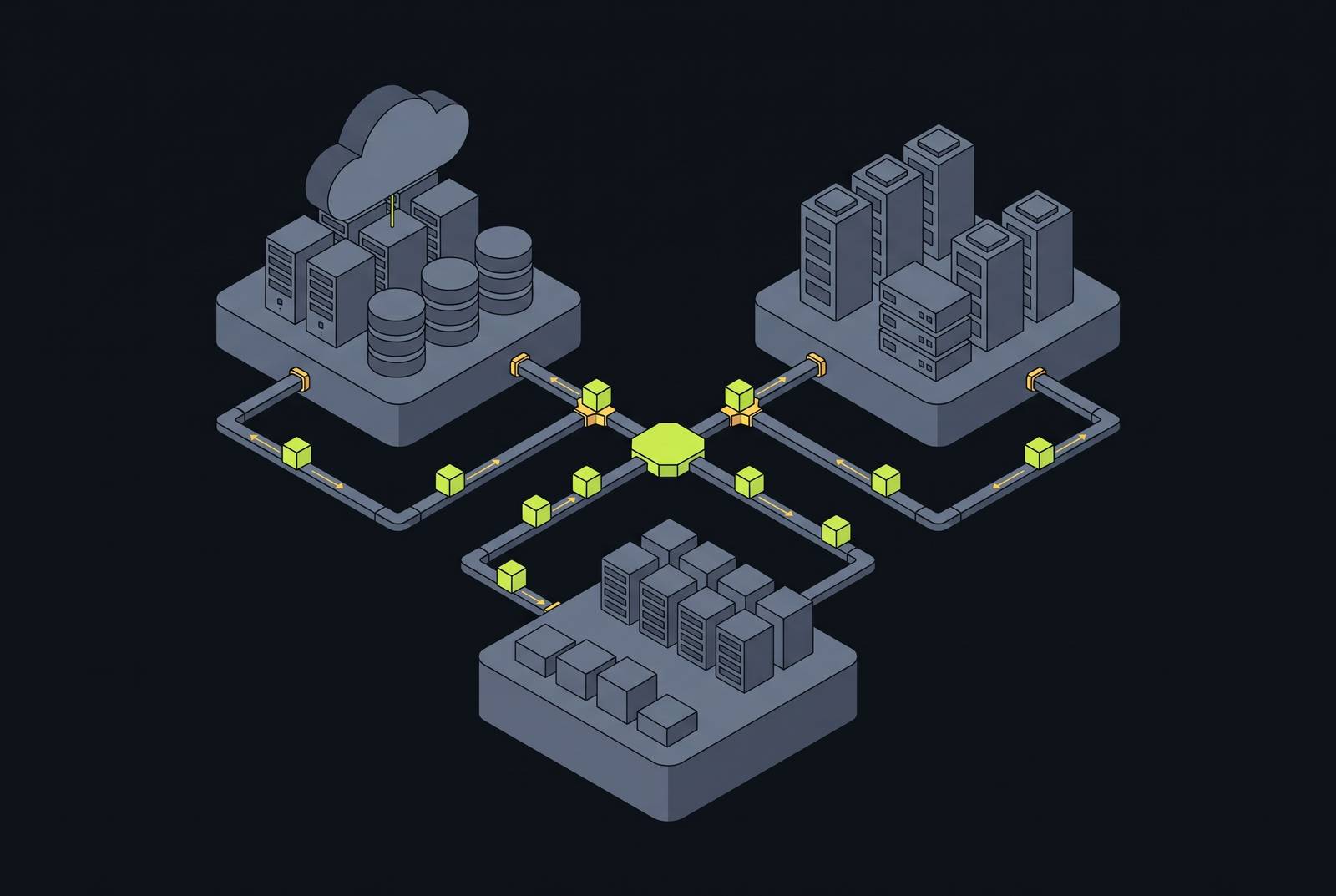
Cross-cloud data portability comes from open formats, storage abstraction, and deliberate placement of workloads. Data should stay readable outside the cloud it is in, while usually staying close to the workloads that use it. A PaaS that deploys into a team’s own AWS, GCP, or Azure account can support that control, but it does not replace those architectural decisions.
Why choosing multi-cloud does not automatically make data portable
Multi-cloud often happens before anyone plans for it. An acquisition brings another provider, a team chooses a different service, or a customer contract names a cloud. The organization then has two identity systems, two network models, and two sets of failure modes. Those costs exist whether the split was deliberate or accidental. Without portable data practices, the result is usually two dependencies.
Data is harder to relocate than an application. An application can be rewritten or redeployed, while its data grows attached to a storage service, query engine, and format. Consider an organization on AWS or Azure that adds GCP for AI and analytics. Data lands in BigQuery, model outputs feed back into AWS-hosted applications, and the second cloud becomes something the data depends on for good, beyond the choice of where to run computing tasks.
That is a design gap. Containers and Kubernetes can make application deployment more consistent, but they do not release data from the services around it. What practices keep its data movable when the organization needs to change providers?
How open data formats and storage abstraction prevent data from becoming stranded
The first durable portability decision happens before data is written. Parquet and Avro let structured and semi-structured data remain readable across AWS, GCP, and Azure without transformation. A dataset written in a proprietary managed format may need the provider’s export toolchain before another engine can read it. As the dataset grows, that export step becomes a larger migration burden and may not preserve fidelity at scale.
Open does not mean equally supported everywhere. ORC has a narrower ecosystem than Parquet, while Delta Lake’s cross-engine support varies by vendor. Delta Lake adds ACID guarantees, time travel, and schema enforcement on top of open Parquet files in object storage. Those features make the data as reliable as it would be in a warehouse, while the files can stay out of a proprietary warehouse format. The performance gap with native formats has narrowed, while the work of extracting a growing proprietary dataset compounds over time.
Storage interfaces provide another layer of separation. S3’s API has become a de facto standard, but teams need to be clear about what compatibility covers. GCP Cloud Storage exposes a compatible interface through its S3-interoperable XML API. Azure Blob Storage needs a third-party gateway because it does not provide that interface natively. S3-compatible tooling can therefore span the providers, but the adapter remains part of the architecture.
The practical pattern is to anchor raw data in object storage using open formats and keep downstream processing stateless and provider-agnostic. Query engines, ML pipelines, and transformation jobs can then change without forcing the raw dataset into a new format. Operational data has a similar route through databases such as PostgreSQL, MongoDB, and Cassandra, available across clouds or runnable on standard VMs. Here, the engine provides the abstraction between data and provider. Both approaches leave transfer costs in place, but cut the work needed before a transfer can start.
What Kubernetes actually solves for portability, and what it leaves unresolved
Kubernetes standardizes how workloads are packaged and scheduled. The same container image can run on AWS EKS, Azure AKS, and GCP GKE without modification, providing portability at the image level. Persistent volume implementations, ingress controllers, and workload identity mechanisms still differ across clouds. A container that calls a provider-native queue or reads a cloud-specific database still depends on those services.
Deployment tooling extends the useful part of that standardization. Helm charts and GitOps workflows using ArgoCD or Flux can manage deployments consistently across clusters on different providers. Terraform adds a provisioning layer, with infrastructure changes recorded as version-controlled commits. The same kinds of resources can be described across providers, though each still has its own identity, networking, and storage models.
The unresolved boundary is the data plane. A workload can be portable as a container while remaining tied to a proprietary analytics store or managed database. Object storage integrations and cross-cloud networking also sit beyond what packaging alone solves. Portability is therefore a layered problem, with Kubernetes handling one layer well. Even when both the workload and its data format can move, the transfer still has a price.
The structural cost of moving data between clouds and how to reduce it
AWS, GCP, and Azure charge per-GB internet egress fees. AWS’s 2026 pricing puts that charge at $0.09/GB, and cross-cloud traffic can incur similar rates. When transfers happen often, the bill keeps coming and grows with the amount of data moved. This expense is part of the operating model whenever a workload routinely reads data from another cloud.
When traffic is moderate but hard to predict, VPN-based private connectivity is a fairly simple choice. It can be provisioned quickly, uses a pay-as-you-go model, and provides more secure connectivity than public internet transfer. Dedicated cross-cloud interconnects are more complex. An arrangement using AWS Direct Connect and GCP Cross-Cloud Interconnect at an Equinix colocation facility brings high fixed leasing fees, making it suitable for sustained high volumes.
Provisioning time changes that calculation as much as price. Google’s Cross-Cloud Interconnect overview gives a provisioning window of 1–4 weeks, so teams have to plan for the capacity they will need ahead of time and cannot add it as soon as traffic spikes. The study Understanding Cross-Cloud Interconnects measured AWS–GCP connections against VPN and public internet alternatives. The study found that CCI links keep strictly to their nominal bandwidth at the link level, though users who share a link may sometimes get throughput above their provisioned capacity.
The same study introduces TOGGLECCI, an algorithm that switches between VPN and CCI using cost trends observed over a sliding time window. It shows how hard-to-predict demand, fixed fees, and provisioning delays mean teams have to keep working out which link is best. Better connections can cut the cost of transfers that need to happen. Avoiding unnecessary transfers goes deeper because it changes how much traffic the architecture creates in the first place.
Why keeping data in one home per dataset is the most effective portability practice
Each dataset should have one authoritative home on the cloud where its most frequent reader runs. This is the central placement rule for portable multi-cloud data. The format preserves the option to leave, while co-location keeps routine processing from paying cross-cloud transfer charges. “Portable” means the data can move when there is a reason, without requiring it to be “constantly moving” or everyday work to cross provider boundaries.
The split should be by workload. AI/ML pipelines might run on GCP with BigQuery and Vertex AI, while enterprise identity and compliance workloads sit on Azure. Compute-intensive or globally distributed workloads might run on AWS. In each case, the primary dataset stays with the workload rather than in a separate cloud chosen only as a storage location. Clouds then share results, API calls, or event notifications, which takes the place of sending raw data back and forth.
A training-and-inference split makes the distinction concrete. Training can run on a GPU-optimized provider while inference runs on AWS for its global managed services. The training dataset stays where training happens. Model weights move from training to inference, and the inference environment handles its serving data independently.
This arrangement preserves flexibility without making transfer a daily tax. It also avoids treating every provider as a complete duplicate of every other provider. Still, teams need more than clear data ownership and well-placed workloads to keep all their clouds in step. Monitoring, access rules, and cost records still cross organizational and cloud boundaries. Those connections need their own governance infrastructure.
Governance, tagging, and observability as the connective tissue of a portable multi-cloud data estate
Provider-native monitoring gives only part of the picture. AWS CloudWatch, Azure Monitor, and GCP Operations Suite each operate within their own cloud context, leaving cross-cloud incidents and cost anomalies fragmented. Datadog or New Relic can provide a shared observability plane, as can a stack using Prometheus, Grafana, and OpenTelemetry. OpenTelemetry also keeps instrumentation vendor-neutral, so changing the receiving backend does not tie application telemetry to a provider’s native tooling.
Cost visibility needs a similarly consistent foundation. Cost-allocation tags enforced through infrastructure-as-code policy let teams identify resources across providers, even when each cloud has its own way of naming them. Without that consistency, spending becomes harder to assign and waste harder to expose. Open Policy Agent and Sentinel extend enforcement to governance rules at deployment time. A misconfigured resource can then be caught before it runs.
Each modification can have a commit with an author, timestamp, and reason, supporting the audit-trail requirements of SOC 2 and ISO 27001. A commit is not the whole compliance process. Formal approval, risk assessment, testing, and post-implementation review remain necessary.
AWS, GCP, and Azure hold FedRAMP, SOC 2, and ISO certifications and offer HIPAA-eligible services with Business Associate Agreements, but no formal HIPAA certification exists for cloud providers. The team still owns its configuration and governance work. Cloud Security Posture Management tools such as Prisma Cloud or Wiz can audit configurations across providers for drift. Federated identity through Okta or Microsoft Entra ID provides the matching access-control layer, reducing the fragmentation created by separate identity systems.
What "portable enough" looks like in practice for a team that is not yet fully multi-cloud
For a small or growth-stage team, portable single-cloud is usually the better near-term posture. One primary provider limits today’s operating burden while portable habits preserve tomorrow’s choices. The goal is to avoid decisions that make a later migration or second-cloud addition require a rewrite. Depth on one platform can coexist with deliberate freedom to leave it.
For a team adopting that posture, the practices follow directly from the architecture. Raw data belongs in Parquet or Avro in S3-compatible object storage, and teams need to know the limits of that compatibility. Workloads belong in containers, with Helm and GitOps providing a consistent deployment path. Infrastructure changes should go through version-controlled Terraform rather than console clicks, while OpenTelemetry keeps instrumentation independent of the cloud’s monitoring backend. Teams should use infrastructure-as-code policy from the start to enforce the same cost-allocation tags.
A second cloud should meet a specific need. That might be a customer contract naming a provider, a data-residency rule, a specific capability gap, or a disaster-recovery target that has actually been tested. Abstract fear of lock-in is not enough to justify another operating environment. When a second provider earns its place, workload-data co-location keeps it focused on the role it was added for. The team adds a useful capability rather than a routine stream of raw data crossing clouds.
For teams considering a PaaS, deployment location is a concrete buying criterion. A platform that deploys into the team’s own AWS, GCP, or Azure account leaves the team in control of that account, rather than placing production data in a shared-tenant environment under someone else’s egress and residency policies. Cluster management, CVE patching, autoscaling, and compliance features can reduce the need for a dedicated DevOps function. Those services do not, however, turn “one-click compliance” into complete governance or make proprietary data formats portable. The useful platform is the one that reduces operating work while preserving the team’s control over where its workloads and data live.