Retrofitting Compliance Into AWS Infrastructure Costs More Than Building It In
Building compliance controls into AWS from the start costs far less than retrofitting them later.
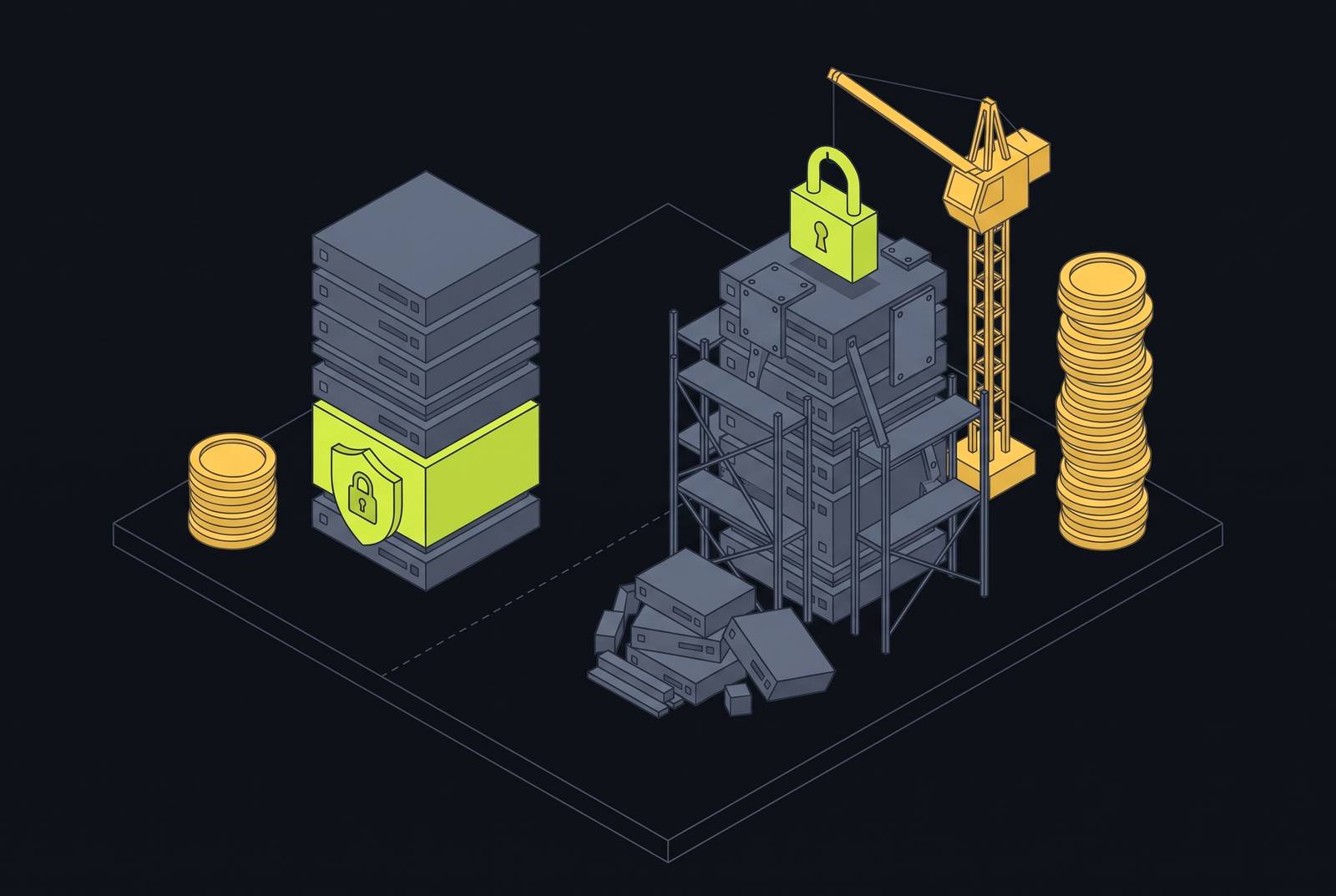
Building SOC 2 and HIPAA controls into AWS infrastructure from the first deployment costs less than adding them to a live system. A platform that deploys compliant defaults into your own AWS account can reduce the setup burden without replacing audits, legal obligations, or application-level controls. The expensive mistake is treating compliance as paperwork that can wait until an enterprise customer asks for it.
Why compliance costs more when added late to AWS infrastructure
AWS’s shared responsibility model is where the confusion starts. AWS provides cloud infrastructure and compliance capabilities, but the customer is still responsible for how its workloads are configured and for the controls inside its applications. Using AWS does not settle who can access sensitive data, whether application activity is logged, or how personal data can be deleted. Those decisions belong to the team deploying the product. An audit exposes which controls the cloud offers that the team has yet to build.
That difference becomes harder to close once services depend on each other. IAM permissions, encryption, audit logging, network segmentation, and data schemas are connected parts of the architecture. A change to one can force changes elsewhere. To tighten access, for example, the team needs to understand the service-to-service relationships that grew with the product. The live environment constrains the repair in ways an empty account does not.
Data deletion makes that structural problem concrete. If a schema was built without user-level deletion, the team may need to change every table, service, and downstream integration that handles that user’s data. A policy update cannot repair those dependencies. At the first Terraform commit, the team can establish ownership and access boundaries before anything relies on them. At audit time, it must reconstruct those boundaries while keeping the product running.
Where retrofit costs actually accumulate in IAM, encryption, logging, and data schema
IAM is often the first substantial rework project. The team must check policies written for speed against least privilege, one role and one resource at a time. The team needs to look again at each service-to-service trust relationship and take care when revoking credentials that live workloads still use. The work requires coordination across the teams using them. What looked like a permissions cleanup becomes a review of how the application operates.
Encryption then complicates the access work. The team needs a migration strategy for unencrypted data already in S3 and EBS as well as a setting that protects future data. With AWS KMS customer-managed keys, the team must decide how rotation and cross-account access will work with the application code and CI/CD pipelines already in use. Those decisions also depend on IAM permissions. The team is changing both how data is protected and which workloads can use it.
Logging adds a different kind of constraint. Missing historical audit records cannot be created after the fact, even if the current configuration is repaired. Turning on AWS Config across an estate already in use also creates a first billable recording of supported resources, then adds more configuration items as resources change or are deleted. Conformance pack rules add another source of activity across that estate.
The deepest rework often sits in the data schema. GDPR’s right to erasure requires a way to locate and delete personal data, while SOC 2 includes documented deletion controls for confidential and personal data. HIPAA is different here. It addresses secure disposal of ePHI from retired media. When data is scattered across dozens of cloud services, the team must trace who owns it to meet the deletion requirements that apply, through the same services whose permissions, encryption, and logging it is already reviewing.
The cost gap between catching a misconfiguration in code versus catching it in production
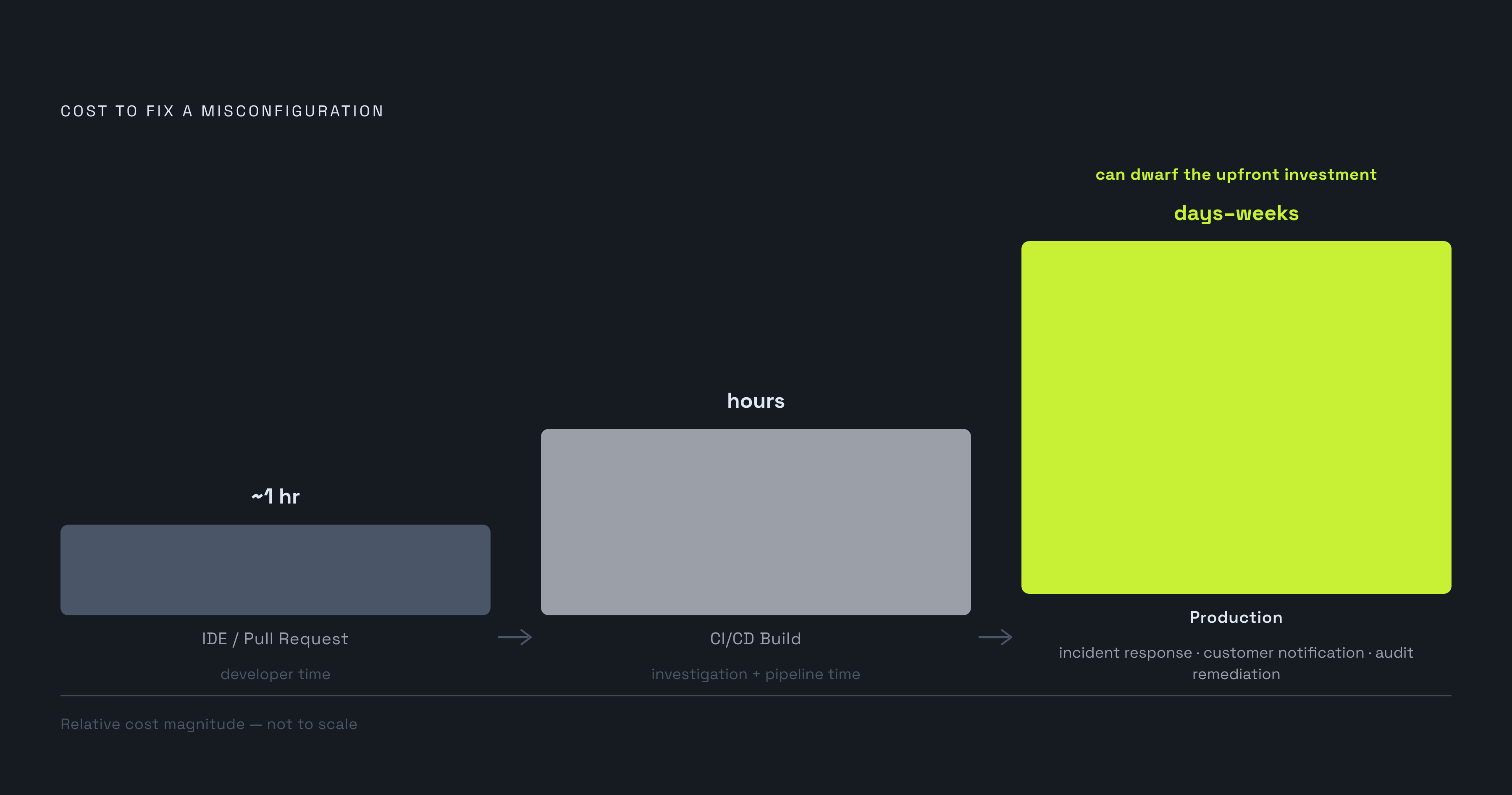
A misconfiguration caught in an IDE or pull request can cost a developer an hour. At the CI/CD build stage, the same issue adds investigation and pipeline time. Production changes the economics sharply. The team may need to handle the incident, decide whether customers need to be notified, and carry out audit remediation. After a breach, those obligations can dwarf the upfront investment in preventing the finding.
Verizon’s Data Breach Investigations Report describes misconfigurations as a chronic source of breaches. Infrastructure-as-code scanning addresses that class of problem before the configuration reaches a live environment. At the pull request stage, the team still has time to fix the design. A production finding makes the team investigate what happened as well as fix what is wrong.
AWS Security Incident Response moved to metered pricing in November 2025, with an initial block of monthly findings free and a per-finding charge beyond it. That makes reactive response cheaper for teams that have fewer findings. It does not remove the operational work. Investigation and remediation still consume time that a sound initial configuration could have saved.
In December 2025, GuardDuty added EC2 instances and ECS clusters to its attack sequence detection. Correctly scoped infrastructure can benefit from the broader coverage, while an estate being retrofitted needs its coverage reviewed and configured. Native tooling is getting more capable. That weakens the economic case for postponing adoption, because delaying the setup does not stop the estate from growing or reduce the work needed to bring it under control.
What a full SOC 2 and HIPAA retrofit actually costs a small AWS team
A small company’s first SOC 2 Type 2 can reach $20,000–$80,000 all-in, based on industry estimates. That range includes more than the auditor’s fee. Tooling, readiness work, penetration testing, and internal staff time all contribute to the total. The avoidable portion is the engineering needed to build controls into infrastructure that is already serving customers. Building those controls early reduces rework, but it does not make the audit free.
The schedule creates a separate commercial cost. During the observation period before a Type 2 report is ready, enterprise deals that require the report can stall or disappear. Even after the team pays for remediation, it still needs time to build the missing evidence history. A team can therefore be funding the compliance program while waiting for the sales opportunity that was supposed to justify it. That is why the sequence of work has consequences beyond the infrastructure bill.
Healthcare adds a different kind of exposure. HIPAA enforcement can lead to fines, while the SOC 2 pressure described here comes from customers and security reviews. Pursuing SOC 2 first does not settle HIPAA’s Privacy Rule obligations or BAA management. A healthcare team that leaves those requirements until later must revisit work after spending months on a report that does not address them. The frameworks cannot be treated as interchangeable purchases.
Ongoing monitoring also adds to the base AWS bill. Config and GuardDuty need deliberate scope, and repeated audit preparation becomes recurring labor without automation. Native tools can reduce the need for separate tooling, while third-party platforms may serve cross-cloud policy management or specialized reporting needs. Neither choice removes auditor fees, penetration testing, or evidence collection. The useful comparison is therefore total readiness effort.
How AI and GPU startups face a compounded version of the same problem
For an AI startup, the GPU purchasing decision also shapes the compliance architecture. AWS, GCP, and Azure offer GPU infrastructure at higher per-unit prices than specialist providers for equivalent NVIDIA silicon. Their offering also includes integration with existing cloud workloads, enterprise support agreements, and compliance certifications that a specialist provider may not have. Raw compute price leaves those differences out. A later healthcare or finance contract can force the team to rebuild the compliance posture it gave up.
That retrofit extends beyond the cluster itself. Model weight storage, access to inference endpoints, and the handling of training data under HIPAA or GDPR all create control requirements. They are easier to define during cluster design, before a production model serves customers. After deployment, those choices are tied to working data flows and access patterns. The compliance repair now intersects with the compute architecture that the team chose to optimize.
Managed ML services do not erase that boundary. AWS Bedrock and SageMaker provide some compliance infrastructure, but the team remains responsible for who can query a model, how outputs are logged, and how prompts containing PII are handled. Shared responsibility still applies to the application. The AI startup therefore faces two connected decisions, which are where the workload runs and how its sensitive inputs and outputs are controlled.
The architectural decisions at first deployment that prevent the retrofit entirely
The practical response is to build the controls that prevent the rework already described, starting with evidence that cannot be recovered later. Enable CloudTrail organization-wide from day one, with log file integrity validation and delivery to an S3 bucket with object lock. CloudTrail’s validation uses cryptographic digest files, while object lock prevents log files from being deleted or overwritten. These features serve different purposes.
To avoid the later IAM reconstruction, write least-privilege policies with the service code they govern. Use service control policies at the AWS Organizations level to keep accounts within their boundaries and limit privilege creep. Encryption belongs in the same initial design. Enable server-side encryption on S3 buckets, EBS encryption as an account default, and RDS encryption at rest, with KMS customer-managed keys scoped to the workload. This saves the team from having to migrate existing unencrypted data later.
The schema needs its own deliberate choices. Plan for the erasure and portability requirements that apply from the first migration, using user_id as a foreign key in the same way throughout so ownership stays clear. A soft-delete pattern is also a build-time design choice, but it should not be confused with completed secure deletion. A platform setting cannot substitute for a schema that lets the application locate the data it is responsible for.
To keep monitoring from becoming an estate-wide cleanup, scope AWS Config conformance packs while the resource set is small and well defined. Then make infrastructure-as-code scanning a CI pipeline gate. Checkov, Snyk IaC, and KICS are tools for that role. The gate places the correction before deployment, where it does not compete with incident response.
How a PaaS layer that runs in your own AWS account changes the build-in compliance calculus
The strongest objection is that these decisions require expertise an early team may not have. Three engineers shipping a product cannot easily add IAM architecture, conformance pack design, and compliance readiness to their workload. Even a diligent early team can lack that expertise. A platform changes the calculation when it applies sound infrastructure defaults on every deployment.
Account ownership is the key distinction. When production runs on infrastructure controlled by a provider, the customer may not control IAM, encryption, or audit logging, and the evidence an auditor needs may be difficult to obtain. A PaaS that deploys directly into the customer’s AWS account can instead establish VPC configuration, scoped IAM, encryption, and CloudTrail there. The evidence stays in the customer’s account. That makes it available for review without a later move undertaken just to gain control of the infrastructure.
“One-click SOC 2 and HIPAA compliance” is useful shorthand only when it means deploying compliance controls, not receiving an audit report or satisfying every legal obligation. A platform can add automatic CVE patching and production-ready environments to those controls so the team has less infrastructure work to do. Application permissions, sensitive data handling, schema design, and evidence review still need attention. The distinction is essential for a startup without a dedicated compliance team.
Owning the AWS account from the first deployment makes compliant defaults compatible with direct control over the environment. Compliance is an early architectural decision. Teams that defer that decision pay again when an enterprise sale, a security review, or a regulated use case exposes what the product was never designed to support.