Why Startups Treat SOC 2 as a Quarter-Long Project and How Deployment-Layer Automation Ends That
Deployment automation lets startups skip months of control-building work.
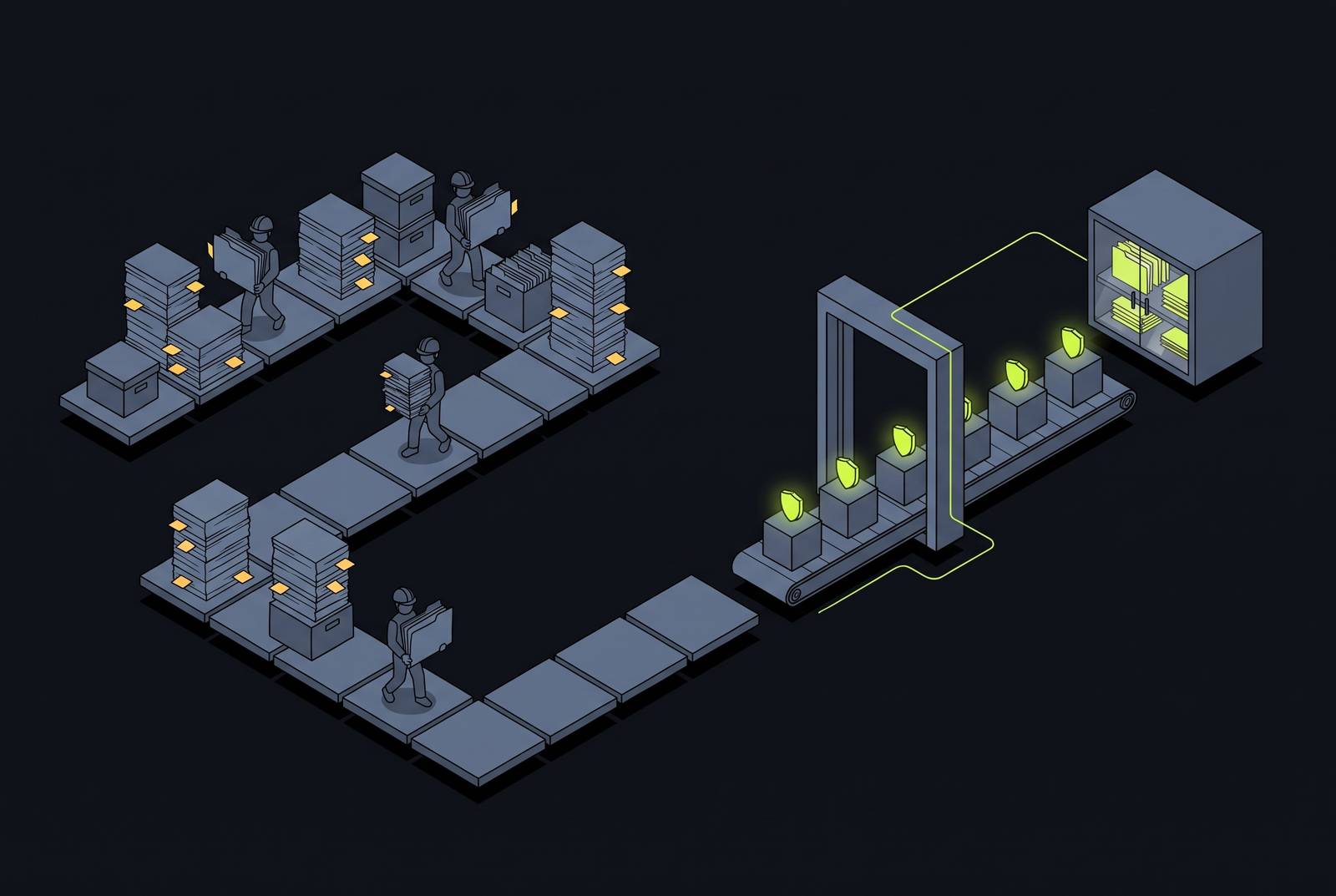
SOC 2 takes a quarter of engineering work when startups have to build infrastructure controls from scratch. A deployment platform that enforces those controls on AWS or GCP turns much of that preparation into configuration. For startups seeking one-click SOC 2 and HIPAA compliance, the useful promise is automated controls and audit-ready evidence.
Why SOC 2 consumes a quarter of engineering time at most startups
The email arrives from an enterprise buyer. Procurement needs a SOC 2 report before the deal can go ahead. Until then, the contract is stuck. This is when founders discover that the work sits less with legal than with the engineers building the product. Someone has to find the gaps, write policies, put controls in place, and collect evidence while the team still has work to do on the product roadmap.
G2's 2026 survey of B2B software buyers found that IT security review is the single biggest source of procurement delay, cited by half of enterprise buyers. Vanta notes that an enterprise deadline can force startups to compress months of preparation into weeks, increasing cost and operational burden. The deadline changes which work engineers stop doing to make room.
SimpleAudit's 2026 research puts a 10-person startup's path from scratch at 3–6 months for Type 1 and 6–12 months or more for a first Type 2. The same research found that the median time from fieldwork to report across 192 audit firms was 9 weeks. Preparation is where much of the time disappears. The quarter-long project is therefore not simply an auditor taking too long. It is an engineering team constructing the operating conditions the auditor will later examine.
Which SOC 2 controls live at the infrastructure layer and why they are the hardest to satisfy manually
The hardest controls govern how production is accessed, configured, monitored, and changed. These are not problems a policy document solves. The Trust Services Criteria name these requirements, but engineers already know the work they call for. CC6.1–CC6.2 cover logical access security and the need to authorise users before they get credentials. Satisfying them means governing access to the systems where production actually runs.
Monitoring and change management extend that responsibility beyond login permissions. CC7.1 covers configuration changes that bring in vulnerabilities, and CC7.2 covers monitoring for anomalies that point to malicious acts, errors, or disasters. CC8.1 covers the review and approval of production changes before they go live. Evidence must show that the deployment that went live had approval. CC9.2 adds vendor risk, including whether the vendor of the deployment tool meets the requirements that apply to the startup's control environment.
That evidence needs more detail than a successful build notification. Auditors expect immutable records of the commit SHA, branch, changed files, deployment timestamp, outcome, and destination server or environment, plus a diff or file manifest showing what was transferred. Pull request workflows, ticketing links, automated deployment logs, and pre-deployment security and functional tests can record that chain as the work happens. Without that integration, engineers export logs, validate access reviews, and chase records across systems. The burden is not merely producing records, but connecting them into evidence of an enforced control.
Why the audit preparation bill is higher than the audit fee itself
An audit quote prices the auditor's work. SimpleAudit's research lists estimates that put specialist CPA firms in the middle of the Type 2 price range, with full-service firms costing more and Big Four firms costing the most. Comparing them can help with procurement, but it leaves the largest internal variable unresolved. Someone still has to implement the controls.
Probo says vendor quotes often leave out the extra cost of readiness assessments, penetration tests, and security tool upgrades needed to get ready. Many auditors expect to see penetration tests as evidence for CC7.1. Comp AI estimates that a small company's DIY SOC 2 effort can require hundreds of hours of internal work. Those hours never appear on the auditor's invoice. They come out of the same engineering capacity used to ship the product.
The full bill is also difficult to establish precisely. SimpleAudit notes that no independent source publishes a verified total first-year figure with a stated method. That limits any confident claim about a universal startup budget, but it does not erase the labor cost. A plan that funds the audit and allocates no engineering time risks overrunning both its schedule and its cash budget. So when comparing costs, startups should look at how much work each approach saves in putting controls in place, as well as how much the audit costs.
How deployment-layer automation converts control construction into control configuration
A deployment platform can remove the construction work for infrastructure controls it already enforces. Access management, environment hardening, immutable logging, change approval, and CVE patching then become platform capabilities to configure. When a tool collects evidence from infrastructure, engineers still have to fix that infrastructure. A platform that operates the controls changes the starting point.
Immutable logs are already in the CI/CD pipeline, access to production follows the platform's IAM integration, and the required reviews and deployment gates record approvals. Platform-level CVE patching also makes vulnerability-management evidence continuous. Engineers no longer need to reconstruct each deployment after the fact. Their remaining task is to establish that the enforced settings and records match the controls being tested.
There is a real limit to that promise. Evidence automation does not prove that control design is correct, and a well-documented control can still be the wrong control. Teams with heterogeneous or self-hosted environments must validate how platform controls map to their auditor's Trust Services Criteria requirements. For a startup whose production workloads run on one deployment platform, more of that design is already embodied in the platform itself. Choosing it is therefore a compliance decision as well as an infrastructure decision.
Deployment into the customer's own AWS, GCP, or Azure account can also simplify the vendor-risk boundary. The startup owns the infrastructure instead of depending on shared-tenant infrastructure run by a third-party PaaS. That gives auditors a cleaner account of ownership and control. It reduces the additional infrastructure-attestation dependency that comes with relying on infrastructure the startup does not own.
What the compliance timeline looks like when the deployment platform does the heavy lifting
When infrastructure controls are enforced from day one, waiting to observe them can replace building them as the schedule's main constraint. The observation period still has to happen. Even with platform automation, a Type 2 assessment takes time to check how controls keep working. It lets evidence accumulate while the team continues product work, rather than postponing that accumulation until a separate control-building project is finished.
The practical decision starts with the deal deadline. Vanta advises that going directly to Type 2 usually saves time and money when there is no immediate deadline. If a deal needs proof sooner, ComplyJet recommends finishing Type 1 and starting the Type 2 observation window at the same time. That lets evidence accumulate while Type 1 is being issued. When the platform already logs deployments, enforces access, and patches CVEs, infrastructure readiness need not delay the start, provided the required controls are enforced and the window is agreed with the auditor.
Scope is the other major scheduling choice. ComplyJet advises that most early startups need only the Security criterion, because adding Availability, Confidentiality, Processing Integrity, or Privacy increases cost and scope without improving deal velocity for most B2B buyers. Its over-scoping example describes a fintech startup that included its HR system, marketing site, and Slack, with costs ballooning over nine months. Broader is not automatically more useful here. Clear deployment boundaries help separate the production environment under control from systems added without a clear need.
AI startups need particular care about what the report covers. The Cloud Security Alliance notes that the AICPA has published no AI-specific Trust Services Criteria, so two AI companies can hold clean Type 2 reports after testing entirely different control sets. A clean report alone does not establish a consistent baseline. Startups therefore need to check what the platform covers, especially when production runs workloads beyond ordinary application deployments.
What should a startup look for in a deployment platform for SOC 2 readiness?
For a startup evaluating platforms, the first test is what each platform enforces by default. Immutable, queryable deployment logs should record who changed what, when it happened, the commit SHA, and the diff. Those records support the evidence needed for CC7.1–CC7.2. Logs alone do not establish effective monitoring. Their value depends on whether they cover the deployment events within the audit boundary.
Role-based access linked to the organisation's identity provider supports CC6.1–CC6.2, and a required review before changes are deployed to production supports CC8.1. Automated CVE patching and cluster upgrades address the recurring remediation work that otherwise returns before each audit cycle. The platform should enforce these controls as well as report on them. One-click SOC 2 and HIPAA outputs are useful when they expose audit-ready evidence generated by those operations, rather than masking manual work behind an export button.
The next test is where those controls run. A customer-account deployment model on AWS, GCP, or Azure gives a clearer ownership boundary for discussions about data residency, isolation, and vendor risk. With shared-tenant infrastructure, the startup also depends on how well a third party meets its compliance requirements. The distinction affects what the startup can show directly and what requires third-party attestation.
For AI-native startups, coverage must include GPU workloads and rapid inference redeployment. If a log misses GPU job deployments, part of production is left out of the control environment it records. That is an incomplete basis for audit evidence. More broadly, one control plane covering VPC setup, networking, autoscaling, CI/CD, patching, and compliance outputs creates a cleaner boundary than several tools with separate evidence formats.
How to sequence the SOC 2 project when you are starting from the deployment layer up
For a technical founder starting from scratch, stand up the deployment platform first so its default controls establish the baseline against which gaps are measured. Otherwise, the assessment describes a moving target. Once that baseline exists, define scope narrowly around the production environment and the controls the audit needs to test. ComplyJet's recommendation is Security only for most early startups, with additional criteria added when a specific customer or deal requires them.
Next, agree the Type 2 observation window with the engaged CPA firm and begin it when the platform is running and the required controls are enforced. SimpleAudit notes that the observation period's length is agreed with that firm. If an enterprise deal needs proof before the window closes, use Type 1 as the bridge against the platform-enforced control set. Without that deadline, proceed directly to Type 2.
After the first period, treat continuous logging and control enforcement as the operating compliance program. Type 2 requires ongoing operational effectiveness, and the next observation period begins immediately after the first ends. A platform-generated badge is not an endpoint. A lapsed report can block the next enterprise deal just as the missing report blocked the first. The deployment platform earns its place by keeping controls running and evidence accumulating through renewal, making that ongoing responsibility manageable without a dedicated compliance team.